

In the modern tech landscape, handling all tasks in-house is increasingly difficult. To stay competitive, businesses rely on strong external partners across different spheres, and software development is no exception.
Choosing between in-house vs. outsourcing software development is a strategic decision for German businesses. With rising salaries, long time-to-hire, and a persistent talent shortage, many companies are rethinking how to strike a healthy balance between in-house and outsourced teams. While the in-house specialists require ongoing investments in recruitment, education, and retention, an outsourced development team provides ready-to-deploy expertise. It can supplement in-house capacity during peak load periods, accelerate delivery when deadlines are tight, and provide specialised expertise. Whether through team extension or a fully dedicated team, outsourcing brings skilled experts who shorten time-to-market and keep projects moving, with high flexibility to upscale or downscale based on project needs.
This article explores the key differences between in-house software development and outsourcing in terms of costs, operations, and supervision. It also shows how external teams can strengthen business and delivery processes.
Software development outsourcing vs in-house: cost comparison
Recruitment cost
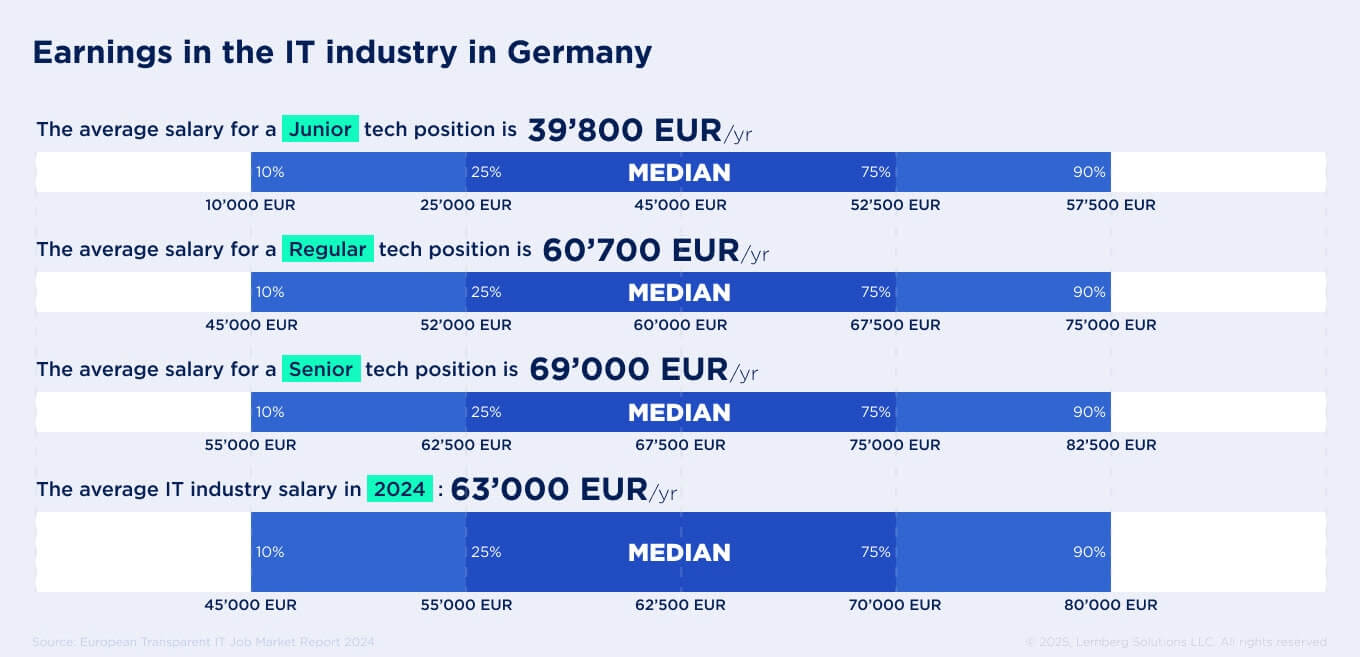
Most companies begin with internal recruitment, which is far from cost-free. First, it includes specialists’ salaries themselves. In Berlin, a software development expert earns an average of €62,500 gross per year, excluding bonuses or equity. Salaries vary significantly by role, seniority, and individual experience, and can reach up to €120,000 for narrow in-demand specialists such as AI architects.
In addition, the recruitment costs also include salaries for recruiters, hiring tools, sourcing time, and months of effort that accumulate quickly. If internal recruitment is not successful, companies turn to external agencies. They typically charge 15–30% of the candidate’s annual gross salary, constituting an additional €12,500–€18,700 in agency fees alone for software engineering roles that usually fall at the upper end of that range. In avarage, German recruiters estimate total hiring costs of €6,000–€25,000 per employee, depending on seniority and location.
Expenses for outsourced software development teams are lower and much more predictable, with the recruitment costs largely absorbed by the vendor. Unlike in-house hiring, outsourcing clients pay a much more predictable daily or hourly rate..
The vendor distributes recruitment and talent acquisition costs across multiple projects, thereby significantly reducing the financial burden on any single client. The difference becomes even clearer over time. While an internal mis-hire can cost a company up to 30% of the engineer’s annual salary, outsourcing providers replace underperforming team members at no additional cost. Thus, an outsourcing software development company handles sourcing, screening, replacing, and scaling the team, while the client typically pays only for the capacity they actually use. This adds another value: clients scale up or down without restarting an expensive recruitment cycle each time.
Non-wage labour costs
For an in-house software development team, substantial non-wage labour costs are added to salaries. On average, non-wage costs amount to 21–22% of an employee’s gross salary in Germany and include health, pension, and unemployment insurance, paid vacation, bonuses, and other benefits.
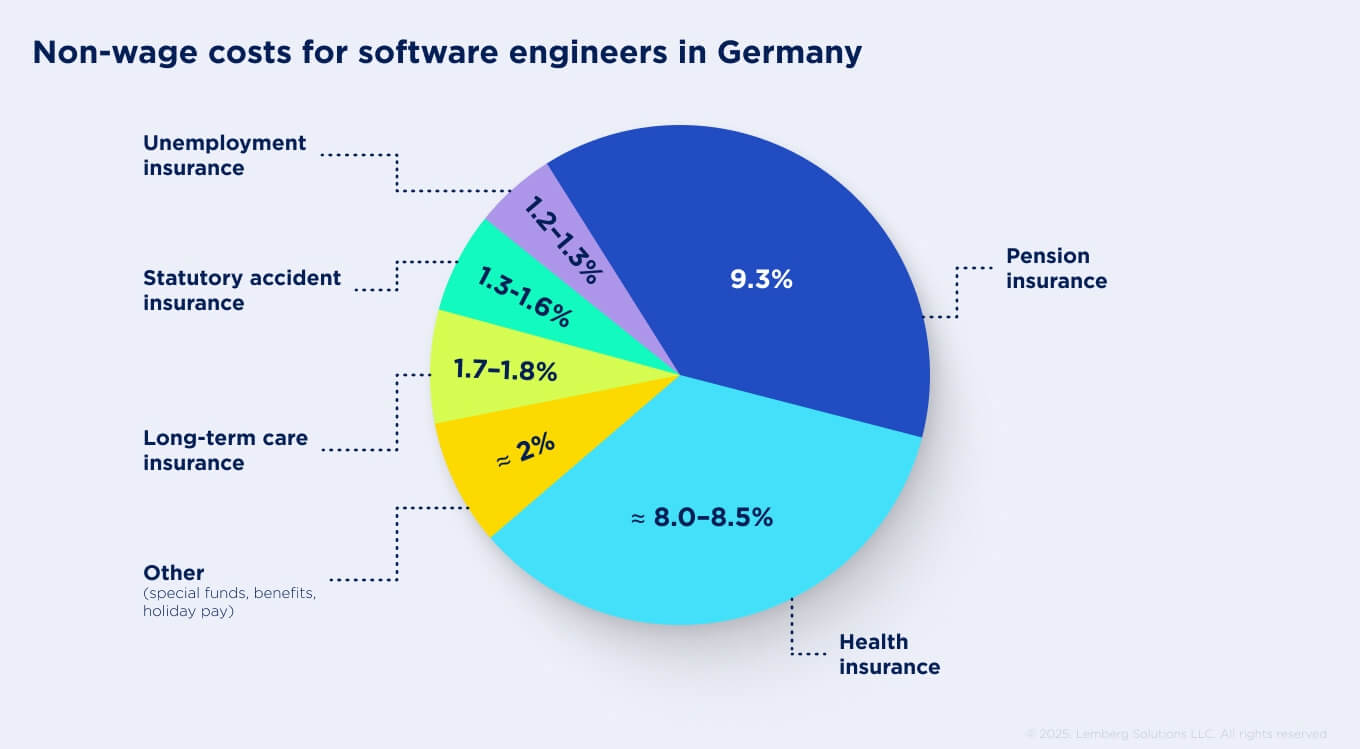
With outsourcing, the non-wage labour costs are effectively baked into the software development vendor’s rate. The relationship changes from employer–employee to client–service provider, with the provider being responsible for specialists’ social insurance, payroll, and other non-wage costs. Instead of paying salary plus employer social charges, the client pays an agreed service fee.
Time-to-hire
Long time-to-hire for in-house engineers is costly. Germany has one of the slowest hiring cycles globally, with IT positions remaining vacant on average for 7.7 months in German companies. For senior roles, the hiring cycle alone can stretch to 9 months. When adding the typical 3-month notice period, it can take 9–12 months before a senior developer can start. The average vacancy costs may reach around €49,500 per open role. For senior embedded, AI, or security engineers, this “empty seat” quickly becomes one of the largest hidden cost drivers.
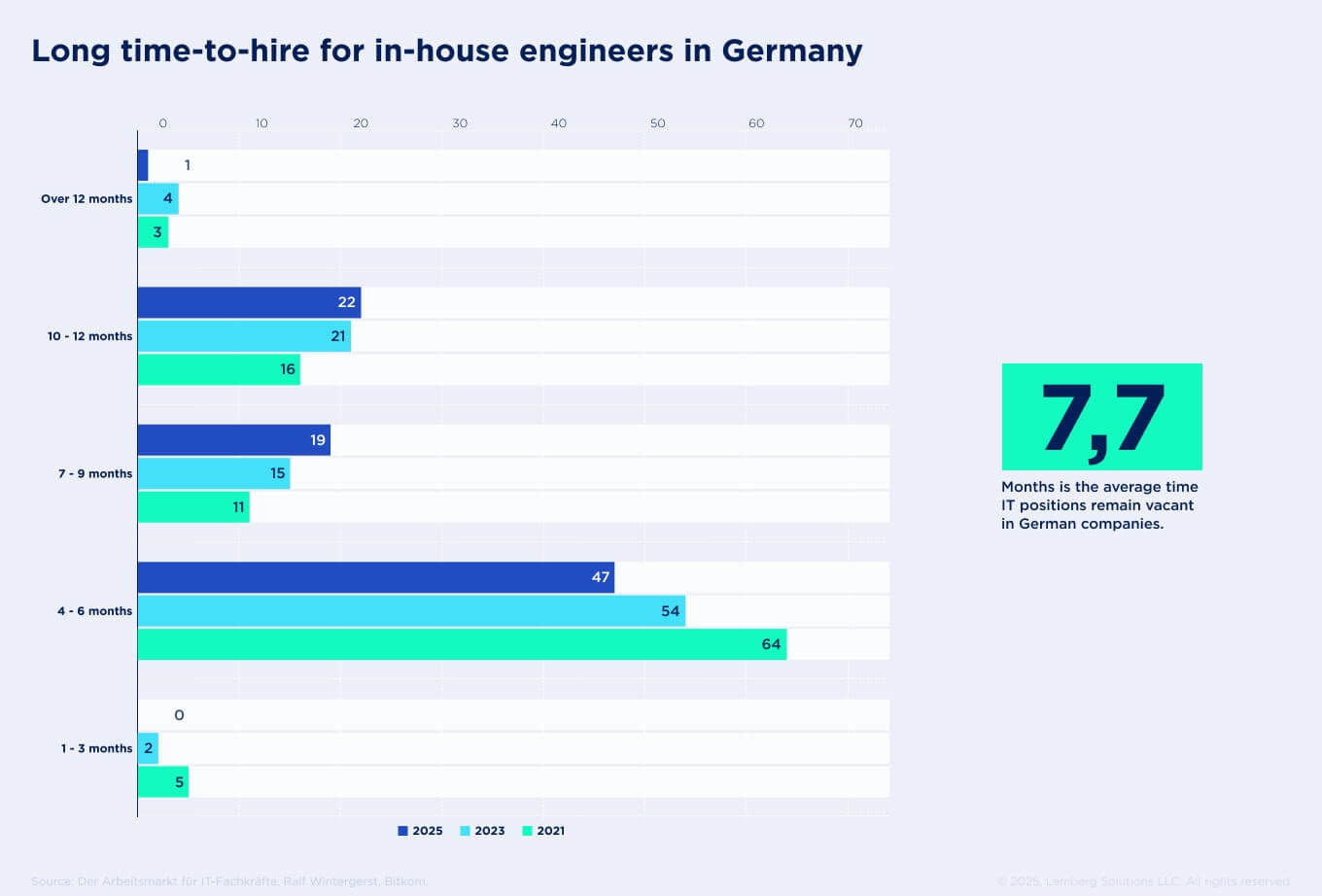
During this period, projects are delayed, or existing teams are overworked. Even after the contract with the specialist is signed, companies must plan for 2–3 additional months of onboarding, including familiarization with the product, codebase, industry specifics, and internal processes. In practice, this means that a role opened in January might only become fully productive toward the end of Q3, significantly impacting core business processes.
While the in-house IT positions remain vacant for up to 12 months, software development outsourcing can shorten this time by 2–8 weeks, dramatically reducing time-to-start.
The typical timelines are 1–4 weeks to assemble a small team (e.g., 2–5 engineers). Another 2–6 weeks for domain onboarding and knowledge transfer, depending on project complexity. Established vendors maintain an active engineering bench, internal talent pools, and ongoing recruitment pipelines, allowing them to fill specialised roles far faster than a single company could on its own. Furthermore, experienced software development teams often work in parallel with in-house teams, streamlining the delivery process and reducing delays.
Total costs for an in-house vs software development outsourcing
To understand the real financial impact of outsourcing software development, it’s important to compare the full cost of employing an engineer in Germany.
We start with the median German IT salary of €62,500 and add the main costs that come with it. Internal hiring, outsourcing software development agency fees, and employer social contributions further increase the total in-house cost, and the typical long time-to-hire in the German IT market creates substantial vacancy losses compared to outsourcing.
The table below breaks down the total cost difference between in-house and outsourced developers.
| In-house | Outsourcing | |
| Recruitment costs | €22,500 | ~ € 0 direct recruitment cost |
| Non-wage costs | ~ €13,000 | ~ 0% (handled by vendor) |
| Time-to-hire | €49,500 | ~ €12,200 |
| Education | €1,500–€2,000 | ~ 0% (handled by vendor) |
| Administrative overhead | ~€700 | ~€200 |
| Total cost impact per engineer | ~€85,000 | ~€12,400 |
Skills gap, education, and retention: in-house vs. outsourced teams
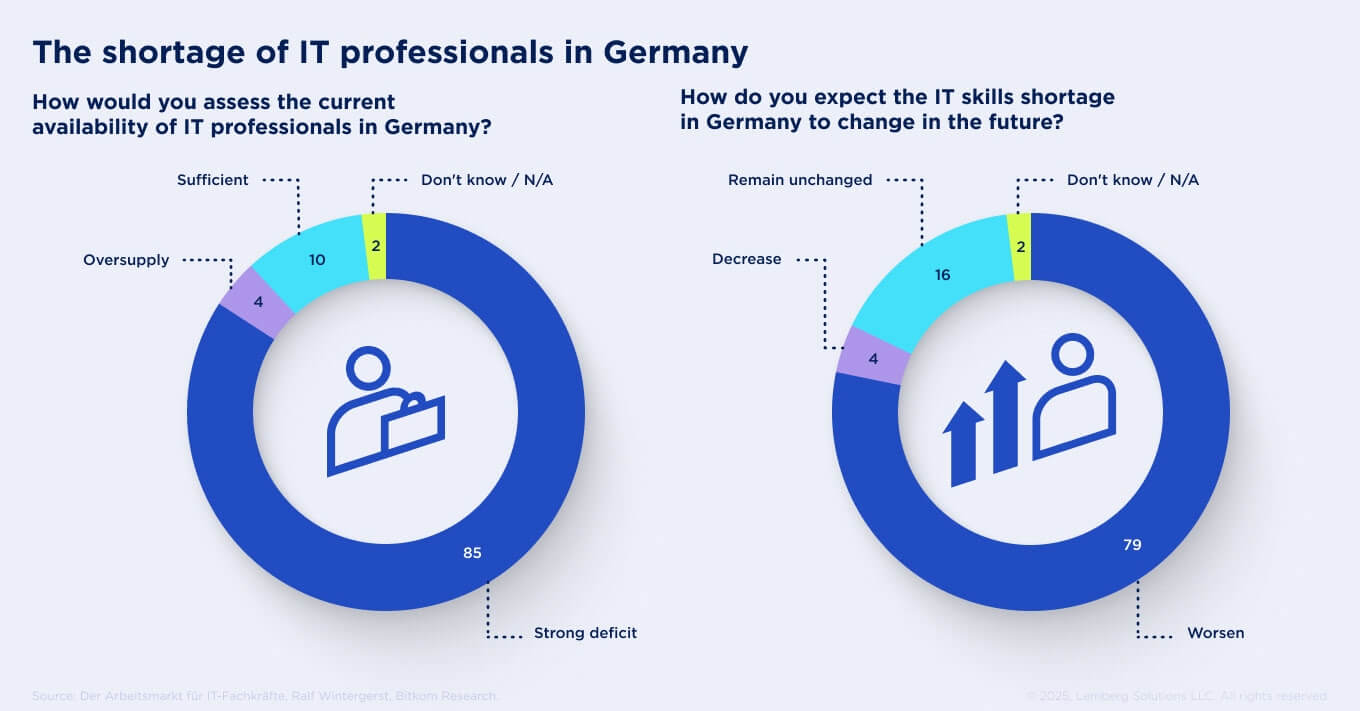
Skills gaps and the limited specialisation of software development teams are structural issues, and not only in Germany. Bitkom repeatedly reports more than 100,000 unfilled IT positions, and forecasts a shortage of up to 663,000 IT specialists by 2040, with companies particularly struggling to fill expert roles. Salary and labour-market reports highlight that the situation is especially difficult in AI and cloud architectures.
Even when companies succeed in hiring top experts in-house, they must plan for ongoing investments in their education and retention. For example, German software and IT companies operate with training budgets, so-called Weiterbildung, in the range of roughly €1,500–€2,000 per employee per year as a minimum, with additional spend for high-end certifications that can easily add several thousand euros per engineer and year. While resource training is the right approach for improving in-house expertise, maintaining and retaining deep in-house expertise across areas such as embedded systems, IoT, cloud, and AI/ML is not easy.
That’s where software development outsourcing may help. It bridges the persistent engineering skills gap by providing instant access to expertise that is hard to build in-house due to time or resource constraints.
Furthermore, outsourced software development teams often share their experience with clients’ internal teams, thereby enhancing their expertise. They often work in tandem with internal teams, supplementing in-house expertise, thereby covering niche skills, accelerating delivery, and allowing internal teams to focus on their core strengths.

Administrative overhead
Hiring in-house experts is always accompanied by compliance burdens and strict employee protection regulations. For example, the German Protection Against Unfair Dismissal Act, which strongly protects employees from dismissal, creates substantial challenges for employers. Whether the situation involves organisational changes or performance-related issues, every dismissal requires thorough documentation and clear legal justification.
In addition to employment law, companies must comply with rigorous regulatory obligations. Any company processing employee or customer data must comply with the GDPR and the German BDSG, including lawful bases for processing, transparency obligations, records of processing, technical and organisational measures, and deletion concepts. From 20 employees who work with personal data, German law requires appointing and registering a data protection officer, which adds cost and organisational effort. In industries that handle highly sensitive data, the bar is even higher.
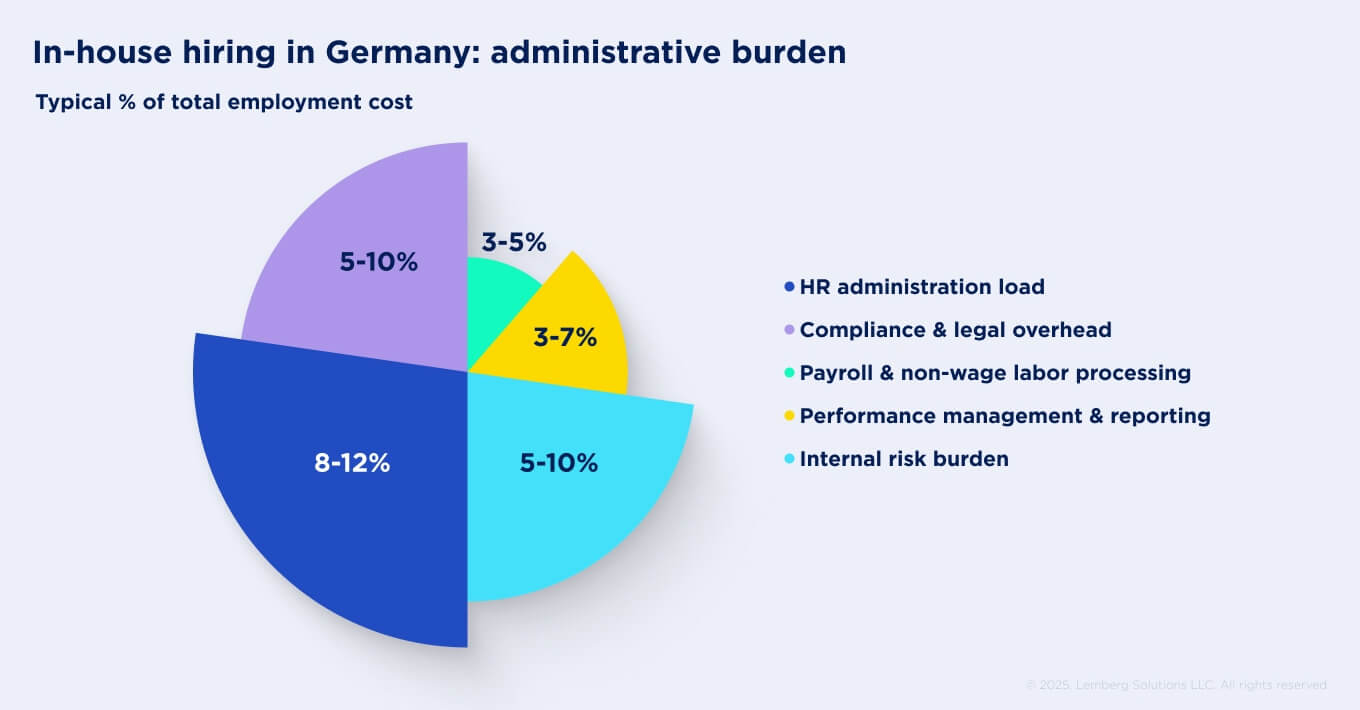
By choosing an outsourcing software development team, the compliance workload falls on the provider. Reputable outsourcing partners follow GDPR-aligned workflows and maintain ISO/IEC 27001–based security management. This means much of the operational compliance work, such as security documentation, access governance, audit evidence, and data-processing safeguards, comes built into the partner’s established processes.
Another advantage is scalability. Companies can expand or reduce their engineering capacity upon requirements, without the administrative overhead, long notice periods, or contractual rigidities typical of in-house teams. Outsourcing vendors maintain a continuous talent pipeline, allowing clients to add specialists within weeks, temporarily boost capacity during peak workloads, or scale down when a project enters a maintenance phase.
Supervision workload
Managing an in-house engineering team requires continuous coordination, performance management, mentoring, conflict resolution, and administrative oversight. These responsibilities generally fall on product owners or engineering managers. 62% of German mid-sized companies report that internal IT teams consume too much management capacity, slowing down decision-making and product delivery.
Reputable software development vendors have their own project managers, delivery leads, and QA coordinators, ensuring smooth workflows, sprint planning, documentation, and reporting. Instead of excessive supervision, the client communicates with one or two responsible people, discusses priorities, and focuses purely on business outcomes.
External teams also operate within established delivery frameworks such as Scrum, Kanban, SAFe, or ISO–aligned development workflows. This results in predictable communication, cleaner documentation, and fewer managerial bottlenecks.
How to choose the right outsourcing partner
Choosing the right outsourcing partner requires a balance of technical expertise, transparency, and operational maturity. Look for a vendor with proven expertise in embedded, AI/ML, and cloud, and a track record of delivering stable, long-term engineering teams.
A reliable outsourcing software development company should offer clear budgets, communication timelines, and full responsibility for recruitment, screening, replacement, and team scaling. Prioritise partners who work with transparent processes, provide access to specialised talent without additional fees, and demonstrate cultural compatibility and proactive project management. The right partner not only reduces operational overhead but also accelerates delivery and strengthens your internal capabilities.