


The European Union has an ambitious plan. They aim to reduce emissions by at least 55% by 2030 compared to 1990 and achieve full climate neutrality by 2050. This vision is outlined in the Energy Efficiency Directive, which is part of the Fit for 55 initiative. Among its provisions, the directive states that enterprises with energy consumption exceeding 85 TJ over the past three years are required to set up an energy management. And one of its components is an energy management system, used to monitor and optimize energy consumption.
Keep reading to learn more about energy management systems, their core components and benefits, and what it takes to implement one effectively.
What is an energy management system (EMS)?
An energy management system (EMS) is a combination of software and hardware components. It is designed to monitor and optimize the energy distribution and consumption by connecting physical energy assets, such as PV panels, inverters, BESS (battery energy storage system), EV chargers and wallboxes to a smart digital platform. EMS gathers data across the energy system, analyzes usage patterns, and enables adjustments to reduce inefficiencies in power consumption.
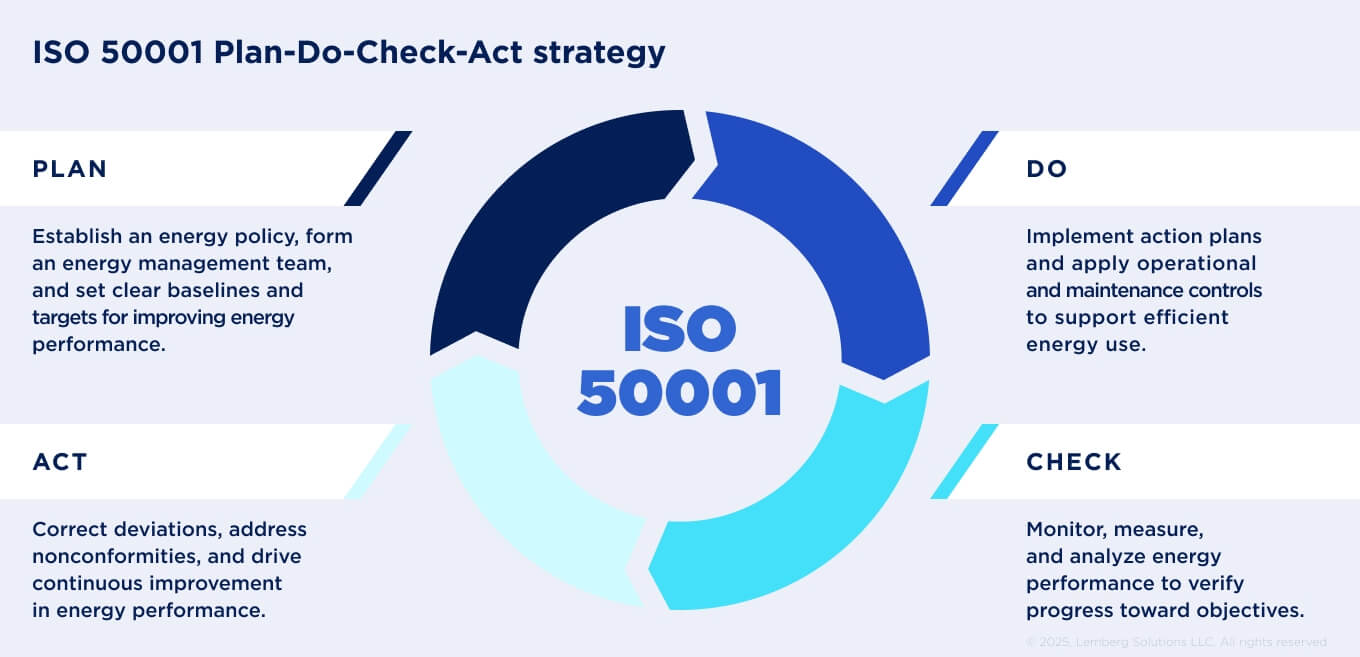
Under the EU Green Deal, all companies with excessive energy usage must implement an energy management policy in accordance with EN ISO 50001 and Annex VI of Directive (EU) 2023/1791. The purpose of ISO 50001 is to promote best practices and approaches for energy management, aiming to improve efficiency, reduce consumption, and minimize environmental impact. To achieve ISO 50001 certification, the energy management strategy must follow the Plan-Do-Check-Act (PDCA) cycle. And smart EMS can provide valuable support during each stage of the PDCA cycle by analyzing your consumption patterns, monitoring real-time performance, and automatically optimizing certain energy systems.
Core architecture of a sustainable EMS
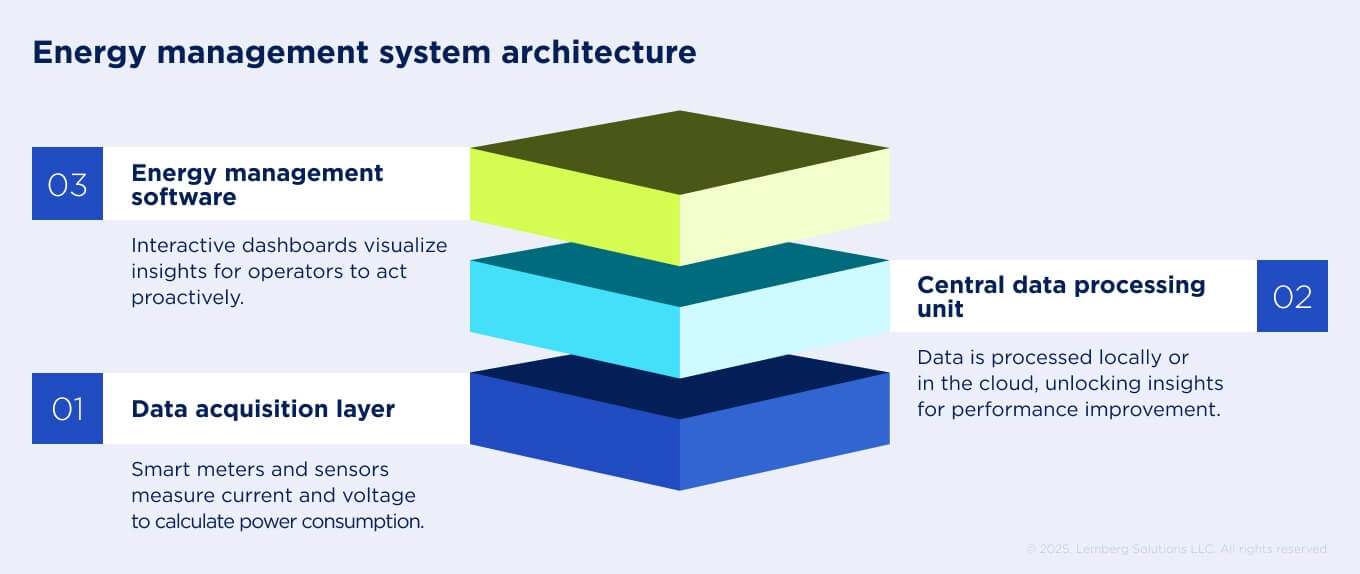
Usually, sustainable energy management solutions are divided depending on the area of application: either into industrial or residential settings. These systems have differences in scale and operational requirements, which affect their architecture, but typically, they have the following components at their core.
Data acquisition layer
Every sustainable energy management system starts with data collection. Installed on the energy systems, smart meters and sensors track the parameters — power, current and voltage — and convert them into digital data.
Central data processing unit
Once the data is collected, it is sent to the central unit for processing and storage, either on local servers or in the cloud. There, analytics tools transform data into insights, highlighting the energy-intensive processes, spotting anomalies, or, with sufficient historical data, forecasting the demand for months ahead.
Energy management software
The must-have of all effective energy management solutions is the user interface. Here, the valuable data is presented in the form of interactive charts and diagrams, graphs, so system operators can view consumption trends and plan better resource usage.
Key requirements for a sustainable EMS in Europe
The requirements for EMS are the following:
Cybersecurity & data integrity
First and most crucial is compliance with security requirements.
To safeguard IoT devices and critical energy data from cyber threats, the system must adhere to industry best practices, including the use of firewalls, secure access controls, and encryption protocols. Apart from these strategies, EMS must meet essential security compliance requirements.
For instance, any solution that handles confidential data must follow GDPR standards. This way, all personal and operational data is processed transparently, securely, and according to European data protection laws.
Also, the European Union Agency for Cybersecurity (ENISA) provides guidelines and best practices on security measures implementation to protect energy infrastructure from unauthorized access, data tampering, and other cyber threats.
Another thing to keep in mind is that a sustainable energy management system must also comply with the Cyber Resilience Act. It obliges all software and hardware products with digital components to have cybersecurity measures in place during each stage of the product’s lifecycle. Therefore, all EMS must be secure by design, including vulnerability management and incident reporting to demonstrate their resilience against potential cyberattacks.
To ensure full protection and data integrity, it is better to delegate this task to a tech vendor who is certified under ISO 27001 and ISO 9001. Following these standards, the development team builds its process with information security requirements and quality management strategy in mind, which ensures that your management system is secure by default.
Scalability and flexibility
As European regulations are still forming, the EMS must be scalable and flexible enough to adapt to new requirements and evolving regulatory frameworks. The design of such a system must have a modular architecture.
This design approach means that each component of the system is independent and interchangeable. In the case that an upgrade is needed for a specific component, developers can make the change without disrupting the entire system. This not only simplifies the system’s maintenance but also ensures that future enhancements can be implemented efficiently.
Also, implementing cloud-based storage enhances scalability by adjusting to increasing data volumes. As the system collects and transmits more energy data over time, the cloud storage adapts without dropping performance.
Interoperability
Energy infrastructure is a complex entity that relies on a range of assets, including smart grids, renewable energy sources, and energy storage systems. Without interoperability, these assets are unable to share insights with each other in real-time, which makes it difficult for system supervisors to maintain grid stability and optimize energy supply and demand.
To ensure interoperability, EMS must be built on open communication standards such as Modbus, M-bus, LoRaWAN, MQTT, and OPC UA. This approach allows smooth data exchange across different assets and external systems, making all connected devices operate as a unified, smart ecosystem.
Features that drive compliance and efficiency
EMS can include a range of features designed to improve energy efficiency and support compliance with regulations. Here are a few key ones:
- Real-time monitoring and data visualization. Sensors and meters installed on devices transmit the collected data to the central dashboard. It gives the company’s responsible system operators better visibility into when, where, and how energy is consumed across their systems. While operators monitor the current state of the system, algorithms adjust and optimize energy system operations in real-time; human intervention is required only in critical situations.
- Automated reporting. Such a system eases efforts automatically collecting and compiling energy data in line with report requirements. With built-in templates, supervisors can generate reports with just a few clicks. And what is more, this feature minimizes human error and allows auditors to verify the energy system's status.
- Peak shaving. EMS can reduce electricity consumption during periods of high demand. It is commonly achieved by temporarily reducing non-essential loads or by using the power from energy storage systems without relying on the grid.
- Energy arbitrage. With this functionality, the system can optimize electricity costs by monitoring the grid prices. Then it can either buy or sell energy when it is optimal, ensuring cost efficiency and grid stability.
- Predictive analytics for demand management. Beyond simple monitoring, energy and sustainability management systems can also forecast power demand. As they have integrated AI algorithms or machine learning, they can forecast consumption based on historical data. By predicting demand peaks, companies can also adjust their operations, ensuring their energy system is stable.
- Renewable source integration and control. A truly sustainable EMS must be able to integrate with renewable energy generation sources. An advanced system can track the power generation and automatically switch between different sources to ensure reliable system operation. For instance, EMS can prioritize renewable power during hours when these sources are the most productive.
Best practices for implementing an EMS
Identify the current situation of your energy system
Before rushing to implement any technical solution, make sure you understand where your energy system stands: how it is functioning, which areas are most inefficient, and where you lack resources. Start with energy audits – they can give you a full picture of how your energy system is performing. This knowledge will help you determine the next steps in terms of what to focus on and what you want to achieve when aiming for an effective energy management system.
Choose the right solution
Once you have identified areas for improvement and set your goals, you can choose between an off-the-shelf system or a custom one.
A ready-to-use system is usually more cost-efficient, however, it lacks flexibility. While it has built-in functionality, it typically covers only basic needs. Adding specific features or scaling can be time-consuming, costly, and challenging to align with your existing legacy systems.
If you want your EMS to fit your energy infrastructure, opt for custom energy management software development. This approach allows you to add features you consider important for achieving your sustainability goals and ensures seamless integration with your legacy systems. It can take longer to develop and require a higher upfront investment, but in the end, it will pay off through savings on energy costs.
Train your staff
Prioritise staff training so that they understand the value and purpose behind implementing an EMS. Communicate clearly its benefits and how its implementation may reshape roles and responsibilities across your company.
Engage with the development team that designed your custom EMS to conduct the training sessions for your people. During these sessions, they will exchange insights on how to use EMS properly, keep it in optimal condition, and interpret its findings to support informed decision-making.
Business value: why invest in a custom EMS
Investing in EMS is the best way to future-proof your business. Here’s how this investment can pay off.
Reduced operational costs
With rising utility prices, monitoring your energy consumption is an absolute must to significantly reduce your expenses. By closely monitoring energy systems with the help of EMS, energy managers can spot inefficiencies, reduce waste, and plan the replacement of outdated systems to make energy consumption smarter. Over time, these improvements lead to substantial cost reductions and free up budget for further growth.
Tailored to your infrastructure
A custom EMS is designed to align with your specific sustainability goals and seamlessly integrate with your energy equipment. Unlike off-the-shelf solutions that usually follow a one-size-fits-all approach, a tailored solution naturally fits your system and scales as you grow.
Data unification & centralisation
EMS consolidates data from various energy devices in one centralized location, so managers do not have to do it manually just to create a report. As the process is automated, it also eliminates the possibility of human error, making reporting as easy and accurate as possible.
Compliance with sustainability and energy efficiency laws
EMS can help businesses to comply with government regulations related to climate neutrality and energy efficiency. The EU Energy Efficiency Directive outlined a transposition deadline for enterprises to have effective energy management in place – 10 October 2027. Those companies that implement custom EMS early will have a significant advantage. Since such a system has all the necessary functions, from power consumption monitoring to identifying inefficiencies, organizations can significantly reduce their carbon footprint and contribute to the global sustainability movement.
What’s next: the future of sustainable EMS
With the emergence of new technologies, sustainability and energy management systems will evolve even more, bringing closer to reality Europe’s 2050 net-zero goal.
For example, we will see even more EMSs with integrated AI systems, empowering energy supervisors to analyze vast datasets, predict consumption patterns, and suggest optimal operational strategies. Also, AI can monitor equipment performance in real time, instantly detect anomalies, and alert operators to prevent potential failures.
Even more, some sustainable EMS will also feature AI chatbots. This will allow operators to retrieve needed information, either on the current state of the energy system or a specific moment in the past, simply by conversing with a chatbot. Looking ahead, with the support of generative AI, next-generation EMS will be capable of automatically generating ESG reports, allowing companies to quickly calculate their sustainability performance, track emissions, and ensure compliance with evolving EU regulations.