


In the first half of 2026 alone, physical AI companies raised $47.4 billion across 521 venture deals — a record-breaking number for the industry. Meanwhile, actual production adoption of physical AI systems has been lagging behind. During the same period, only 6% of globally shipped humanoid robots were actually placed in production lines or warehouses driving ROI, with the rest being sold for entertainment, scientific research, or data collection.
Such figures demonstrate a clear gap between R&D initiatives, prototypes, or demos and adoption-ready systems that work in the field and bring economic value. Today’s production adoption is still limited to highly structured environments with mathematically predictable return on investment, like automated warehouses, restricted military test areas, and geo-fenced commercial properties.
At the same time, investors are looking for funding opportunities in physical AI companies that can reach production milestones, win customers, and scale efficiently, as opposed to experimentation-focused ventures.
In this article, we review the technological foundations of physical AI, look at working production examples, and show how development teams can bridge the gap between a demo and a deployable, commercially viable system.
What is physical AI: definition
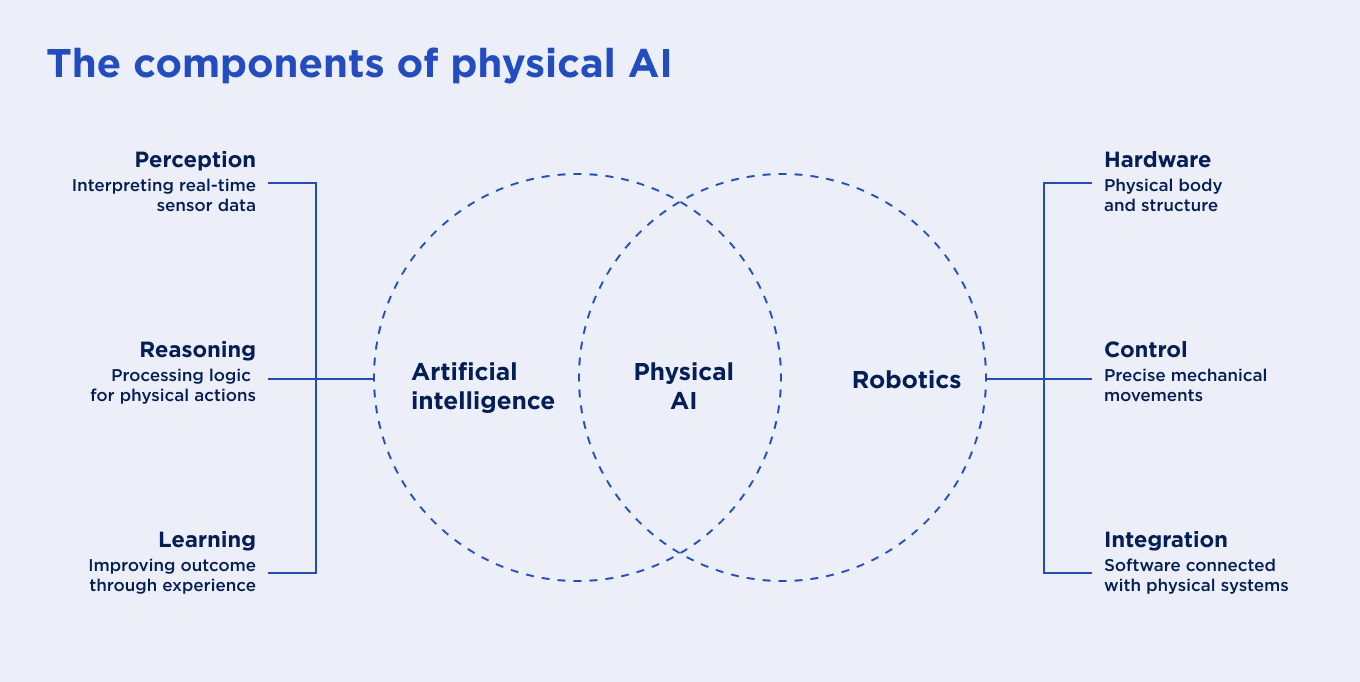
Physical or embodied AI is a class of AI systems that enable machines to understand physical environments and operate in them. Edge AI development combines embedded engineering and data science to integrate physical AI into robotic systems and enable them to take in sensor data, independently reason about it, and take relevant physical action autonomously.
Is physical AI the same as robotics?
No. While many modern robotic applications do rely on artificial intelligence, robotics in the traditional sense consists of the hardware layer and mechanics powered by rigid, deterministic rules. Thus, a standard industrial robot arm follows pre-programmed instructions to weld the exact same seam on an assembly line, but will weld empty air if you move the metal sheet two inches left.
Physical AI is also not any AI model. In contrast to generative AI or recommendation engines, which work in the digital realm and basically transform data into other data, models for physical AI can interact with the real world. Without perception, physical reasoning algorithms, and control programs, computer systems cannot process real-time sensory inputs to execute physical actions.

What are some real, commercially viable examples of physical AI systems?
From the business perspective, physical AI delivers the highest return on investment in spaces with dynamic conditions but clear operational layout, such as industrial facilities, warehouses, or open-air workplaces. It effectively replaces deterministic task-by-task automation with adaptive and autonomous behavior.
Manufacturing & assembly
On assembly lines, physical AI is implemented in industrial robotic arms that handle high-precision or physically demanding but dynamic manufacturing tasks. The embedded spatial reasoning models, integrated tactile and visual sensors, and hardware actuation mechanisms enable machines to perform accurate electronics manufacturing, gentle goods packaging, or heavy gear production.
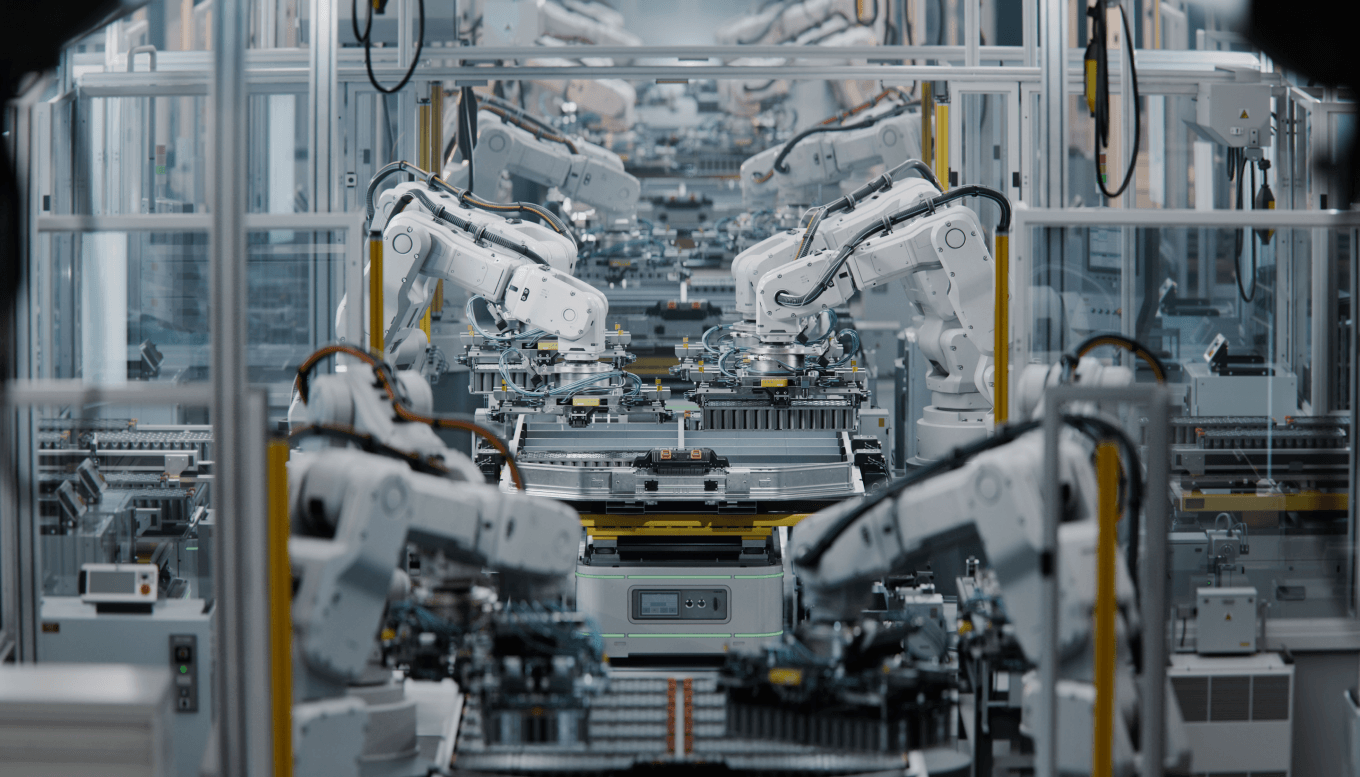
- NASA has been using Machina Labs’ AI-enabled robotic forming platform to manufacture specialized donut-shaped toroidal fuel tanks for lunar landers without molds. By eliminating manual work, the company reduced production time by 75% and cut costs by 87%.
- Ford uses cobots integrated with force sensing and adaptive vision to sand and finish car bodies in just 35 seconds. The AI system dynamically adjusts contact pressure and tool paths in real time based on micro-variations in the vehicle's surface.
Logistics & warehouse operations
Modernized warehouse floors, loading docks, shipping yards benefit greatly from AI-powered mobile robots or autonomous forklifts. Smart self-driving vehicles build and maintain spatial maps of infrastructure, track inventory, and move heavy cargo safely without fatigue or interruption. To navigate multiple aisles and perform complex maneuvering, autonomous vehicles rely on a combination of technologies: in addition to sensors and computer vision, they employ simultaneous localization and mapping, path planning, and reliable, low-latency wireless communication.
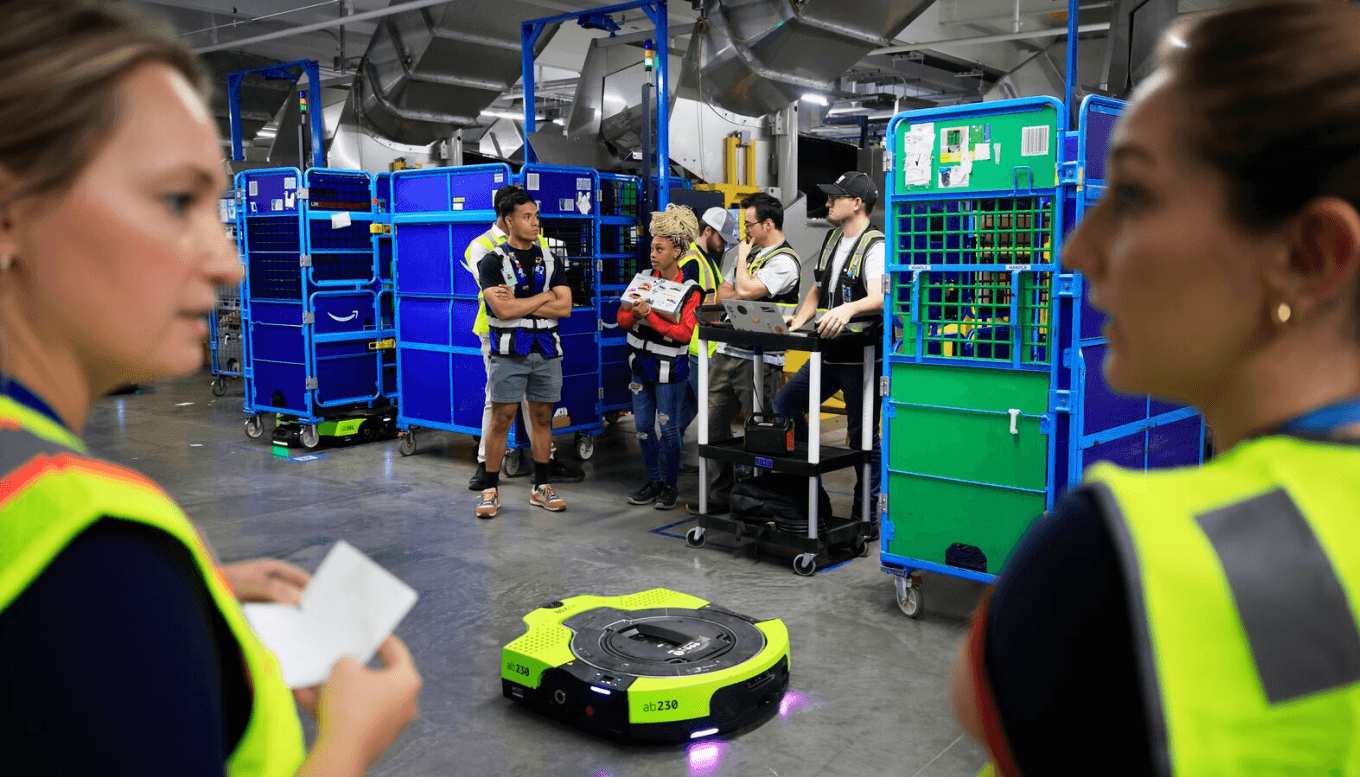
- DHL is now using fully electric, driverless vehicles to move goods within the company’s logistics hub in Singapore. One such vehicle completes a 700-meter hub-to-hub journey completely autonomously, delivering an average of 60 tons per 24-hour shift.
- Amazon's autonomous robotic systems help the company cut order-processing time by 50% and expand its ultra-fast delivery service in Europe and India. For example, the new Proteus robot can operate across different sites, understand employees’ conversational prompts, and figure out the task priority, the route, and the timing.
Smart spaces & visual inspection
Spatial sensor networks, quadruped robots, aerial drones are handy for remote quality control or automated condition inspections at industrial facilities and construction sites. Active stabilization and foot placement mechanisms allow machines to handle complex terrain. These systems integrate sensors with CV models and anomaly detection algorithms. Using real-time kinematic (RTK) GPS technology, drones can accurately map and follow automated paths across open areas.
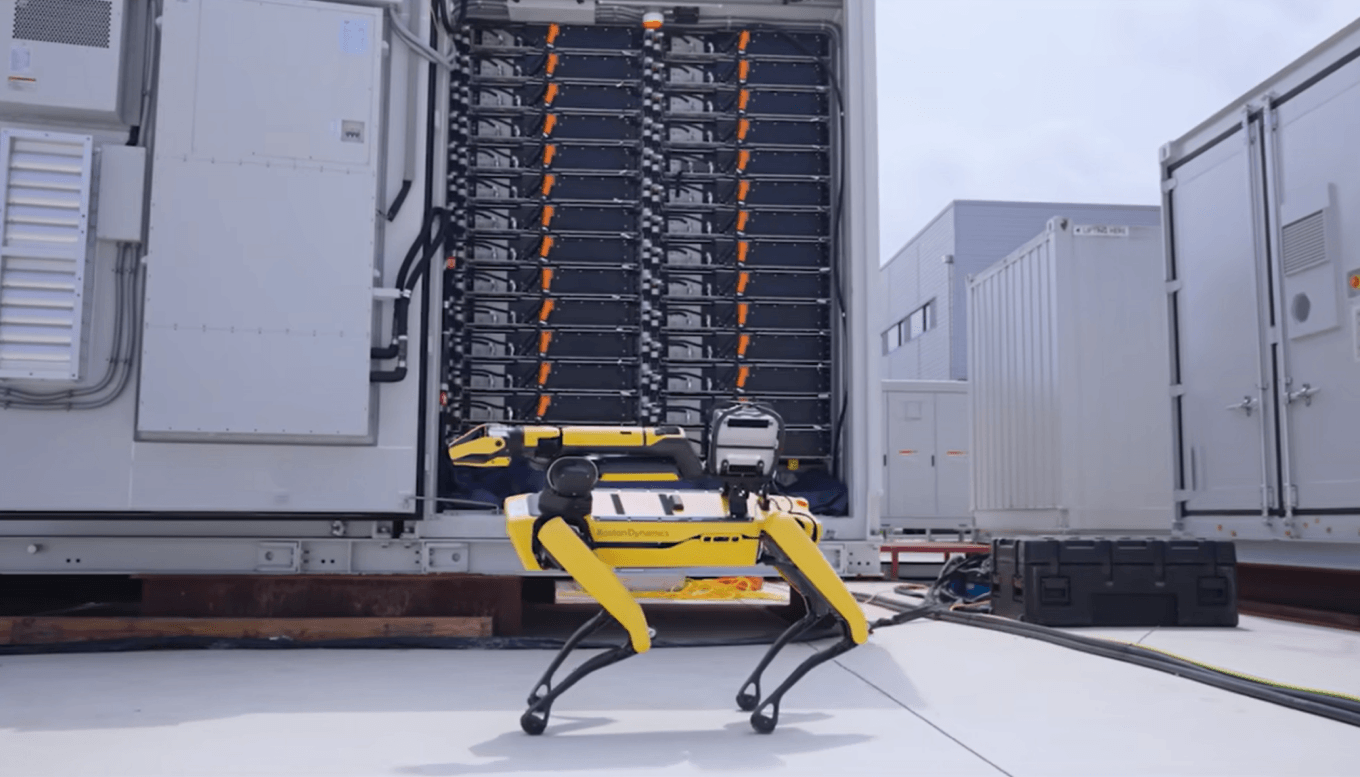
- LG Energy Solution leverages quadruped robots equipped with AI vision and 3-meter-tall camera towers to autonomously inspect the battery production pipeline in real time. The company reports 90% detection accuracy and expects 50% more effective production by 2028.
- Siemens automates the inspection and monitoring of critical water infrastructure with AI-powered drone intelligence system Aerosophia. It scans large water facilities using RGB, thermal, LiDAR, and multi-spectral drone imagery; then automatically spots and labels surface cracks, erosion, or soil subsidence.
If you have a physical AI solution in mind and are looking for a reliable team to assist with delivery, check out Lemberg Solutions’ physical AI companies list, highlighting trustworthy vendors with expertise in industrial automation, system modernization, and predictive maintenance.
How does a physical AI system work?
At its core, a physical AI system runs a continuous loop, processing raw sensor signals into spatial reasoning, precise motor control, and real-time behavior adjustments. It enables hardware to operate with accuracy and support natural interactions with humans.
This continuous loop relies on a five-stage operational cycle:
- Perception: The system collects and fuses raw, heterogeneous sensor signals into a coherent 3D representation of the surrounding environment.
- Reasoning: The vision encoder model (DINO, SAM, YOLO) interprets the spatial context, understands physical phenomena like gravity, friction, or collision risks, and, based on preceding training and real-time sensor data, evaluates goal states.
- Decision: The vision-language-action model (OpenVLA, Google DeepMind’s RT-series) translates these high-level intents into actionable spatial paths and trajectory plans. LLMs help the system coordinate different execution skills. Foundation World Models (NVIDIA Cosmos) predict future frames and physical consequences.
- Actuation: Diffusion policies or transformer-based action chunking in embedded firmware convert planned trajectories into precise, low-level commands, such as adjusting motor torques, joint angles, or gripper forces.
- Feedback: The system reads the immediate physical result through sensors, closing the loop with continuous learning to instantly correct errors and log system performance.
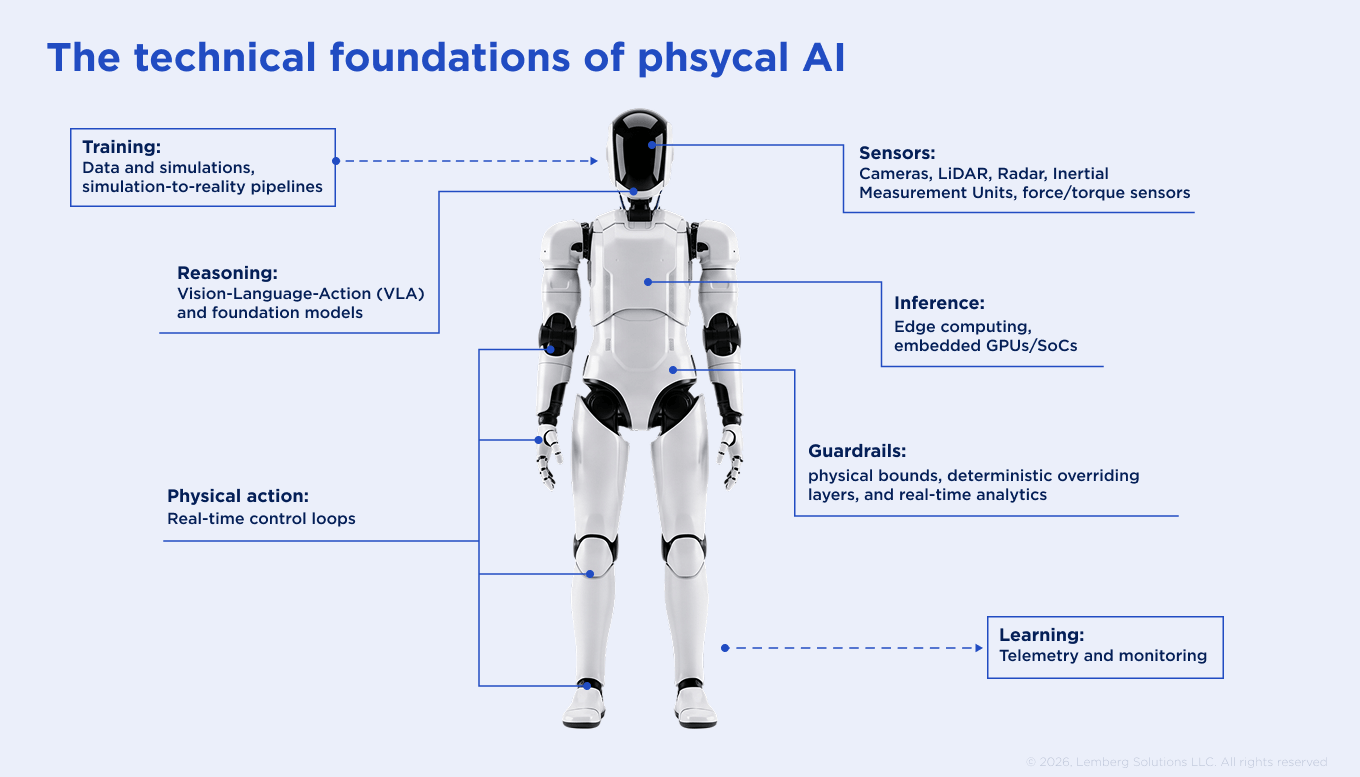
With these key operational stages, physical AI requires a technical foundation that combines data science, ML algorithms, embedded systems, and real-time control:
- A sensor suite of cameras, LiDAR, Radar, IMUs (inertial measurement units), and force/torque sensors. Fusing these disparate signals into a structured data stream allows the system to build an accurate map of the surrounding environment and track changes in real time.
- Multimodal vision encoders transform raw image pixels into mathematical vector representations, creating a shared embedding space for visual and linguistic concepts (e.g., a picture of a cat and the vector for the word "cat" sit in nearly the exact same mathematical location).
- Vision-language-action (VLA) and foundation world models serve as the central reasoning engine. They are trained on vast physical datasets and provide the system with generalized spatial knowledge. This lets a robot process images, video, and text, and infer their physical properties.
- Simulation & data: In addition to collected data, physical AI developers often need photorealistic simulator environments that align with real-world physics. They help generate volumes of training data impossible to collect but necessary to stress-test robot policies in rare edge scenarios or speed up learning cycles without actual physical risks.
- Simulation-to-reality pipelines bridge the gap between virtual simulation and the physical world. Such techniques as domain randomization and real-world calibration help ensure that policies trained in digital twins execute reliably on imperfect hardware.
- Edge inference computing most often relies on high-throughput on-board processing units (embedded GPUs/SoCs) capable of running model inference directly on-device. Edge compute minimizes operational latency and eliminates dependency on cloud connectivity during safety-critical maneuvers.
- Real-time control loops: Deterministic software controllers operating on millisecond execution cycles translate neural network outputs into precise physical actions, ensuring stable motor torque, velocity modulation, and grip control.
- Safety & fallback guardrails, including hardcoded physical bounds, deterministic overriding layers, and real-time analytics, constantly monitor operational limits. If a model generates an unsafe path or detects an unpredictable anomaly, these systems immediately enforce safety fallbacks.
- Telemetry & iterative learning lifecycle: Continuous data-logging pipelines collect edge cases, failure states, and operational telemetry from deployed fleets. Such feedback feeds directly back into model retraining cycles, continually improving accuracy and safety over time.
Why do most physical AI demos never become products?
Many physical AI demonstrations don’t reach commercial production because demos usually take place in tightly controlled environments, test a narrow technical hypothesis, and rely on a limited dataset — conditions insufficient to validate a commercial product. It must perform continuously across a number of use cases under real-world conditions.
Industry data on physical deployments show that a system achieving 95% accuracy in a lab can deliver only 60% reliability in real-world conditions. The shift from controlled lighting, static camera angles, and clean backgrounds to glaring light, shadows, or changing object textures creates more ambiguity than the underlying AI model can handle. In industrial environments, a 40% failure rate makes a solution too unusable and costly to deploy.
Here are the most common reasons why a successful demo cannot guarantee a commercially viable physical AI solution:
Comparison table: Expectations of a demo vs. production-grade physical AI system
| Loop stage | Typical demo | Production system | Why the gap matters |
|---|---|---|---|
| Perception | Single sensor, controlled environment, static conditions | Sensor fusion, edge cases, real-world noises | Unaccounted environmental variance degrades accuracy |
| Reasoning and decision-making | Model running on high-power workstation or fine-tuned for a specific task | Optimized model runs on constrained hardware, with zero-shot generalization | Single-case model use masks edge inference budgets, battery use, and thermal constraints |
| Actuation | Single-step tasks, short runs | High-level perception + sub-millisecond motor control | Micro-errors accumulate across sequential actions |
| Feedback | Manual resets; no data logging, failure harvesting, or remote update mechanisms | Deterministic hardware safety fallbacks + automated telemetry, edge failure harvesting, and retraining pipelines | Without telemetry, updates, and continuous learning, a system remains frozen at its demo capabilities |
Missing technical hypothesis
Technical hypothesis helps engineering teams replace trial-and-error with measurable, targeted stress tests: it defines the exact boundary conditions of physics, compute, and environment. Without a well-formulated technical hypothesis, they risk producing a demo that operates successfully within a narrow "happy path" but can’t survive the constraints of mass deployment, like physical variability of the real world or power and compute constraints. Even simulation with world foundation models will drift into generic photorealism, missing precise parameterization.
Hypothesis-driven sim example: The policy's failure mode is caused by specular reflection on brushed aluminum and latency jitter exceeding 12 ms; randomize surface reflectance should be randomized by 40% and inject 5–20 ms sensor delays in the digital twin.
Ignoring the importance of data
Engineering teams often keep model architecture in focus, neglecting the operational data pipeline. If they collect training data that doesn’t reflect real-world physical variance, the model will overfit to lab conditions and reduce its prediction accuracy as soon as the physical environment changes. Missing clock synchronization and rigid timestamping cause temporal drift, leading to poor motion trajectories, unstable control, and actuation lags.
Note: Don’t forget to collect and analyze telemetry data generated during operation: this way, you support continuous system improvement by learning about edge-case scenarios that cause failures and training the model to factor them in.
Environment generalization
A system trained to pick parts in warehouse A will most likely break in warehouse B with slightly different shelving heights, other package geometry, or floor reflective properties. To achieve true zero-shot transfer, ML engineers use physics-grounded simulation environments with varying conditions to train models to understand invariant spatial layouts and universal physical laws.
This way, if a robot understands the invariant spatial layout needed to complete an action, it can substitute tools, e.g., use a pen to stir liquid when a spoon is missing, because it recognizes the shared structural affordance of a pen and a spoon. Combining this with multimodal vision-language-action (VLA) foundation models, the system can define what an object is and how it behaves in any room.
Manipulation complexity barrier
Physical AI has achieved commercial viability in spatial navigation (e.g., autonomous mobile robots rolling down aisleways) and simple picking (e.g., suctioning uniform boxes off a conveyor). However, complex multi-step manipulation mostly remains stuck in the lab.
When a task requires sequential physical operations, such as threading a cable, aligning a screw, or assembling multi-part components, micro-errors accumulate at each step. Without precise tactile feedback and immediate error-recovery policies, the system quickly cascades into complete task failure.
Compute, thermal, and power budgets
Laboratory demos typically run off-board, attached to high-powered GPU workstations with unrestricted power and active liquid cooling. Meanwhile, a commercial product must run perception, reasoning, and real-time control on localized, low-power edge processors.
Balancing compute power and battery life creates operational bottlenecks that require major system redesigns before production. Many humanoid and mobile robots spend so much power on onboard AI inference and joint actuation that their runtime is capped at 90 to 120 minutes. Meanwhile, industrial shifts require at least 8 to 12 hours of continuous operation to justify production-grade capital expenditure.
What has to change to turn a physical AI demo into a shipped product?
Closing the demo-to-production gap requires a transition from software-isolated pattern recognition to end-to-end spatial reasoning and systems engineering. Professional embedded AI development vendors engineer every component across the perception-action loop, including hardware, simulation, model architectures, edge compute, control, and telemetry, achieving actual field reliability.
Table: What should change from prototype to production
| Engineering area | Demo | Shippable product |
|---|---|---|
| Sensors | Basic cameras or single sensors; uncalibrated mounting, susceptible to noise | Production-grade multi-modal arrays with sub-millisecond timestamping, thermal compensation, and sensor redundancy |
| Model/compute | Full-precision models running off-board on workstations without power, latency, or thermal bounds | Compressed, quantized models optimized for embedded edge compute, high-level vision policy + sub-millisecond motor control loop |
| Simulation & data | Small, manually gathered real-world datasets or basic lab setups, excluding edge cases | Real-world datasets complemented by physics-grounded digital twins based on WFMs generating photorealistic synthetic data at scale |
| Safety | Software-only limits or manual emergency stop buttons; reliance on correct model predictions | Deterministic hardware-level safety guardrails and overriding controllers that instantly enforce physical limits if AI outputs exceed bounds |
| Update lifecycle | Static model deployed once; manual on-site reflashing and re-engineering whenever the environment changes or the policy fails | Continuous edge telemetry and failure harvesting that automatically routes edge cases to cloud retraining pipelines, pushing improvements to the fleet via over-the-air (OTA) updates |
Production-grade sensor fusion and hardware integration
Commercial systems utilize multi-modal sensor arrays (time-of-flight depth cameras, solid-state LiDAR, haptic tactile sensors, and high-rate IMUs) with active thermal compensation and automated self-calibration pipelines. Camera exposure times, LiDAR frame rates, and joint encoders must be hardware-triggered and timestamped down to the sub-millisecond level. Sensor latency jitter directly leads to control instability during high-speed physical maneuvers.
Physics-grounded simulation
As physical data collection is slow, expensive, and potentially dangerous, production teams rely heavily on synthetic data generated inside photorealistic, physics-grounded digital twins. Simulation ingests real-world environments using 3D Gaussian-based spatial reconstruction. This allows autonomous systems to simulate rigid-body dynamics, contact mechanics, and variable lighting inside exact virtual replicas of specific target facilities.
World foundation models (WFMs) are the generative engines for virtual environments. They automatically generate, annotate, and augment synthetic training scenarios at scale, covering long-tail edge cases (e.g., glare, missing parts, unexpected collisions) that would be impossible or unsafe to stage physically.
For example, NVIDIA’s OpenUSD provides a standardized 3D scene description framework across tools and workflows. It serves as the universal data pipeline for bringing CAD models, material physics, camera paths, and real-world telemetry into a single, interoperable simulation environment. Ongoing development of advanced, physically viable world models further extends the capabilities of physical AI systems training.
Specialized model training
To handle unpredictable environments, production systems combine complementary training paradigms rather than relying on a single learning framework:
- Reinforcement learning (RL): Agents learn complex behaviors through trial-and-error inside high-throughput simulation engines, maximizing task reward functions across millions of simulated hours.
- Physics-informed reinforcement learning: Integrates physical equations (kinematics, mass distribution, friction bounds) directly into neural loss functions. This forces the policy to consider real-world physical boundaries, drastically reducing sample complexity and eliminating unfeasible actions.
- Imitation learning & behavioral cloning: Teleoperated human demonstrations provide rich datasets for delicate, hard-to-reward tasks like fine assembly or wire routing.
- Domain randomization: During simulation training, physical parameters like object friction, joint damping, mass, visual textures, and lighting, are continually varied across vast distributions. As a result, the model learns underlying physical traits over specific visual or dynamic cues.
Edge compression
Foundation and vision-language-action models are compressed using different techniques so they can run on constrained hardware without cloud dependency: quantization, structural pruning, and neural engine-specific compilation.
Dual-rate real-time control
To combine the vision logic with stable, well-controlled actions in the real world, engineers most often decouple perception from motor control in physical AI systems.
- High-level policy loop (10–30 Hz): Processes heavier visual context and plans trajectories using deep edge inference.
- Low-level control loop (500–1000 Hz): Runs lightweight deterministic, low-latency joint controllers on dedicated microcontrollers to modulate motor torque, maintain balance, and respond to tactile resistance.
Safety guardrails
The system must account for cases when an AI model may violate predefined velocity, torque, or spatial boundaries. Deterministic hardware-level safety measures should be built in by design to instantly take over to prevent collisions or damage.
Telemetry and failure harvesting
Every time the edge system encounters an unconfident state, near-miss, or manual intervention, this information is recorded into a contextual sensor log and transmitted back to the cloud as data for further improvement.
Continuous learning and over-the-air (OTA) updates
Failure logs are converted into synthetic simulation scenarios. The policy gets retrained against newly discovered edge cases. Optimized models are then validated in simulation and deployed back to the fleet via OTA updates. This way, the entire fleet can learn from every single edge-case failure.
How do you choose the right physical AI approach for your product?
When building a physical AI product, the engineering approach must take into account what the system will do, in which operational environment, and what physical constraints exist.
Naturally, a fixed cobot on a factory assembly will have different compute needs and safety requirements than a mobile robot working in unstructured public spaces. The available power budgets, latency requirements, and deployment architectures (fully on-device vs. hybrid edge-cloud) will define the AI inference engine, firmware, and sensor payload.
In this section, we review the most common physical AI use cases to demonstrate how environment type and hardware constraints may frame the physical AI architecture.
Table: Matching physical AI approach to use case
| Use case | Environment type | Main engineering constraint | Example |
|---|---|---|---|
| Factory cobot | Limited, semi-structured | Ultra-low latency, deterministic precision, and strict functional safety on low-power edge compute | Collaborative arm performing dynamic bin-picking or manipulating deformable wire harnesses on an assembly line |
| Warehouse mobile robot | Semi-structured, moderately dynamic | Compute-to-power ratio for 8–12-hour battery shifts and dynamic spatial mapping | Vision-guided forklift rerouting around spilled pallets or dropped boxes |
| Hospital service robot | Unstructured, highly dynamic, human-dense | Context-aware multimodal reasoning and privacy-first local data processing | Autonomous delivery robot navigating through crowded halls |
| Autonomous vehicle | Unstructured, high-speed, infinite edge cases | High-throughput multi-sensor fusion, massive physics simulation coverage, hardware redundancy | Delivery truck distinguishing between road debris and a pedestrian |
Fixed factory cobot — edge architecture
Since collaborative robots, like robotic arms, work side-by-side with humans, they have to embed strict functional safety and the fastest decision-making possible. These requirements can be satisfied by an edge decision and control engine. From the inference perspective, cobots don’t need heavy, computationally demanding "common sense" reasoning as their operating environment is relatively fixed and semi-predictable. Focusing on a limited scope of tasks, they can do so with a narrower perception-action loop, which allows them to concentrate compute resources on edge inference.
Example: To perform dynamic bin-picking or manipulate deformable materials like wire harnesses, a collaborative robotic arm relies on local, optimized vision models and force-torque feedback. It completes the specific task, adapting to slight misalignments without endangering nearby human workers.
Mobile warehouse robot — hybrid cloud-edge architecture
A warehouse has a known layout, but the environment is more chaotic than on an assembly line: dropped boxes, moving forklifts, walking personnel can be in the robot’s way. Safety concerns, again, dictate the need for low-latency decisions and controls. Plus, to run 8–12-hour shifts on batteries, mobile robots need optimized perception for energy efficiency. At the same time, autonomous navigation around the facilities requires compute-heavy sensor fusion (cameras + LiDAR) and spatial mapping. A hybrid architecture is a good solution in this case, with local edge processing for real-time obstacle avoidance and cloud-based inference for remote fleet orchestration.
Example: A vision-guided forklift follows a pre-mapped route to execute daily work but it can detect a spilled pallet in its path and dynamically calculate a new route without human intervention.
Autonomous hospital service robot — tiered edge architecture
Similarly to navigating a warehouse environment, a hospital service robot needs dynamic, multimodal perception to differentiate between a static wall, a moving cart, or a patient in a wheelchair. Such an unstructured space already requires heavy vision-language-action reasoning. But the healthcare context also mandates keeping all data processing local to avoid patient identity or raw footage exposure. With a layered edge architecture, we can combine on-board inference for high-frequency reflex actions and move complex, cognitive tasks to the hospital's on-premise server, so no data ever crosses the hospital’s WAN boundary.
Example: An autonomous logistics robot delivers lab samples or medications moving through a crowded hospital floor. If a patient steps in front of the robot, the on-board control loop will trigger an immediate emergency stop, while the server-based reasoning will identify the obstacle as a human and update the path to go around them.
The autonomous vehicle — edge architecture with hardware redundancy
Public roads present the hardest physical AI challenge. The environment is highly dynamic and fast-paced, hiding millions of rare, dangerous edge cases. The inference can be on-board only and the computer system for it must be designed with hardware redundancy to include backup sensors and processing power, so the vehicle can respond to massive incoming data in real time. This redundancy presumes the on-board execution layer to run two structurally distinct stacks:
- a neural network world model policy that predicts surrounding behaviors and plans optimal paths;
- a rule-based isolated engine that overrides the system and executes an emergency stop or pull-over in case of a failure, software glitch, or hardware crash on the AI side.
Example: An autonomous delivery truck operating on public highways. It can instantly distinguish between a plastic bag blowing across the road and a pedestrian stepping off a curb, and decide the second requires emergency braking.
Read our comprehensive overview on Edge AI vs Cloud AI Architecture to get a deeper understanding of the factors that affect system architecture choices. Or you can talk to our experts.

Conclusion
Physical AI brings a fundamental transition in technology: artificial intelligence is moving out of well-structured digital environments into the chaotic and unpredictable physical world. While digital AI models primarily convert data into other data, physical AI produces more tangible outcomes through its ability to perceive spatial context, reason about physical constraints, and act in real time.
Moving from a 95%-accurate lab demo to a commercially viable product demands a holistic, end-to-end approach to system engineering:
- Hardware-software co-design: Balancing deep reasoning with local, edge compute constraints, thermal limits, battery runtimes, and sub-millisecond motor control.
- Physics-grounded simulation: Utilizing digital twins, OpenUSD standards, and world foundation models to generate photorealistic synthetic data and solve the generalization bottleneck long before hardware ever touches the floor.
- Closed-loop telemetry and safety: Pairing deterministic hardware guardrails with automated failure-harvesting pipelines so that edge devices continuously learn, adapt, and improve via over-the-air updates.


