

Demand for real-time intelligent decision-making is growing. And edge AI brings this opportunity by delivering the desired speed while maintaining security and stability.
This guide highlights the top providers in 2026 and helps you identify the right partner based on your industry, technical requirements, and budget.
What is edge AI, and why does it matter in 2026
Edge AI is an architectural approach to building and integrating AI models directly into devices, such as sensors and IoT systems. What sets edge AI apart is its ability to process data without relying on a stable internet connection. This enables immediate feedback and allows devices to adjust to their environment in real time.
In 2026, edge AI is becoming increasingly important. The reason is that AI use cases expand across many industries, where low latency, high reliability, and continuous operations are most critical. And in these environments, cloud-only architectures might not be enough.
Edge AI vs cloud AI
The major difference between edge AI and cloud AI is where the data is located and analyzed.
With edge computing, data is processed directly on the device. Because the system doesn’t send data elsewhere, this approach has been proven to be faster and more secure. With cloud computing, data takes a round trip: from the device to the cloud and then back. While such a process takes longer to respond, all complex, compute-intensive tasks are handled more efficiently. For a deeper comparison, explore our edge AI vs cloud AI guide.
Key benefits of edge AI
Many systems operate under major operational constraints: latency, limited connectivity, and security risks. Edge AI development provides the foundation for handling these challenges because of its capabilities.
- Real-time execution at the source. AI runs locally, and data processing happens in milliseconds, which is critical in cases when delays can pose safety risks.
- Always-on operation in any environment. Edge AI keeps functioning even when connectivity is unavailable, especially in remote sites or field environments.
- Cost-efficiency at scale. Сloud AI costs grow with usage, while edge computation happens on hardware, making data processing cost-efficient.
- Reduced data exposure by design. When data is processed on-device, it never leaves the system, so an entire category of security risk disappears.
- On-device autonomy. With edge AI, devices can act independently, making decisions based on processed data, without any human input.
Common edge AI architectures
Within edge computing, there are various architectural options to choose from. They differ in how data flows and how devices interact with each other and with the cloud:
- Fully on-device. The system collects data through its sensors, processes it on the device, makes a decision, and acts on it, all without communication with external systems.
- A hybrid system, one of the dominant patterns across industries. Most enterprise edge AI deployments combine local processing with cloud capabilities. Within a hybrid architecture, organizations can choose different patterns depending on their scale. For example, a simple gateway-based setup for retrofitting AI onto existing equipment or a multi-tiered hierarchy for large facilities with many data sources.
- Mesh architecture, or device-to-device communication. In this case, devices communicate directly without any centralized point. For example, autonomous vehicles sharing position data, or drones coordinating a search pattern.
How to recognize that your business case needs edge AI development services?
Most teams switch to edge AI when cloud architecture starts breaking under conditions that can’t be solved by simple optimization alone. If the scenarios below sound familiar, it may be time to find the best edge AI development company for your needs.
- When your physical product must function independently. If you are building a physical product that must operate without constant human input, edge AI becomes a core part of the product architecture.
- When you need a real-time response. In robotics, industrial automation, and ADAS systems, decisions must be made without delay. Edge computing enables on-device inference on embedded systems, with processing and decision-making performed in real time.
- When regulations define architectural constraints. Healthcare devices and industrial systems often process sensitive sensor data that cannot be transmitted externally. If privacy or compliance requirements restrict data movement, edge AI is favorable.
- When you want to cut operational costs. In large IoT and sensor networks, costs grow with every additional device and data stream. Edge AI reduces dependency on continuous cloud processing by shifting intelligence to embedded hardware.
- When your devices must operate in places with unreliable connectivity. Factories, remote industrial automation sites, and field-deployed IoT systems cannot rely on stable connectivity. An edge AI partner can ensure that your robotics and embedded systems continue to operate even in offline conditions.
Top edge AI development companies in 2026
| Company | Country | Focus | Technologies | Industries |
|---|---|---|---|---|
| Lemberg Solutions | Ukraine, Germany, UK, Poland | Edge AI consulting / Hardware and software co-design / AI model architecture design / Sensor fusion & data processing / Computer vision / Cloud-edge integration | TensorFlow Lite / PyTorch Edge / Edge Impulse / NanoEdge AI Studio / OpenVINO / NVIDIA / Raspberry Pi / Qualcomm AI / C/C++ | Manufacturing & Industrial IoT / Healthcare / Automotive / Energy |
| Yalantis | Ukraine, Poland, Estonia | Consulting services / Model optimization / Firmware development / Hardware design / Edge-to-cloud integration | PyTorch / TensorFlow Lite / Rust / Embedded C/C++ | Automotive / Logistics / Retail / Healthcare / Industrial / Energy |
| TechAhead | USA, India | Application development / AI model deployment / Edge-to-cloud integration / Consulting | TensorFlow Lite / PyTorch Mobile / OpenVINO / NVIDIA | Healthcare / Manufacturing / Logistics / Automotive |
| Promwad Engineering | Germany, Lithuania, Poland, Latvia, Serbia | Software & hardware development / AI consulting | Renesas / DPR-AI Renesas RZ/v2m / NVIDIA | Automotive & smart cities / Industrial automation / Construction |
| Softeq | USA, Lithuania, Mexico, Germany, United Kingdom | Embedded & IoT development / AI development | JavaScript / Java / Xamarin / Unity / C/C++ | Consumer electronics / Industrial automation / Automotive / Energy / Healthcare |
| Consult.Red | UK, Poland, USA, India | Edge computing / Sensor fusion / LLM implementation | Keras / MxNet / PyTorch / TensorFlow | Media & telecoms / Manufacturing / Consumer electronics / Healthcare / Energy |
| Softweb Solutions | USA, India | Architecture design / AI model development / Edge MLOps/ System integration | Tensorflow / Pytorch / Onnx / Runtime | Manufacturing / Agriculture / Transportation |
| Intera Group | Spain | AI model development / Local data processing / Edge AI Deployment | C++ libraries / TensorFlow / Pytorch | Energy / Healthcare / Manufacturing/ Smart home and smart building |
| deepsense.ai | Poland, USA | Consulting / Edge solution development / Team Augmentation | OpenAI / NVIDIA / Anyscale / LangChain / Vespa | Manufacturing & Industrial Automation / Consumer Goods / Logistics |
Lemberg Solutions
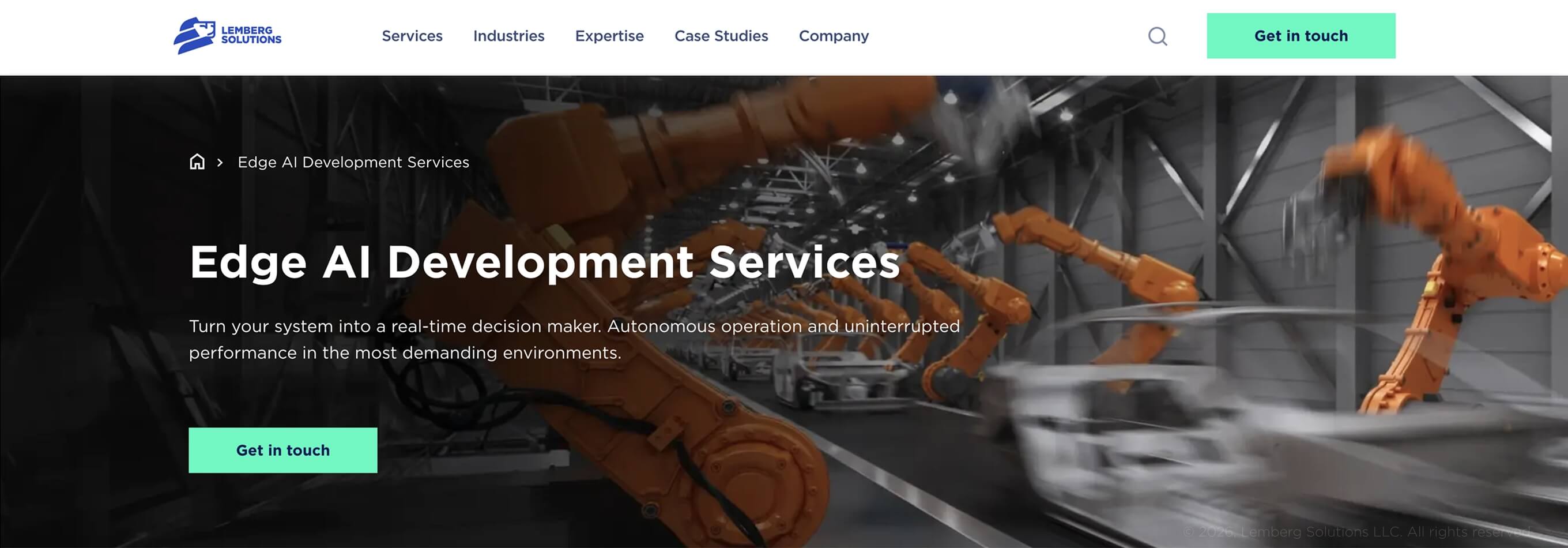
Lemberg Solutions is a hardware and software engineering company with over 15 years of experience in embedded systems, IoT, and AI systems development. Providing edge AI development services, the company covers full-cycle hardware-software co-design, along with custom AI model design and optimization. Lemberg Solutions is an ISO 27001- and ISO 9001-certified vendor that organizes the delivery process according to industry best practices to ensure security and quality.
Lemberg Solutions partners with leading semiconductor ecosystems, including NXP, Microchip, and STMicroelectronics, using proven components to build production-ready edge AI solutions.
The company works in several industries, including healthcare, automotive, energy, agritech, consumer electronics, industrial IoT, and transportation and logistics.
Founded: 2007
Employees: 200+
Hourly rate: $50 - $99
Locations: Ukraine (Lviv, Lutsk, Rivne), Germany (Hamburg), the UK (London), Poland (Krakow)
Key clients: Bosch Rexroth, Astronics, Caltech, Ferno, Speede, NoiseAware, Selco
Yalantis
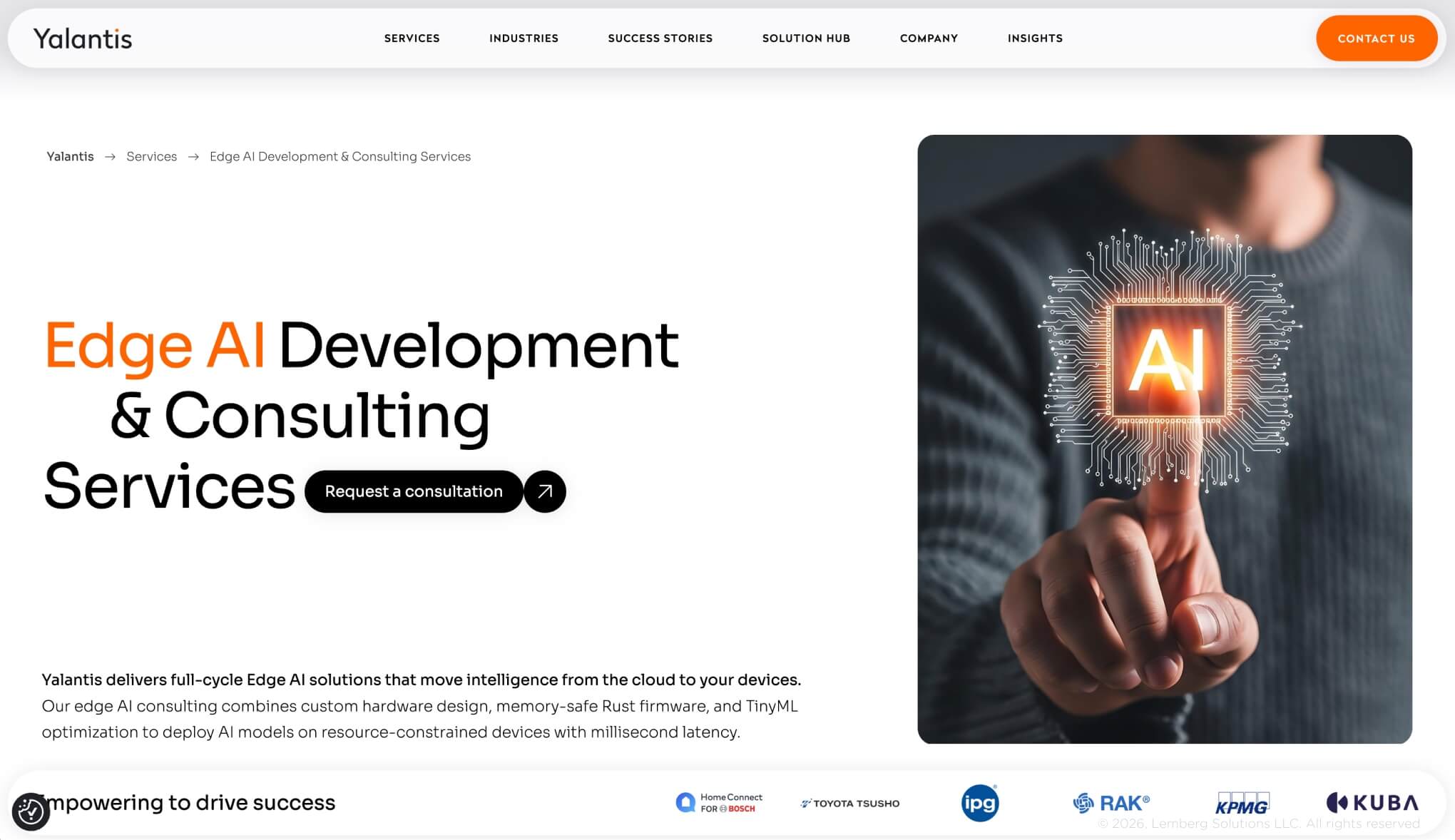
Yalantis provides certified software, hardware, and AI development services, covering the entire product lifecycle. It specializes in consulting, hardware design, firmware engineering, and AI model optimization to deliver intelligent systems that run efficiently on-device and at scale. The company operates across industries such as automotive, logistics, and industrial IoT, building edge AI solutions for connected devices, sensors, and distributed systems.
Founded: 2008
Employees: 500+
Hourly rate: $50 - $99
Locations: Ukraine (Kyiv, Lviv, Dnipro), Poland (Warsaw), Estonia (Tallinn)
Key clients: IPG, Zillow, RAKwireless, Orbis Systems, Duo Health, ViewTrade
Techahead
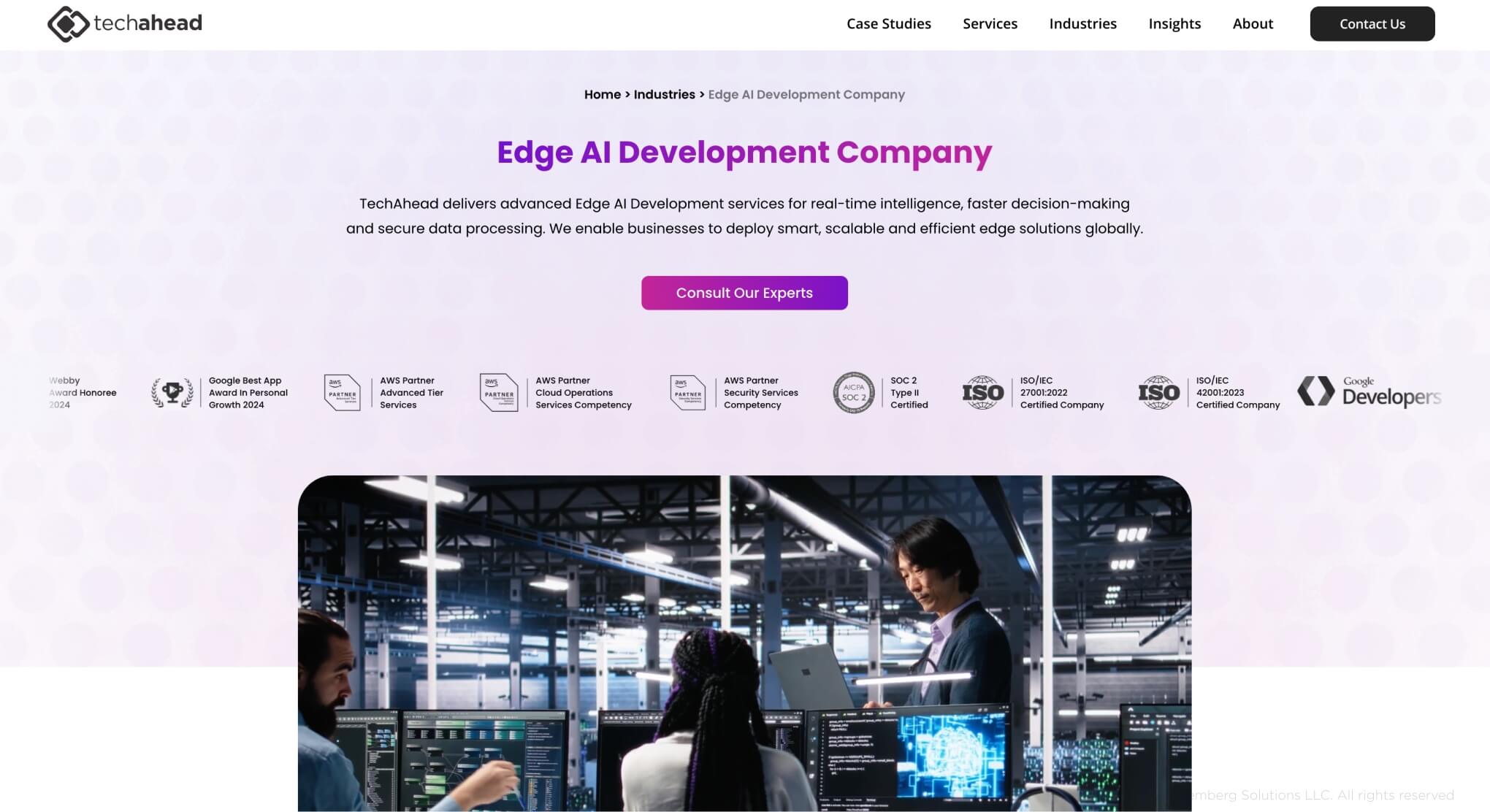
TechAhead is a global partner that provides custom software engineering services. From custom application development to model optimizations, its edge AI development services cover computer vision and predictive maintenance solutions. The company supports industries such as retail, finance, mobility, and enterprise services.
Founded: 2009
Employees: 240+
Hourly rate: $25-$49
Locations: USA (California), India (Noida/New Delhi)
Key clients: AXA, International Cricket Council, Human Touch, Plunge, Lafarge
Promwad Engineering
Promwad is a European electronics design house with over 20 years of experience. Their custom engineering services include design expertise for hardware, mechanics and enclosures. Apart from that, the company also offers software development for automotive, industrial automation, telecom, digital TV, and video streaming industries.
Founded: 2004
Employees: 100–200
Hourly rate: $50–$99
Locations: Germany (Essen), Lithuania (Vilnius), Poland (Warsaw), Latvia (Daugavpils), Serbia (Niš)
Key clients: WIKA, Hypervsn, Dewesoft, JVL, Parrot, INCYMA
Softeq
Softeq supports startups and enterprises of all sizes in building smart, connected solutions powered by AI/ML, IoT, wearables, computer vision, industrial automation, and robotics. Softeq develops edge AI solutions across industries such as automotive, energy, consumer electronics, and industrial automation.
Founded: 1997
Employees: 500+
Hourly rate: $80
Locations: USA (Texas), Lithuania (Vilnius), Mexico (Monterrey), Germany (Munich), United Kingdom (London)
Key clients: Verizon, Epson, Lenovo, AMD, Verifone, Western Digital, OMRON
Consult. Red
Consult.Red is an embedded engineering consultancy focused on designing and scaling intelligent connected devices with edge AI capabilities. The company supports industries such as telecom, media, and consumer electronics, where real-time processing and device-level intelligence are essential. Consult.Red specializes in system architecture and development, optimization of existing systems, and testing and compliance services.
Founded: 2003
Employees: 220+
Hourly rate: Not publicly disclosed
Locations: UK (West Yorkshire), Poland (Wrocław), USA (Florida), India (Hyderabad)
Key clients: Comcast, Sky, Liberty Global, DIRECTV, Astro, Polsat, Telecom Italia
Softweb Solutions
Softweb Solutions has been designing, building, and scaling digital solutions using its cloud, data, and AI expertise. They also specialize in building edge AI systems that integrate IoT devices, real-time analytics, and secure data governance. The company works in manufacturing, healthcare, logistics, and retail. Their solutions typically run on distributed IoT architectures and cloud-edge hybrid environments.
Founded: 2004
Employees: 501-1,000
Hourly rate: $150-$250
Locations: USA (Texas, Chicago), India
Key clients: NEC, T-Mobile, SYKES, TruGreen, Alliant, Texas Instruments
Intera Group
Intera’s focus lies in developing embedded AI solutions, using advanced technologies and data science to power automation. The company leverages deep technical expertise to build AI systems across the edge-to-cloud continuum, with a strong emphasis on chip-level design and development, including ASICs, FPGAs, SoCs, and embedded software. Their work is particularly relevant to industries such as Industry 4.0, smart energy, and digital health.
Founded: 2006
Employees: 50–100
Hourly rate: Not publicly disclosed
Locations: Spain (Barcelona)
Key clients: Solectrix, Atom Semiconductor, Transeleva, Monolitic, Tridec, Cafès Cornellà
deepsense.ai
deepsense.ai is focusing on delivering custom AI solutions to clients worldwide. The company also specializes in edge services, from consulting and model development to production deployment. Its core focus areas include manufacturing and industrial automation, retail, logistics and supply chain, and smart cities.
Founded: 2014
Employees: 100–200
Hourly rate: $50–$99
Locations: Poland (Warsaw), USA (Palo Alto)
Key clients: Sky, Zebra Technologies, Brainly, DocPlanner, Hexagon
Edge AI development companies by industry
Edge AI is an attractive option for many industries. However, not every service provider can address specific industry demands. As each sector has distinct requirements and constraints, below is a list of providers that offer top edge AI development services in these domains.
Industrial IoT & automation
Industrial edge AI is primarily used for factory operations automation. From visual inspection and defect detection to predictive maintenance, edge AI helps to catch equipment failures before they happen. It also reduces downtime and improves worker safety by processing sensor and camera data directly on machines or local edge devices.
Among the many edge AI companies, these are the ones that provide their services for industrial IoT and automation:
- Promwad Engineering — predictive maintenance, technology control, and robotics.
- Lemberg Solutions — real-time anomaly detection at the machine level and increased industrial autonomy.
- TechAhead — computer vision, predictive analytics, and IoT-driven industrial solutions.
- Yalantis — predictive maintenance solutions.
- deepsense.ai — defect detection and quality control through computer vision.
- Softeq — solutions for remote control of technical processes and production line automation.
- Softweb Solutions — AI systems to minimize downtime and enhance product quality.
- Intera Group — embedded AI for Industry 4.0, automation, and supply chain systems.
Healthcare & medical devices
Edge AI in healthcare powers real-time patient monitoring, faster diagnostics, and secure processing of sensitive medical data. It can also ensure uninterrupted operations, directly impacting patient safety. Below is an edge AI companies list that can support AI implementation into your healthcare device:
- Lemberg Solutions — patient monitoring & imaging analysis solutions developed in compliance with FDA, HIPAA, IEC 62304, and ISO 13485.
- TechAhead — healthcare AI systems, monitoring, and predictive analytics.
- Yalantis — privacy-first patient monitoring with on-device anomaly detection for wearables and diagnostic equipment.
- Intera Group — on-device data processing and healthcare AI integration.
- Softeq — embedded AI and connected healthcare devices.
- Softweb Solutions — AI-enabled healthcare ecosystems and connected systems.
Automotive & robotics systems
Within automotive and robotics, edge AI computing allows machines to perceive their environment and make real-time decisions. They can operate safely without relying on cloud connectivity, which is essential for applications such as ADAS and industrial robotics. Companies providing automotive & robotics edge AI services:
- Yalantis — safety-critical systems for ADAS and autonomous vehicles.
- Lemberg Solutions — real-time embedded AI for automotive and robotics systems (ISO 26262, IEC 61508, AUTOSAR).
- Softeq — advanced driver assistance systems and object recognition software.
- Promwad Engineering — driver monitoring systems, face recognition cameras, drones, navigation devices.
- Softweb Solutions — AI systems for transportation and automotive analytics.
Smart devices & consumer electronics
Edge AI allows IoT products, cameras, wearables, and sensors to process data locally instead of relying on the cloud. This improves responsiveness, enhances privacy, and user experience. Consider these edge AI service partners to make your consumer devices smarter:
- Consult.Red — edge computing for media and consumer electronics.
- Lemberg Solutions — embedded AI and device-level intelligence for connected products.
- Softeq — devices and apps for tracking performance, pet activity, data visualization, and analysis.
- Intera Group — smart home and connected device intelligence.
Energy & smart infrastructure solutions
From real-time monitoring, predictive maintenance to autonomous grid optimization — these are typical edge AI applications in energy and smart infrastructure. Even in remote environments, utility operators can easily maintain stable machinery performance by detecting anomalies faster, significantly reducing downtime.
What companies can offer you edge AI integration in the energy and smart infrastructure sector?
- Softeq — automation of multi-party communication, equipment monitoring, and health and safety condition compliance.
- Lemberg Solutions — battery analytics (SoC/SoH), BESS optimization, predictive maintenance & industrial AI applications (IEC 61850, IEC 62443, ISO 15118).
- Yalantis — grid monitoring and predictive maintenance for distributed energy assets.
- Consult.Red — edge systems for telecom, utilities, and energy infrastructure.
- Intera Group — smart energy systems and infrastructure intelligence.
- TechAhead — engineering intelligent grid ecosystems.
Edge AI development companies by technical expertise
From embedded firmware and hardware development to real-time computer vision, different projects require different strengths. Below is an overview of edge AI companies grouped by their core technical expertise.
Embedded AI and firmware development
Edge AI at the firmware level requires deep expertise in MCUs, ARM architectures, RTOS, and low-level optimization to run AI models on constrained devices such as the ESP32. This is critical for high-performance systems because they need to operate independently at the hardware level.
Companies that provide embedded AI and firmware development expertise:
Computer vision and video analytics
Computer vision, a cutting-edge technology, is widely in demand for enabling smart environments, from industrial to consumer applications. Powered by it, devices can detect and track objects, processing video locally. Consider the vendors below to partner with to implement computer vision into your solution:
Local and on-device data processing
Local inference ensures data privacy and offline functionality. For regulated industries and environments with limited connectivity, it is a complete must. Check out this list of edge AI providers focusing on data collection and processing:
Real-time edge AI system optimization
The design of edge AI systems must be carefully engineered to ensure low-latency processing and real-time decision-making. Cutting-edge AI companies below can support real-time systems in applications like robotics, streaming analytics, and automation:
Hardware, firmware, and AI integration
Edge AI requires tight integration among hardware, firmware, and AI models, ensuring systems are optimized for performance throughout the full-cycle engineering process — from prototype to production. Rely on these vendors to integrate hardware, firmware, and AI, end to end:
Sensor fusion
One of the fundamental parts of edge AI development is sensor integration. To enable automation and real-time insights, IoT systems process telemetry data from devices, gateways, and sensors. The following edge AI providers can deal efficiently with sensor fusion:
Best edge AI development companies by budget and project scope
Edge AI projects vary significantly in cost, depending on the level of development complexity. Budget levels often reflect not only engineering effort but also system maturity, ranging from the PoC stage to full deployment. Here is an overview of edge AI companies divided by project and budget caps.
Projects under $50K
Such projects typically focus on the discovery phase with PoC solutions, including:
- Model selection & integration on target hardware
- AI model optimization
- Simple software development
- Lightweight sensor-based solutions
Here is a top edge AI companies list that offer edge AI integration through the PoC phase under $50K:
Projects between $50K and $100K
Within this budget range, projects move from a validated concept to production-oriented components. The typical scope of work includes:
- Complex data pipeline
- Hardware customization
- Embedded firmware development
- Integration of advanced AI models for computer vision or signal processing
- Implementation of basic OTA update capability
Companies that can support projects between $50K and $100K budget cap:
- Yalantis
- Softeq
- Promwad Engineering
- Lemberg Solutions
- Consult.Red
- Softweb Solutions
- deepsense. ai
- Intera Group
Projects over $100K
Large-scale projects focus on building edge AI systems for complex environments and industrial automation. Typically, the scope of the project is following:
- Full integration of hardware, embedded software, and AI models
- Complete MLOps pipeline for the edge
- Distributed intelligence with a hybrid cloud-edge architecture
Here are the top edge AI companies working on over $100K end-to-end solutions with full integration:
How to choose an edge AI development company
Unlike standard software development, edge AI requires a specific combination of embedded, AI, and systems engineering expertise. Often, it’s hard to find the right mix of capabilities needed to cover the full delivery process: from hardware selection and firmware development to AI optimization and system-level deployment.
For this reason, the criteria below provide a way to evaluate edge AI development providers.
Embedded hardware and firmware experience
The firms that can genuinely bridge hardware and AI are more valuable to most edge AI projects, because most problems begin with the integration process. All edge AI systems must be built with hardware constraints in mind, or they will not function as intended. Only a vendor with embedded hardware expertise can do it efficiently. When selecting a service provider, ask whether they can work directly with physical computing platforms. Also, evaluate their experience with C/C++, bare-metal development, and real-time operating systems (RTOS).
AI optimization experience
Running AI on edge devices is about making them work as accurately as possible while minimizing computational load and power consumption. Good vendors will have extensive experience with quantization, pruning, and model compression. Also, it is important to understand how they work with data. Ask how they collect and prepare datasets, whether they can gather edge-case data, and how they clean and structure existing datasets. A mature vendor should be able to build a data pipeline that ensures the model is trained to perform reliably and accurately.
Industry expertise
Edge AI in a hospital operates under completely different conditions than edge AI on a factory floor or inside a consumer device. Regulatory requirements, safety standards, environmental conditions, data sensitivity, and user expectations vary enormously. When evaluating a vendor, ensure they are familiar with all relevant compliance frameworks and certifications and have a proven track record of projects that show full alignment with your domain's requirements.
Security and compliance
Certifications such as ISO 27001 and ISO 9001 can demonstrate that a vendor follows established security and quality management processes. Ensure that the vendor has a strong understanding of data protection principles and secure firmware development practices.
Delivery model and timeline
Some companies provide only AI models, others, only hardware, and some deliver complete solutions. Choose a partner whose delivery model aligns with your needs, whether it's just consulting, a PoC development, or full product development. A reliable vendor has a clear delivery process that includes defined project phases, iterative development, and regular validation against real hardware. This ensures that models, firmware, and hardware are tested together early, reducing risks later in the project.
Project cost
Edge AI projects often cost more than traditional AI model development. Hardware prototyping costs, component sourcing, certification and compliance testing, and firmware development — all add to the bill beyond the AI model work itself. Some firms put low initial costs but also exclude critical components that appear later. A good vendor will clearly explain what is included in the price: hardware platform selection, post-deployment model updates, production-ready firmware, or just a demo.
How can Lemberg Solutions’ development services help you with AI on the edge?
Lemberg Solutions helps companies build production-ready edge AI systems that combine hardware, firmware, and AI models. The team works across four main areas of expertise: embedded, data & AI, cloud-to-edge integration, and digital experiences.
On the embedded engineering side, we design devices that operate efficiently under hardware constraints while running AI models locally. This includes hardware design, firmware development, platform and chip selection, as well as digital twin simulation and virtual testing to validate performance before deployment.
In data and AI, Lemberg Solutions builds and optimizes models that power real-time decision-making on devices. From model selection, architecture design to computer vision and sensor fusion implementation, we continuously improve models to maintain performance over time.
Through cloud-edge integration, the company enables hybrid architectures where devices process data locally while staying connected to the cloud for updates and orchestration. This includes edge-to-cloud synchronization, distributed intelligence across devices, edge MLOps, and secure OTA updates.
As industries move toward real-time, on-device intelligence, edge AI is growing in demand. And its successful implementation depends on choosing an experienced vendor who has cross-domain expertise. In particular, hardware expertise matters just as much as AI capability. The right partner will bridge AI, firmware, and hardware into a single, scalable system ready to operate in demanding conditions.


