


In industrial operations, the cost of an error can run into the millions of dollars. An idle production in a heavy industry plant, for example, costs $59 million a year, Siemens has estimated. The automotive plant figure is even more impressive: $2.3 million per one lost hour of production, which equals $695 million a year.
AI-enabled predictive maintenance comes as a remedy, saving Fortune 500 companies hundreds of billions of dollars through increased productivity and maintenance cost reduction.
At the same time, Rockwell Automation reports that only 43% of surveyed organizations use the data they collect effectively. To us, this gap suggests that, leveraged to its full potential, data analytics can result in even more cost savings. On production and warehouse floors, with edge AI and real-time data processing, the benefits go beyond just reducing downtime: think of improved assembly line accuracy, production quality, precise condition control, and more.
In this article, we review how the right approach and collaboration with a matching edge AI development company can help industrial businesses use data as a powerful resource for AI-driven modernization.
What industrial edge AI is, and why companies are modernizing now
Industrial edge AI is the deployment of artificial intelligence models directly on devices and systems located at the edge of industrial environments like factories, energy grids, or logistics centers, where data is generated. This way, data from industrial sensors, like vibration sensors or cameras, is analyzed locally, to detect patterns, anomalies, or events instantly and take action immediately.
Speaking of industrial applications of edge AI, organizations often refer to predictive maintenance — detecting equipment failures before they occur. Other popular use cases include automated quality inspection using computer vision, energy arbitrage and optimization, real-time safety monitoring. But how exactly does this technology make a difference for companies?
Real-time operations save resources
First of all, by leveraging edge AI, plants and warehouses enable an important efficiency multiplier — real-time data processing from industrial sensors and machines. For example, UPS leveraged real-time traffic, weather, and delivery window analytics in its new ORION platform to streamline business operations. As a result, they managed to save $320 million by reducing fuel consumption by 10 million gallons.
Reactive systems become predictive
The shift to edge AI and real-time operations in industrial organizations moves plain industrial automation to predictive and autonomous actions. In our predictive maintenance case, the use of AI-powered ultrasound sensors helped manufacturers avoid production downtime and expensive repairs. Edge AI algorithms on the devices detect abnormal sounds in rolling bearings inside the costly factory equipment before they break down. Taking into account the high cost of an unexpected failure, the solution pays off within 60-12 months.
Increased operational safety and data security
Edge AI introduces extra security by separating the OT (operations) and IT (administrative) layers. For manufacturing environments, especially in regulated industries, like energy, it is critical that production floor operations are isolated from other activities — to avoid interference and causing errors. Also, massive manufacturers don’t want their sensitive production data to go public by accident. This is much easier to ensure when all data processing is handled directly on board.
Bandwidth and token needs shrink
In industrial environments where data is generated continuously and is often multimodal, edge AI implementation reduces bandwidth usage and cloud costs dramatically. When we add AI workloads to this equation, rising token prices and limits push a shift to local inference even more. In fact, one edge AI solution for real-time fault detection cut down data transfer needs by 43 times, a 97% reduction for the manufacturing facility.
Daily work efficiency multiplies
Edge AI in industrial automation also enhances overall operational efficiency by saving the time employees spend completing routine tasks. For instance, a livestock production facility was able to achieve a 24 times faster animal weighing process with a computer vision-based edge AI solution.
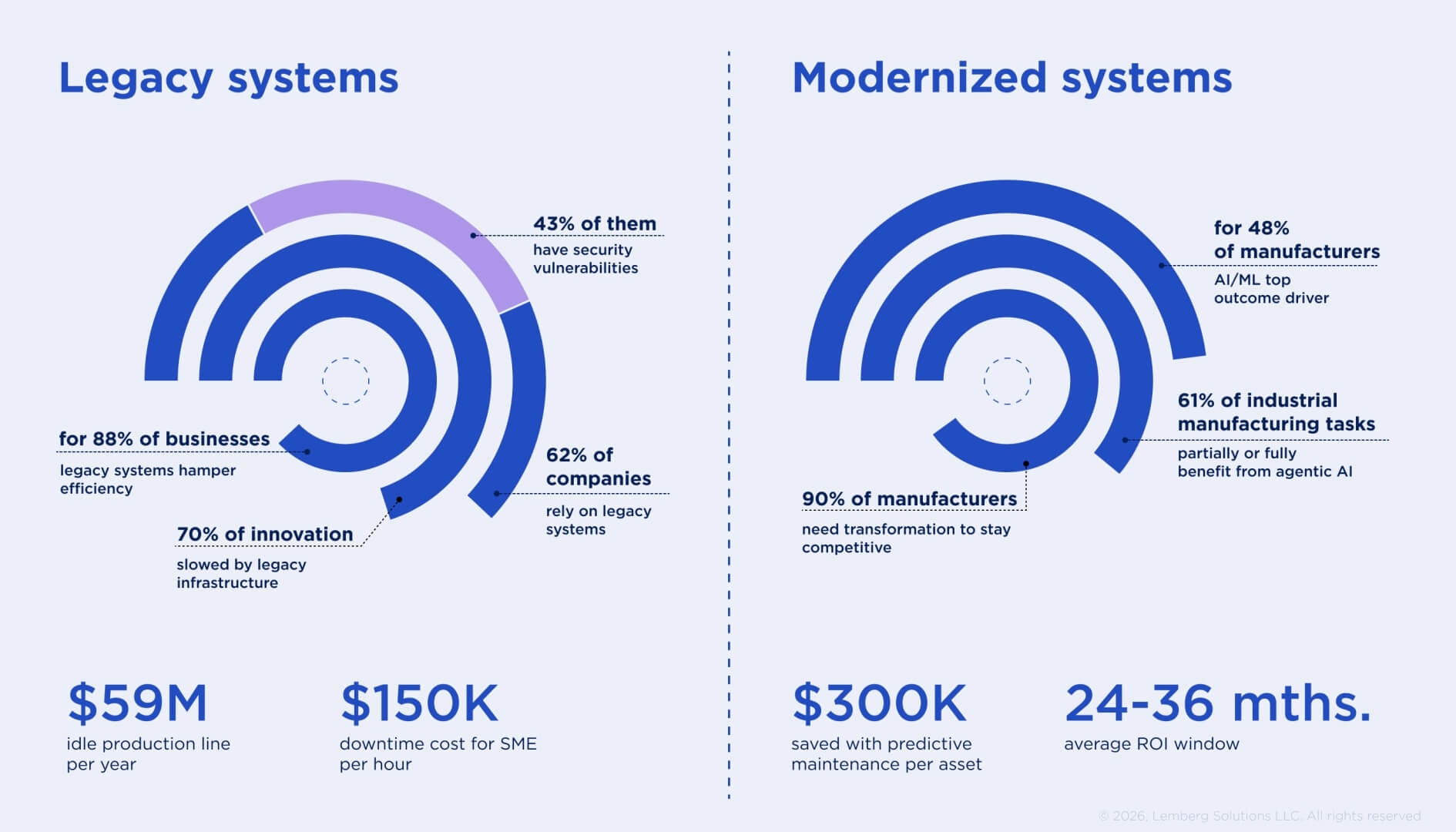
As the figures above show, legacy systems struggle to handle the pressure of modern industrial needs. Traditional architectures were designed for batch processing and centralized data flows. Edge AI addresses this by filtering, analyzing, and acting on data locally, in real time. Businesses delaying the transition will remain stuck with outdated mission-critical systems that cannot support the required efficiency, resilience, or sustainability.
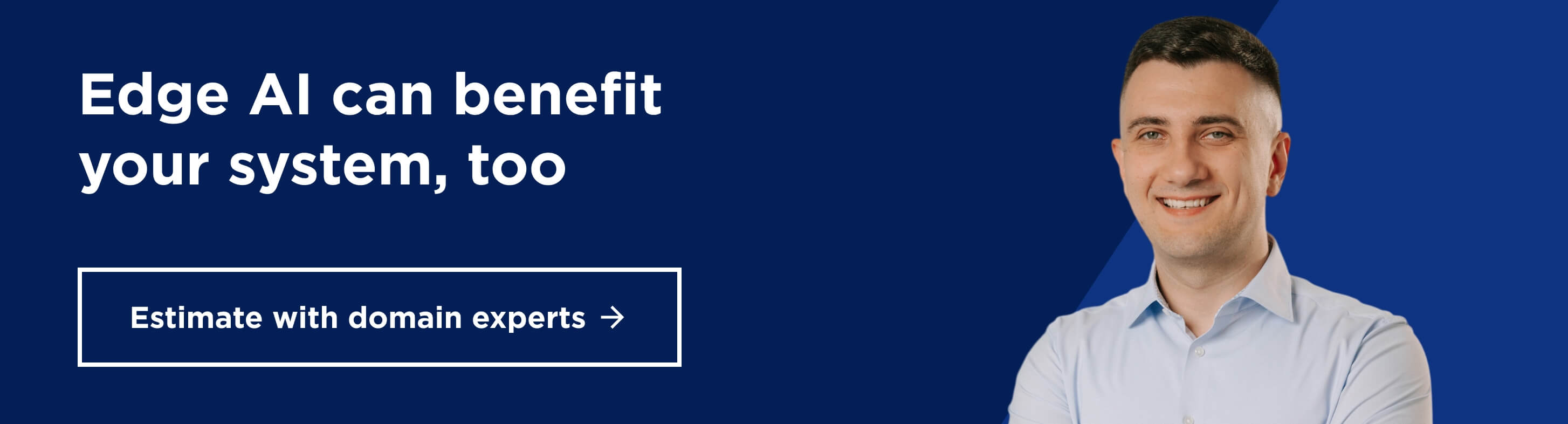
Modernizing industrial systems with edge AI: a step-by-step guide
A living factory floor with changeable conditions and unique equipment constraints requires a delicate balance between rugged legacy hardware and modern, fast-paced software. To avoid disruption risks when integrating industrial IoT with existing assets, it’s important to apply gradual architectural changes rather than try replacing everything at once.
Therefore, we suggest a phased approach that can help balance immediate operational gains with long-term maintainability and deliver measurable results at each stage.
Step 1: Assess and prioritize use cases
First of all, know the problem you are trying to solve and make sure it requires a complex AI solution at all. Involving solution discovery experts can save you a lot of budget and effort. For instance, you might reveal that, instead of using AI, your system can easily do with a deterministic automation algorithm, which will be much easier and cheaper to implement.
If sticking with AI, focus on high-value use cases to ensure your investments will be justified by tangible outcomes. Consider high-impact scenarios, such as predictive maintenance, energy optimization, or production defect detection with computer vision. Measurable results within the first 60–90 days will help win executive support and create a proven foundation for further upgrades.
Step 2: Audit existing infrastructure
A deep analysis of your legacy system’s assets will help you introduce edge AI with minimal disruption and the most benefits. Create an inventory of available data sources, computing power, and communication networks to more accurately evaluate resource needs and deployment timeframe. To better understand which hardware you’d need to handle AI workloads, it’s important to consider not just the inference requirement but also your shop floor’s physical constraints: temperature, humidity, dust, vibration, and power sources.
Step 3: Design data architecture
The real differentiator between successful and failing AI implementations is the ability to connect, contextualize, and act on data across systems. To extract the most value from it, start by drawing how the data will be collected and pre-processed before even entering the AI model. Consider such parameters as different data modalities and formats, or acceptable data quality thresholds.
Industrial AI solutions benefit a lot from hybrid architectures that split edge and cloud processing in order to control response latency, bandwidth costs, and data management risks. If you process time-sensitive data locally and send only aggregated insights to the central server, you can reduce data transfer costs by up to 70–90%. For this, you will have to identify which data you want to process on-device in real-time and what can wait and be analyzed locally or in the cloud.
Step 4: Deploy edge AI pilots
With a pilot, you can validate the real-world performance of your edge AI model in actual operating conditions and decrease the risk of a large-scale and costly failure. This is when you will need to have at least a few samples of edge hardware equipped with appropriate accelerators to handle your AI workloads. It should also be adapted to withstand the production environment conditions.
When deploying your AI model, make sure the pilot is isolated so a software crash cannot physically affect the production line. Instead, run the model in parallel with the existing manual or legacy process. This way, you will be able to compare the pilot’s efficiency, define the acceptable model accuracy in your use-case, or gain practical insights into latency improvements. If the pilot goes as planned, you will be able to see initial gains in ROI within months.
Step 5: Build edge-to-cloud integration
Hybrid architectures increasingly help companies distribute AI workloads based on cost, latency, data sovereignty, security considerations, and power availability. The most important task of this step is to implement proper data routing: keep raw, compute-heavy processing loops on the device while sending aggregated insights for long-term analytics to the cloud.
On the edge, consider designing the system to store data locally and forward it later in case your facility loses internet connection. Meanwhile, the cloud can act as a centralized command center and a secure gateway.
Step 6: Ensure system security
To ensure reliable operation and safety for edge AI in industrial automation, all computerized systems should have built-in cybersecurity measures. These measures include implementing a zero-trust principle, role-based access control, sensitive and secret data encryption, and even disabling unused physical ports.
In the context of critical infrastructure, it’s important to isolate the Operational Technology (OT) and the Information Technology (IT) layers to guarantee that digital security cannot be affected by an intrusion on the edge and vice versa. The Purdue Model provides a clear framework for this separation.
Step 7: Implement device and model lifecycle management
Device and model lifecycle management in distributed edge AI systems is one of the most complex tasks, but it ensures stable performance, scalability, security, and compliance across thousands of devices. For instance, due to the dynamic facility environment changes, models can degrade in accuracy over time unless monitored and retrained.
To ensure adequate device health (CPU, temperature) and model performance across the fleet, you need to set up a connection with a central cloud or local server for continuous monitoring. This will also enable a secure, automated mechanism for OTA updates to provide upgraded firmware and retrained AI models to devices. It’s advisable to include an automatic rollback mechanism to cover cases when an OTA update fails mid-transmission.
Step 8: Scale across operations
By scaling your edge AI solution, you can optimize resource usage and achieve consistent production quality through economies of scale and overall standardization. In this respect, it’s better to rely on standardized, ready-to-use hardware components: if a specialized chip goes out of stock, you might hit a scalability ceiling or need a redo.
Speaking of model delivery, containerization is the best approach for rapid deployment across varied hardware. If your facilities have even slight differences in machinery age or calibration, tune models for each site and create tailored replication instructions detailing configuration steps for rolling out the solution.
Step 9: Upskill your team
Technology alone won’t deliver value if your team cannot effectively use and manage it. In fact, compared to other categories that impact the use of edge AI for manufacturing modernization, human capital remains at the lowest maturity level.
First of all, help your personnel adopt AI modernization as a tool that augments workers’ capabilities, not a way to substitute them. Train the production floor technicians on how to interpret AI insights and make sure their dashboards are as simple and clear as possible. Form an internal support team comprising more skilled IT, OT, and data specialists to help other team members adapt.
Step 10: Optimize and iterate continuously
The benefit of edge AI systems is that they can learn and improve over time as more data is collected and models are refined. While the edge performs local decision-making, the cloud aggregates and analyzes this data for deeper insights and model training. Leverage these feedback loops to optimize your system’s accuracy, efficiency, and reliability.
Remember to continuously review your pilot’s and later versions’ ROI against the step 2 baseline to evaluate what really works. Based on the results, you can optimize your model’s performance, consider other edge hardware options, or look for additional modernization use cases.
Challenges you can face when integrating industrial edge AI
When it comes to modernizing with edge AI, industrial companies often struggle with integrating it into complex, long-lived environments. But if recognized early and addressed systematically, these challenges won’t get critical. Here is how we suggest solving bottlenecks that companies often mention.
Financial risks
It doesn’t look safe to invest significant capital when you cannot expect a predictable and measurable outcome.”
Solution: Consider a "Proof of Value" stage-gate framework, where the modernization initiative is structured into consecutive micro-funding stages. Each subsequent funding is unlocked only after the previous phase proves a specific, measurable outcome.
Business disruption risks
Legacy system modernization process might force us to temporarily pause operations, leading to costly production downtime.”
Solution: Our experience shows that enterprise AI transformation shouldn’t necessarily involve ruining the existing system. It is possible to build a parallel-path architecture that allows testing and validating the edge AI system entirely in the background.
Integration complexity
Our equipment is decades-old and heterogeneous; it relies on proprietary protocols and contains numerous undocumented dependencies. All this makes it really difficult to connect our legacy system with the new edge AI solution without disruptions.”
Solution: Introduce abstraction layers, such as edge gateways and standardized APIs, which help decouple legacy systems from modern applications.
Data fragmentation and quality
Our data is siloed across systems and inconsistent in format. We’re afraid we won’t get reliable insights, even if we integrate with the most powerful AI model.”
Solution: Implement data normalization pipelines at the edge and enforce data governance standards to achieve higher model accuracy and more reliable operational autonomy.
Cloud dependency
Cloud computing can’t provide the real-time system responsiveness we need, but edge AI looks too challenging to coordinate.”
Solution: A hybrid architecture is the best solution in this case. This way, edge AI handles time-sensitive decisions locally, while the cloud supports data aggregation, analytics, and model training.
Scalability
There is no standardized framework for managing thousands of custom distributed devices. We don’t know how we will transition from pilot to scale.”
Solution: Centralized management platforms such as AWS IoT Device Management, Siemens Industrial Edge, Cisco Meraki help with device provisioning, monitoring, and updates. We can help with the right tool selection and setup.
Model drift
In theory, everything looks great, but we know that edge AI models can degrade over time when they operate in real-life conditions.”
Solution: Implement continuous monitoring and automated retraining pipelines integrated with the centralized server. Such self-healing loops track real-world "data drift," flag the degraded models, retrain them on the server, and safely redeploy them back to the edge via OTA updates.
Security risks
Our existing systems lack modern security controls, but they are isolated from the web. Adding the connected component will be like opening our front door to security vulnerabilities we’re not ready for.”
Solution: Built-in zero-trust security, data encryption, device authentication, and continuous monitoring reduce the risk of breaches and help ensure compliance with industry standards.
Budget limitations
Our budgets don’t allow us to start the modernization process.”
Solution: Analyze your expenses on maintaining the existing systems for the lowest-efficiency and high-cost areas, such as calendar-based preventive maintenance or buffer budgets. This could be enough for a first low-cost edge AI pilot on a single critical bottleneck that can bring initial operational savings. Moreover, while auditing your legacy system, you will likely stimulate tech debt reduction, further optimizing your company’s budget.
Skill gaps
Our IT and OT teams have different priorities and expertise levels, which really slows down decision-making and deployment.“
Solution: Invest a part of your modernization budget in cross-functional teams and staff upskilling to bridge these gaps.
The best partners for modernizing industrial systems with edge AI in the US
Today’s US tech engineering and consultancy market is rich with companies eager to provide professional support for businesses seeking reliable modernization partners. We assembled a list of renowned and trusted edge AI vendors with a strong expertise in industrial and business transformation that can help.
1. Lemberg Solutions
Size: 200+ employees
Core services: Edge AI, embedded engineering, system modernization, system integration, generative AI, artificial intelligence & ML, tech consulting
Industry focus: Manufacturing & industrial IoT, energy, automotive, transportation & logistics
Best in: Embedded engineering and edge AI expertise, hardware-software co-design, security and compliance, efficient delivery management
Lemberg Solutions is a software and hardware engineering company specializing in edge AI for industrial automation. The company has strong expertise in embedded AI system development, custom AI model design and optimization for mission-critical hardware, like input-sensitive devices, manufacturing machinery, automotive components, and energy management systems. This makes it particularly valuable for industrial companies needing tight integration between hardware, firmware, and AI workloads.
2. IBM
Size: 10,000+ employees
Core services: Data & AI consulting, business transformation, business operations, cybersecurity, cloud consulting
Industry focus: Automotive, energy, finance, government, healthcare
Best in: Enterprise AI, large-scale systems, governance, mature methodologies
IBM is a globally recognized technology leader, specializing in large enterprise environments and industrial modernization. Boasting a strong hybrid cloud and automation portfolio, the company helps enterprise-grade companies build transformation strategies with minimal disruption risk through its highly secure, regulated processes.
3. PTC
Size: 7000+ employees
Core services: Integrated analytics, edge AI support, enterprise-level interoperability across factories and supply chains
Industry focus: Aerospace & defense, automotive, electronics, energy, industrial machinery, medtech, retail & consumer products
Best in: Large ecosystem of products, deep integration with production operations
PTC is one of the dominant industrial enterprise-grade technology vendors in the US market, known for the ThingWorx platform and industrial connectivity capabilities. PTC enables large-scale industrial IoT modernization with its suite of software solutions for end-to-end product lifecycle management.
4. West Monroe
Size: 1000–5000 employees
Core services: AI, M&A, operations transformation, organizational change management, technology modernization
Industry focus: Consumer & industrial products, energy, finance, healthcare, insurance, life sciences, private equity
Best in: Operational modernization strategy, readiness assessment, technology adoption roadmaps
West Monroe is a business and technology consulting firm with a strong specialization in IT strategy and data-driven innovations. The company helps mid-sized to large enterprises undergoing Industry 4.0 transformation align business goals with investment decisions, design industrial IoT and edge-enabled architectures, and orchestrate multi-vendor ecosystems.
5. Edge Impulse
Size: 51–200 employees
Core services: Data acquisition, digital signal processing, model training, optimization, and deployment
Industry focus: Appliances, buildings, health, industry, infrastructure, wearables
Best in: Rapid prototyping, developer accessibility, streamlined deployment to diverse hardware
Edge Impulse is a specialized edge AI platform provider focused on embedded machine learning and real-time intelligence on constrained or small devices. It enables developers to build, train, and deploy ML models directly on microcontrollers and edge hardware, further applying them in industrial IoT, predictive maintenance, and sensor-based analytics.
6. LeewayHertz
Size: 200–500 employees
Core services: Generative AI, artificial intelligence & ML, data engineering, software development, Internet of Things
Industry focus: Finance, insurance, manufacturing, logistics, hospitality, retail, healthcare, consumer electronics
Best in: Rapid prototyping, hybrid architectures, custom solutions
LeewayHertz is an AI engineering firm that specializes in building and deploying AI solutions, such as generative AI and edge-enabled applications across IoT and robotics. It is attractive for companies experimenting with edge AI use cases for the quick development of production-ready pilot systems.
7. ARC Advisory Group
Size: 51-200 employees
Core services: Industrial AI readiness assessment, AI-enabled digital transformation, executive insights, digital transformation consulting
Industry focus: Manufacturing, energy, infrastructure & smart cities, process industries
Best in: Deep knowledge of operational technology (OT), industrial AI trends, and vendor landscapes
ARC Advisory Group provides consulting expertise in industrial AI, smart manufacturing, and edge analytics strategy. It helps SMEs evaluate technologies, define architectures, and build long-term transformation roadmaps. Thanks to its research and benchmarking team, ARC provides vendor-neutral strategic advisory on industrial IoT and edge AI adoption, helping organizations decide on technology stack, select vendors, and prioritize investment.
8. Xcelacore
Size: 51- 200 employees
Core services: AI, cloud & DevOps, custom software development, RPA, cybersecurity
Industry focus: Hospitality, fintech, healthcare, eCommerce, manufacturing & distribution, education
Best in: Flexibility and close client collaboration
Xcelacore is a boutique US-based consulting and engineering firm specializing in bespoke AI adoption and implementation. It stands out for its ability to connect data strategy with execution, helping organizations move from conceptual AI initiatives to practical edge and industrial IoT deployments.
9. LeafLabs
Size: 11-50 employees
Core services: Firmware engineering, electrical engineering, systems engineering
Industry focus: Manufacturing, science, robotics
Best in: Deep low-level engineering expertise, rapid prototyping, and high-performance embedded and AI-driven systems
LeafLabs is a boutique US-based engineering company focused on embedded systems, robotics, IoT, and real-time computing for complex hardware-driven products. For industrial businesses seeking modernization, LeafLabs can be useful in upgrading devices with embedded intelligence, adding edge AI capabilities to machinery, or developing custom IoT and automation platforms.
10. Klyff
Size: 2-10 employees
Core services: Model optimization, quality inspection implementation, predictive maintenance architecture, federated learning, managed operations
Industry focus: Manufacturing
Best in: Rapid deployment, hardware-agnostic edge optimization, support for heterogeneous industrial environments
Klyff is an industrial edge AI and manufacturing intelligence platform provider focused on predictive maintenance, automated visual inspection, fleet intelligence, and real-time analytics for manufacturing environments. The company specializes in edge-first AI architectures that integrate cameras, sensors, PLCs, gateways, and industrial devices into unified operational intelligence systems.
Which type of partner is right for your industrial edge AI project
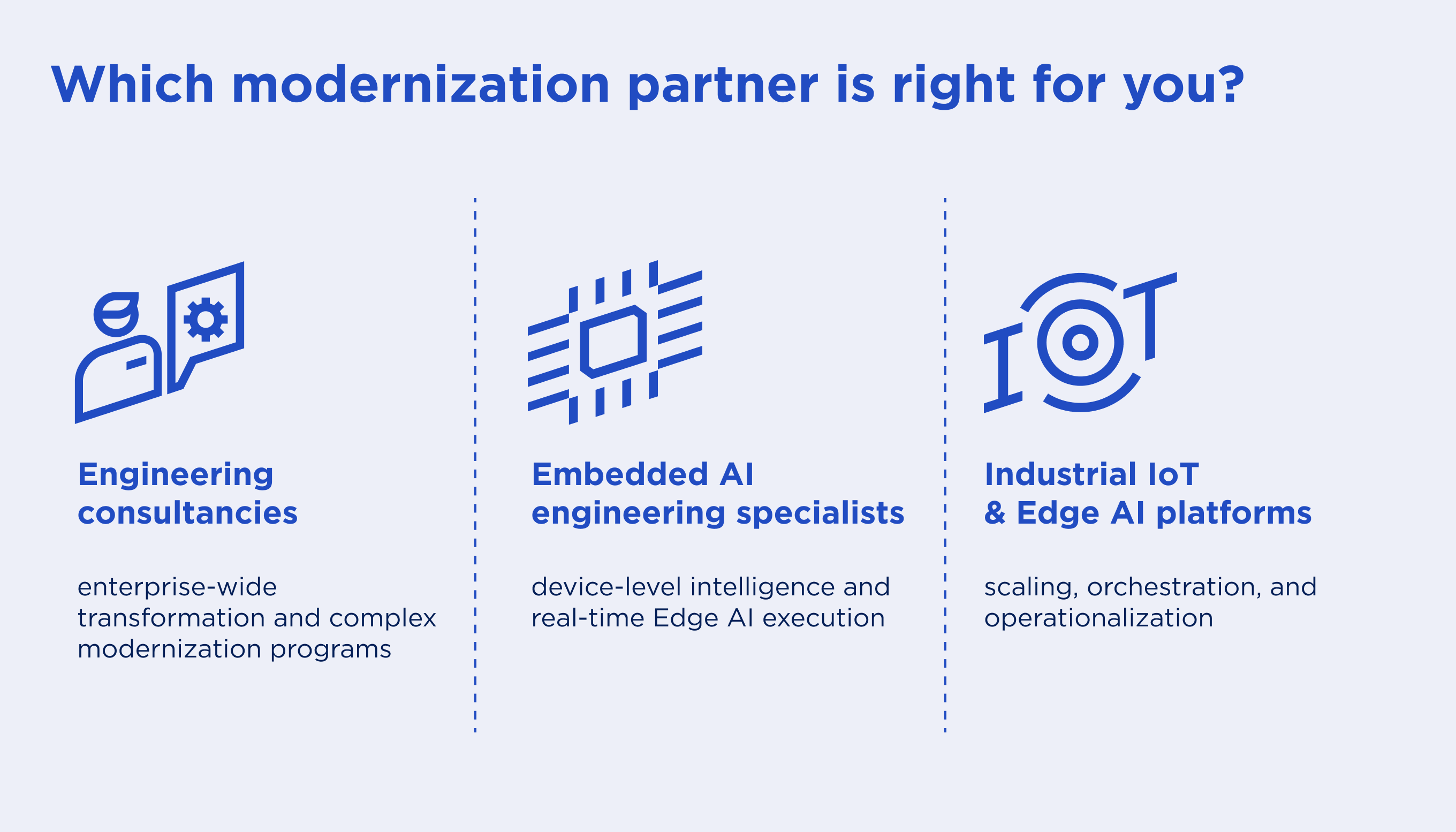
Depending on your company’s needs and modernization stage, you will require a partner that addresses your specific needs, be it an overall transformation strategy, embedded AI system engineering, or an IoT platform integration. Therefore, we differentiated three key vendor groups that help industrial companies transform their legacy systems with edge AI.
Engineering consultancies
Technology consultancies are most valuable at the early and mid stages of industrial AI and edge transformation, when strategic clarity matters more than immediate implementation. Advisory firms help organizations define a clear roadmap, evaluate vendors, or decide between architectural options such as edge vs. cloud processing. Their services are particularly relevant for SMEs and mid-sized enterprises that want to avoid costly trial-and-error in technology adoption.
- IBM: Large-scale modernization initiatives
- West Monroe: Strategy for data-driven transformations
- Lemberg Solutions: Complete architectural and implementation roadmap
- ARC Advisory Group: Technology and vendor selection
Embedded AI engineering partners
The right embedded engineering specialists will help you deal with the technical complexities of industrial modernization, such as training AI models on constrained hardware, optimizing firmware, or enabling real-time processing directly on industrial devices. They excel in translating ML algorithms into efficient, production-grade implementations that work within the limits of MCU, power, and latency constraints. Address them for use cases like integrating predictive maintenance sensors, vision systems, or autonomous edge control, where performance and reliability are non-negotiable.
- Lemberg Solutions: Hands-on embedded engineering and AI adoption
- Xcelacore: Custom AI implementations
- LeewayHertz: Quick prototyping and concept validation
- LeafLabs: Firmware and electrical engineering for robotic applications
Industrial IoT & edge AI platform vendors
When Edge AI solutions start moving beyond pilots, companies need platforms to manage data flows, devices, and models across distributed environments. Edge AI platform vendors enable smooth connectivity, edge orchestration, and integration with the cloud for analytics and lifecycle management. This is particularly valuable for scaling that requires standardizing deployments across multiple sites and ensuring interoperability between systems.
- PTC: End-to-end production automation
- IBM: AI-powered monitoring, predictive maintenance, and reliability planning
- Edge Impulse: AI model deployment on edge devices
- Klyff: Manufacturing-focused edge MLOps
Selecting the right edge AI partner for industrial projects
When selecting an edge AI partner, it’s important to understand how well a vendor will align with your operational setting, risk tolerance, and long-term modernization strategy. Treat partner selection as a due diligence process focused on fit: technical, organizational, and economic. In this section, we suggest aspects to consider and questions you can ask at the research stage.
Proven experience in environments similar to yours. Industrial edge AI projects are highly context-dependent: what works in automotive manufacturing may fail in energy or logistics due to different latency, safety, and compliance requirements. Make sure you find out:
- Can the company demonstrate delivered projects in comparable conditions?
- What physical and environmental constraints have they handled?
- What measurable outcomes did they achieve?
Ability to ensure cybersecurity and compliance. When introducing connected devices into your legacy system, you are expanding your digital attack surface directly into the physical infrastructure. But reliable vendors know how to secure it. To check if they can, ask:
- How do they enforce network segmentation between your OT floor and IT cloud environments?
- How do they ensure that your solution aligns with hardware and AI compliance frameworks, such as ISA/IEC 62443 or the NIST AI Risk Management Framework (AI RMF)?
- How would the vendor prevent AI models from reverse-engineering or extracting the local data in case of a physical intrusion?
End-to-end accountability. Many vendors are strong in isolated layers, for instance, device, platform, or cloud, but they are reluctant to step up when dependencies span across the entire system. To make responsibility boundaries clear, ask them:
- Where do they take full responsibility, and where do they rely on third parties?
- How do they handle failures in the edge-to-cloud journey?
- How does the company transition day-to-day monitoring to your internal team?
Approach to scalability and lifecycle management. Industrial assets live for decades; models and software change constantly. Look for vendors that can build a solution that can work smoothly both in a pilot and when replicated across assets. Questions to ask:
- How will they monitor for model drift and deliver updates without stopping production?
- What tooling does their team use to support large-scale deployments?
- How do they handle cases when an OTA firmware or model update fails mid-transmission to an edge device?
Ecosystem flexibility. To ensure standardization and enable smooth scaling, your modernization partner must be able to work across diverse protocols, smart industrial hardware, and platforms. Make sure you learn:
- How do they handle vendor lock-in risks?
- How much of edge architecture will remain reusable if you decide to migrate your cloud infrastructure?
- Do they build on top of proprietary middleware or leverage open-source frameworks?
Project management. Edge AI initiatives require close collaboration between IT, OT, and data teams, so the partner must be able to operate across these boundaries, especially if this will involve your in-house teams. Ask them:
- How do they arrange cross-functional and cross-team collaboration?
- How would they adapt software development sprints to your rigid downtime windows or safety constraints?
- What is their escalation and decision-making process during critical incidents?

What is important for successful modernization with edge AI?
Edge AI drives real-time efficiency in industrial environments, also enhancing security and reducing costs. If you’ve decided to become one of those companies that are already getting value from implementing the technology on site, remember these three success drivers:
- A clear goal. Start with the problem, not the technology. A defined objective reveals the right use cases, which then drive data architecture, security, integrations, and success metrics.
- Phased roadmap. No need to overhaul what you already have. Introduce edge AI incrementally, starting with small but high-impact pilots that prove ROI early, moving on to scaling confirmed initiatives.
- The right partner. Choose one that fits your profile — no overpaying for unused capabilities, but with the expertise to handle your specific customization and technical needs.
In the context of industrial edge AI, engineering and consultancy partners like Lemberg Solutions stand out by having domain expertise, both in edge AI and embedded engineering for mission-critical systems. Our clients leverage such experience to get better risk analysis, understand potential pitfalls, receive more accurate estimations, navigate industry standards, and use the most relevant technologies.


