Powering an EV charging station with OCPP-compliant intelligent control software
About the client
EDS is a manufacturing and investment company focused on four key areas: Energy, Manufacturing, Construction, and eMobility. They have extensive expertise in constructing energy facilities, electrical equipment, and charging stations.


The challenge
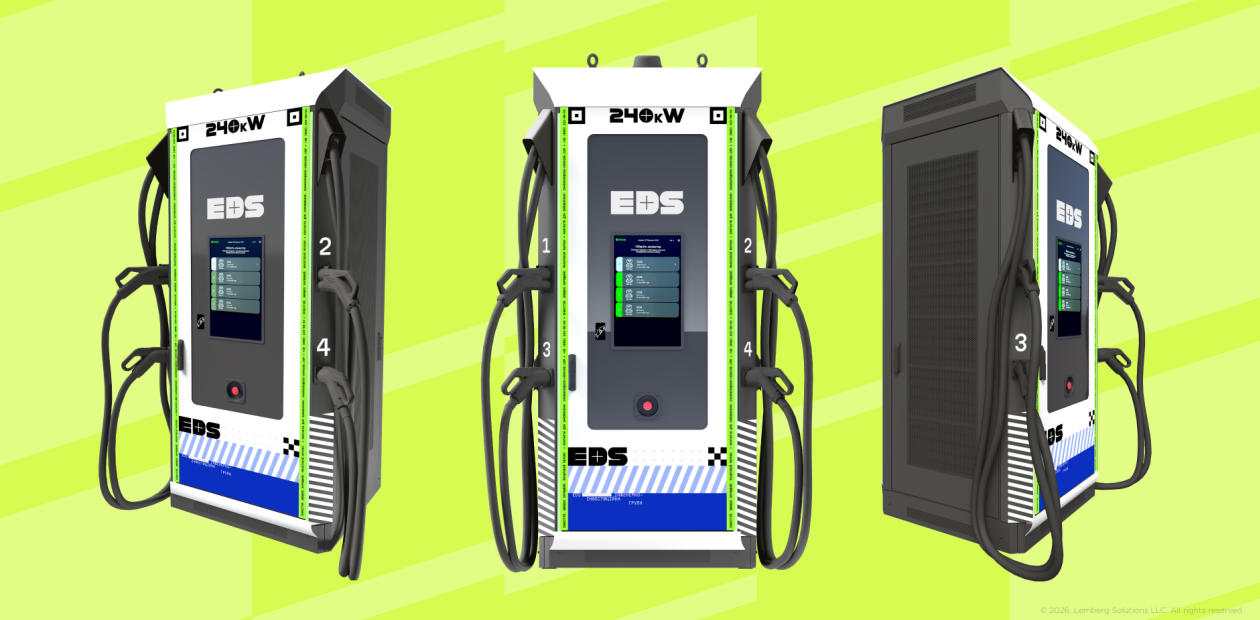
At the core of this project was an electric vehicle charging system, EDS Q360, one of the most powerful on the market. Delivering up to 360 kW of power, it can fully charge up to 4 vehicles in less than 30 minutes. To offer a more intuitive experience for users, the client initially requested to develop software for a human-machine interface (HMI).
However, during the discovery phase, it became clear that the solution had to do much more than provide a user interface. Instead, the client needed software that would act as an intelligent control layer, сoordinating communication between the vehicle and the charging controllers.
Delivered value

Solution

Beyond the typical HMI capabilities, the charging station required a software layer to orchestrate communication among its components. After designing a solution architecture, we selected a proper communication controller from commercially available options, which in turn, accelerated product delivery.
Our team also built a software application and hardware setup that emulates the power controller, enabling engineers to validate the solution without a real physical charging station or electric vehicle.
- OCPP implementation
The station has a multi-connector OCPP architecture, where each charging connector operates as an independent OCPP client with its own configuration and data storage. This enables a single charging station to connect to different charging management platforms simultaneously, while meeting compliance requirements, like AFIR.
- Dynamic load management
Together with the EDS team, we also developed a new Dynamic Load Management (DLM) system. In real time, it decides how to split electrical power among active charging sessions based on demand. Vehicles can be charged simultaneously, while the system controls energy efficiency.
- Web portal for EV charging station management
A dedicated web-based management portal gives the EDS team a centralized and advanced analytics dashboard. EDS operators can monitor charging sessions, energy consumption, charging trends, and failed sessions with the possibility to filter by year.
For faster incident response, the portal has a real-time alert system that continuously monitors station health, automatically detects issues, prioritizes them by severity, and notifies operators.
- Firmware updates with minimized downtime
The firmware packages are downloaded in the background while the charging station remains active until the final installation stage. Operators can remotely schedule updates, deploy selected software components, or roll back to a previous firmware version if needed.
- Operational stability
By analyzing charging scenarios, we continuously refine the software functionality. For example, during Internet outages or power interruptions, the station safely handles charging; once connectivity is back, all data is automatically synchronized with the backend.
The station also has emergency stop logic that supports an advanced emergency system. It has a 90-minute validation process before resuming operation, depending on the state of the charging connectors. By correctly handling scenarios of complete power loss, this system helps maintain safe and reliable operation of the charging station.
Lemberg Solutions developed, tested, and implemented the software project for fast charging stations within short timeframes. They demonstrated excellent problem-solving skills throughout the development and testing process. The Lemberg Solutions team provided professional support at each project stage — research, supplier selection, UI/UX design, and engineering. We enjoyed smooth communication and efficient collaboration with Lemberg Solutions. The LS team delivered our project on time, both on the software and hardware levels.

How it works