

Sensor fusion is the process of combining data from several sensors into a unified and more accurate representation of the world than a single sensor can provide. It is more accurate, indeed, but as engineering teams work with multi-sensor systems, they often face the same issue: devices work perfectly on the test bench but perform worse in the field. Is the algorithm flawed?
This article explores all aspects involved in fusion design, from data preprocessing and synchronization to algorithm selection, compute allocation, deployment model, and sensor failure handling.
What is sensor fusion and what is it for?
Sensor fusion allows a device to estimate its environment more accurately than it could with a single sensor, making its operation safer and more reliable.
Each sensor alone has strengths and limitations: a camera captures visual detail but struggles in darkness; radar measures distance and speed even in fog but can’t classify an object; an IMU tracks movement but its readings drift over time. By putting their outputs together, embedded systems engineering specialists compensate for individual weaknesses.
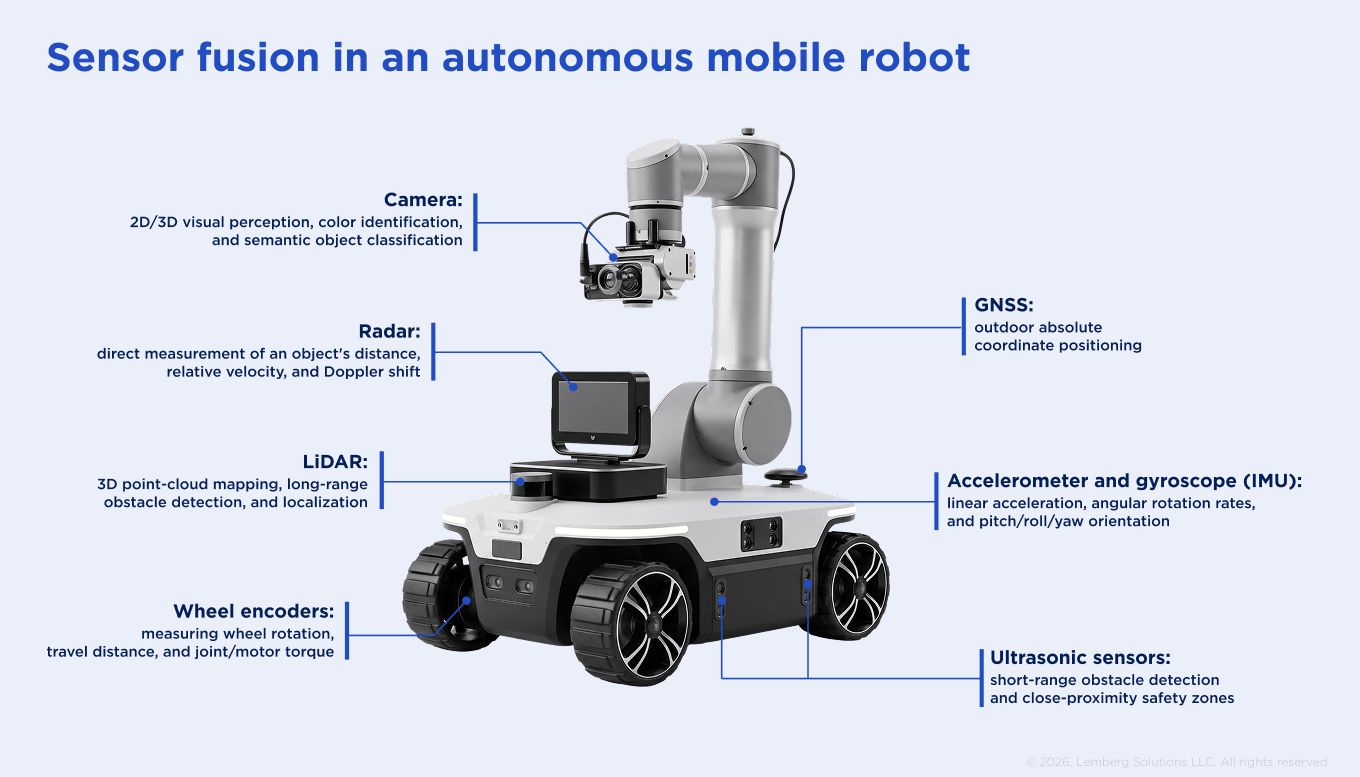
Consider an industrial robot that has to insert a gear shaft into a gearbox housing. It combines data from joint encoders, a wrist force-torque sensor, and a 3D vision camera. Joint encoders track motor angles, force-torque sensors provide tactile feedback, and the camera helps the robot locate the hole. Each sensor contributes different information, allowing the system to execute a high-precision assembly task.
What is the difference between sensor fusion and data fusion? Sensor fusion technology is a form of data fusion. Data fusion is the broader concept, embracing information from different sources, including sensors, databases, and logs. Sensor fusion centers around physical sensor measurements.
Why does sensor fusion fail without data preprocessing?
The quality of the result depends not only on the sensors or the fusion algorithm but also on whether the input data accurately represents the system’s operating conditions.
Take an autonomous mobile robot (AMR). To navigate the environment, it relies on visual references from the front-facing camera and acceleration between frames measured by the IMU. Camera images may get distorted because of glare or poor lighting. Small real-life noises like vibrations from floors and changing lighting may cause IMU readings to misalign in time. The fusion algorithm performs incorrect calculations, and the robot loses orientation or drifts away from its intended route. This example shows that every step of the data flow matters, not just the algorithm.
Since imperfections and misalignments in data streams are common in production use, make sure to include this step in your development process. Here are some techniques you can use:
- Data cleaning is applied to filter noise, remove corrupted measurements, handle missing readings, and correct sensor-specific errors.
- Data normalization makes different data streams compatible through converting units, aligning coordinate systems, calibrating sensors, and resampling measurements to a common temporal reference.
- Data synchronization helps adjust different sampling rates and ensure that measurements from different sensors correspond to the same point in time or the same event.
- Feature extraction converts raw measurements into more suitable representations (e.g., exact object position from an entire image) to reduce the amount of raw data to process.
- Data validation establishes if incoming measurements are sufficient or reliable enough for further processing. There are specialized sensor status and signal strength checks, confidence indicators, and uncertainty estimates.
When developing a device for animal weighing with computer vision, it was important to ensure it is held strictly parallel to the surface. This required a preprocessing pipeline that fused kinematic data with spatial camera streams. It included data synchronization in time, noise reduction, and depth measurement correction.

How to avoid the sensor synchronization bottleneck?
Because different sensors provide readings at different rates, synchronized sensor data fusion is achieved through hardware and/or software adjustments.
Three approaches to sensor synchronization
To align sensor data streams in time, consider including a synchronization mechanism in the system architecture. Depending on the data type, use case, and resource constraints, you might need:
- Hardware triggering: A shared electrical trigger starts the data capture — the best option for precise alignment in high-speed robotics or camera–LiDAR fusion.
- Network time synchronization: When sensors communicate over Ethernet and need a shared time base, special protocols, such as Precision Time Protocol (PTP), can help align clocks across the devices. For example, working on an industrial exoskeleton project, our team had to organize data collection and processing from various sensors in real time, without delays and conflicts. Lemberg Solutions addressed this by connecting the boards through a single communication protocol.
- Software timestamps: Drivers or applications timestamp measurements as they arrive. It’s the cheapest but the least reliable option. Scheduling delays, buffering, and operating-system jitter can make arrival time differ from the actual capture time.
Note: Synchronization alone doesn’t solve the timing problem. Teams have to factor in the time allowed between an event and response — a latency budget. It should cover sensor capture, data transfer, preprocessing, fusion, AI inference, and the control response.
What are the different types of sensor fusion algorithms, and when should you use each?
Choose a sensor fusion approach based on synchronization quality, compute resources, required accuracy, and how the product must behave when a sensor becomes unavailable. The most advanced algorithm is not necessarily the best fit for a device with strict power, cost, or safety constraints.
| Approach | When it fits | Compute cost | Sensitivity to sync errors | Example product |
|---|---|---|---|---|
| Complementary filters | Stable estimates from lightweight sensor inputs | Low | Low to moderate, depends on implementation | Wearable orientation tracking |
| Kalman filters | Tracking position, motion, or changing system states | Low to moderate, depending on the model | Moderate to high if inputs are poorly aligned | Mobile robot localization |
| Early fusion | Joint interpretation of raw or low-level sensor data | High | High | Camera–radar perception |
| Late fusion | Combining independently generated detections or estimates | Moderate | Moderate; association still requires valid timing | Camera–radar object tracking |
| AI-based fusion | Complex multimodal perception with suitable training data and AI hardware | Moderate to high | Depends on architecture and training | Edge AI robotics or autonomous systems |
Complementary filters: simple and efficient
If your system relies on microcontrollers with limited processing power, a complementary filter is a computationally efficient option. It combines different sensor measurements, compensating for each sensor's weaknesses with another sensor's strengths.
For example, a wearable device collects gyroscope readings, which respond quickly to movement but drift over time, and accelerometer readings, which provide a longer-term reference but are affected by motion and vibration. The result is a more stable orientation estimate without requiring a resource-intensive model.
Kalman filters and their variants: tracking over time
Kalman filters and their variations are useful when a system must continuously estimate an object's position, velocity, or the device's own motion. Their distinctive feature is taking into account the expected uncertainty of different inputs. So these filters analyze sensor readings on the go and update the evaluation based on sensor uncertainty every time new measurements come in.
To estimate movement, a mobile robot relies on IMU measurements with wheel encoders, GNSS, and other position sensors. The Kalman filter will prioritize the most reliable measurements at the moment and update its estimate as new data arrives.
Early fusion vs. late fusion: choose where data comes together
Early and late fusion differ by when in the processing pipeline sensor information combines. The choice depends on synchronization requirements, compute load, and the need to keep operating when one sensor becomes unreliable.
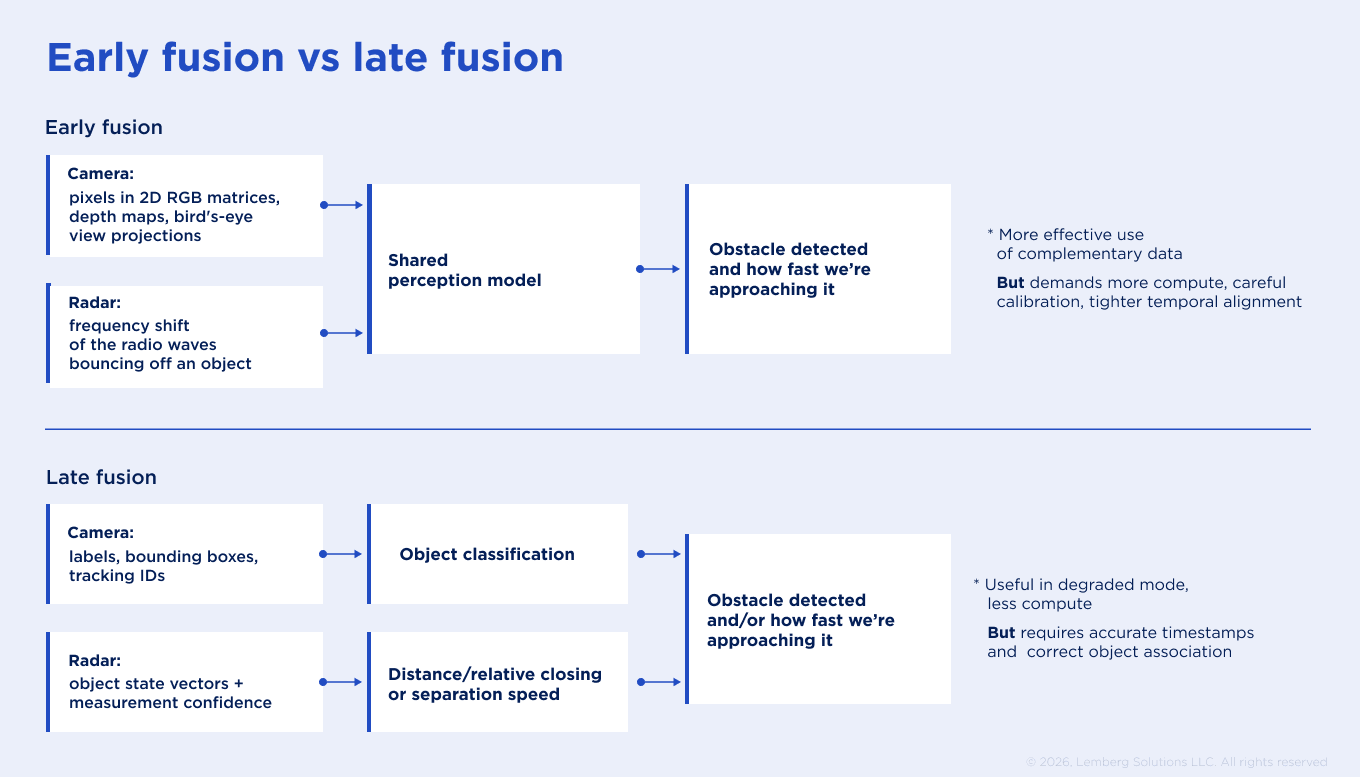
With early fusion, the system combines raw or low-level sensor data before higher-level interpretation. Thus, in camera–radar sensor fusion, visual features and radar measurements go directly to a shared perception model. It can improve how the system exploits complementary information but demands more compute, careful calibration, and tighter temporal alignment.
In late fusion, each sensor is processed independently first, then the system combines the resulting detections or estimates. For example, a camera classifies an object while radar estimates its distance and speed; the fusion stage then merges the results. This approach is often easier to operate in degraded mode because one sensor's processing pipeline can continue when another fails. However, it does not eliminate the need for accurate timestamps and correct object association.
AI-based fusion: useful when the data justifies it
AI-based multi-sensor fusion uses neural networks to combine multimodal inputs or features. It can be valuable for complex perception tasks where relationships between camera, LiDAR, radar, audio, or other signals are difficult to capture with deterministic rules. However, it usually requires representative labeled training data, suitable acceleration hardware, and more extensive validation.
Teams often overlook whether the data used to develop and validate a sensor fusion model reflects the conditions in which the product will actually operate. For instance, industrial machines operate under varying loads, temperatures, rotational speeds. If the vibration monitoring model was trained on measurements from a lab test bench, it may fail to recognize actual equipment behavior in production.
Therefore, data collection and preparation should account for the intended use cases, environmental conditions, sensor limitations, and expected variations in operation.
For certification-heavy or safety-critical products, an AI model may need to operate alongside a conventional estimation or monitoring layer. A classical filter can provide a reference or help detect implausible outputs, but it is not automatically a safety guarantee; the complete architecture still requires appropriate verification and validation with edge AI development experts.
How much compute does sensor fusion need on an edge device?
A sensor fusion edge computer must meet the compute, memory, thermal, and power budgets for the full processing pipeline. Sensor fusion, data preprocessing, and AI inference compete for the same resources, so we recommend selecting the chip along with the algorithm.
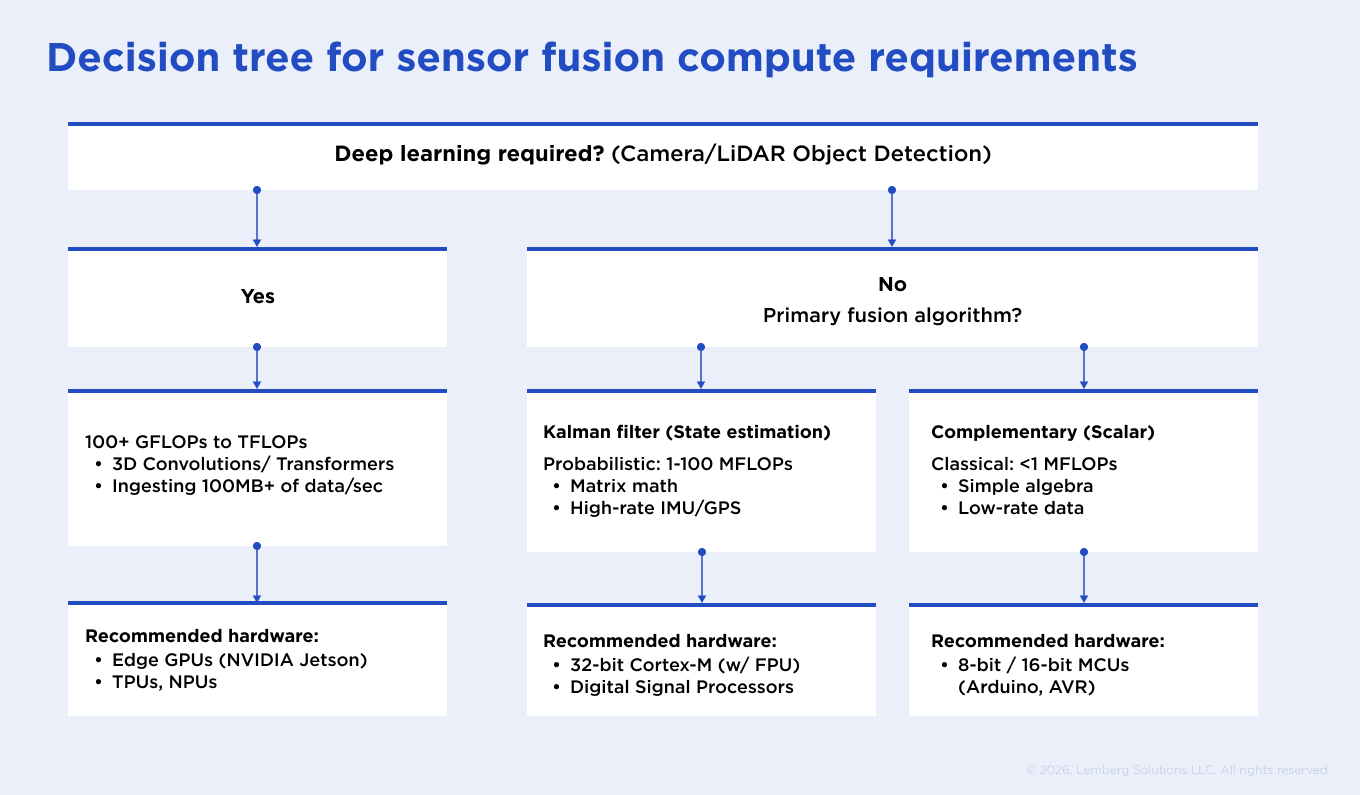
The processor choice depends on the type and intensity of the computation. To understand yours, start by identifying where the processing load comes from and its volume. For instance, raw camera images and LiDAR point clouds generate large volumes of data. Meanwhile, IMU measurements and many environmental sensor readings are comparatively lightweight.
Then, you will see which hardware can handle your data loads:
- An MCU is often sufficient for filter-based fusion involving lightweight inputs like IMUs or temperature sensors.
- A digital signal processor (DSP) efficiently handles high-rate signal processing.
- FPGA will support deterministic parallel processing, custom data pipelines, or bridging between interfaces.
- Application processors (MPUs) and single-board computers (SBCs) run full operating systems and can handle sensor acquisition along with moderate on-device ML inference without dedicated AI accelerators. For example, when developing a predictive maintenance solution for Senzoro that relied on ultrasonic sensors, our team selected a Raspberry Pi 4. It made a good foundation for cost-efficient hardware design and provided sufficient compute for stable on-device inference and precise signal acquisition.
- Advanced fusion that feeds a demanding vision or deep-learning model may need a GPU- or NPU-equipped platform, like NVIDIA Jetson-class devices.
Also, consider memory bandwidth, available interfaces, thermal conditions, startup time, and production cost — not just peak processing performance.
On the other hand, processing every measurement at the maximum sensor rate is not always necessary. Think which data rate your application actually requires. For computer vision, you can preprocess your images and extract just relevant features, not process every pixel. This way, you will reduce the load without compromising the product's required performance. But remember to evaluate these optimizations against your detection accuracy and response time needs.
This is why edge AI hardware selection should start with the actual workload and product constraints rather than a processor benchmark alone. Lemberg Solutions' embedded AI development services cover the integration of embedded hardware, sensor processing, AI inference, and edge-to-cloud components.
Should sensor fusion run on the edge or in the cloud?
When we speak of edge systems, fusion most often has to happen directly on the device as it drives a real-time response: maneuvering around an obstacle, stopping an action, or adjusting a robotic arm. Local data processing has minimal latency and doesn’t require network connectivity to perform a task. Therefore, time-critical sensor fusion has to run on the device, while the cloud is good for tasks such as fleet analytics, model improvement, and centralized monitoring.
| Factor | On-device | Hybrid edge-cloud | Cloud-based fusion |
|---|---|---|---|
| Latency | Low; avoids network round trips | Low for local decisions; higher for cloud-dependent tasks | Network-dependent and potentially variable |
| Connectivity dependence | Low | Moderate; local functions can continue offline | High |
| Data privacy | Raw data can remain local | Selected data can be shared | Often requires transmitting sensor data |
| Compute cost | More processing capacity needed on each device | Processing distributed between edge and cloud | More centralized compute, plus network costs |
| Update path | Device-level firmware and model updates | Local operation with centrally managed updates | Centralized processing and model updates |
What should stay on the device?
Keep the processing local when the system must respond within milliseconds or continue operating without an internet connection. Also, raw sensor streams may be too large, expensive to transmit, or sensitive to upload to the cloud continuously.
For example, a robot detects an obstacle and stops immediately without contacting a remote server. Similarly, an industrial monitoring device must identify a fault condition and trigger a response even if the plant temporarily loses external network connection.
What belongs in the cloud?
The cloud is useful for work that benefits from aggregation across devices or does not need to happen in the immediate control loop. This includes fleet-wide performance analysis, reviewing unusual cases, collecting selected data for model retraining, managing device health, and distributing validated model updates over the air.
When to go hybrid?
A hybrid architecture combines local autonomy with centralized improvement. Edge devices make time-critical decisions, while the cloud helps engineers identify trends, compare equipment, and improve future model versions. When the connection drops, the system can continue local fusion and queue noncritical data for later synchronization.
The hybrid approach is a practical compromise for many connected products, but the right choice still depends on the consequences of network failure, the volume of sensor data, privacy requirements, and lifecycle costs. In our article comparing edge AI and cloud AI architectures, you can learn more about the limitations of purely edge or cloud approaches and how hybrid architecture can solve them.
How does sensor fusion handle sensor failure?
If one of the sensors in a multi-sensor system suddenly becomes unreliable, there must be a mechanism in place that continuously assesses how much it can trust each sensor and degrades it gracefully.
The failure detection methods and fallback actions in the table below are only example design options, not universal solutions. They must be adapted to the sensor technology, operating environment, and product risk assessment.
| Failure | How it shows up | How the system detects it | Possible fallback |
|---|---|---|---|
| Dropout | No new readings arrive | Timeout, missing samples, communication diagnostics | Use remaining sensors; alert the operator |
| Drift | Readings gradually diverge from expected values | Reference checks, consistency tests, trend monitoring | Reduce sensor weight; recalibrate if appropriate |
| Noise | Readings fluctuate excessively | Signal-quality metrics, variance checks, plausibility limits | Filter the signal or rely more on other sensors |
| Blinding | A sensor becomes ineffective in its environment | Image-quality checks, signal-strength monitoring, cross-sensor disagreement | Rely on complementary sensors; limit affected functions |
| Timestamp error | Measurements contradict one another in time | Clock-offset monitoring, timestamp validation, alignment checks | Reject or realign invalid data; enter a degraded mode if needed |
Considering possible risks and ways to prevent them should be a must-have stage of embedded development, as these systems physically interact with their environment. To increase sensor fusion reliability, engineers leverage sensor uncertainty indicators, build with redundancy, and weave fallback mechanisms into the system architecture.
Confidence: know when a sensor can no longer be trusted
Sensor readings should be evaluated alongside information about their quality, uncertainty, and age. A camera image affected by glare, for example, may be less useful for object classification than a clear image. Similarly, an IMU exposed to excessive vibration may produce measurements that are less reliable than expected.
The fusion logic should react to these changes. It can reduce the influence of a sensor whose confidence drops, reject invalid or stale measurements, or flag a disagreement between sensors for further evaluation. Confidence scores alone are not enough: they must be calibrated and tested against actual failure conditions.
Redundancy: add sensors where failure is costly
Redundancy allows a system to cross-check measurements and continue operating when one input becomes unavailable. A camera and radar covering the same area provide complementary evidence about an object's presence and movement. If the camera becomes unreliable, radar may still provide useful distance and velocity information.
It’s worth remembering, though, that redundant sensors add hardware costs, power consumption, integration effort, and software complexity. They make sense for systems where a wrong decision has serious consequences or where uninterrupted operation is a business requirement.
Failure handling: define the fallback before deployment
Every important sensor failure should have a documented response flow. Depending on the product, the system may switch to remaining sensors, reduce functionality, alert the operator, or transition to a safe state. The appropriate response depends on the risk associated with losing that information.
Let’s look at some examples.
Consider an advanced driver-assistance system (ADAS) sensor fusion in an autonomous vehicle. First, it is a safety-critical system. Second, its operating conditions change often: heavy rain, dirt, or glare may impair some sensors. In such cases, sensor redundancy is the best approach to increase reliability. Also, Certain features may remain limited until performance returns to normal.
In industrial contexts, an assembly robot may slow down or stop when position estimates become unreliable. A medical wearable may flag low-quality measurements rather than display a misleading result. A monitoring device may continue with reduced diagnostic confidence while alerting maintenance staff to a sensor fault. For safety-critical products, failure handling should be verified under realistic conditions, including intermittent faults and combinations of degraded inputs.

Conclusion
Sensor fusion reliability depends on multiple factors: data sync, affordable latency, compute and power resources, an appropriate fusion algorithm, and possible failure scenarios. The best approach, therefore, is to design sensor fusion as part of the complete embedded product, bringing together sensor selection, hardware, firmware, AI, and cloud integration from the beginning.
A well-considered architecture will balance the product’s intended use, available resources, and technical constraints. Thus, a lightweight filter on an MCU may be ideal for a wearable, while a robotic or automotive perception system may require hardware-assisted synchronization, higher-performance compute, and more advanced fusion methods.
For CTOs and product leads, the key decision is how to balance business needs against the product's performance, cost, and safety requirements. On a case-by-case basis, Lemberg Solutions’ system architects and regulations experts help product manufacturers evaluate embedded projects already at the discovery stage and design reliable yet cost-efficient architectures.


