


The long-term prevalence of cloud-based architecture is now overshadowed by rising costs for AI workloads. Meanwhile, edge computing becomes more and more attractive. Not only because of its cost-efficiency but also because of its ability to handle real-time responses, data privacy, and stability in unreliable environments.
What are the most common edge AI use cases for different industries? What factors influence development costs, and what key considerations should organizations keep in mind when implementing edge-based solutions? Read about it in our article.
When edge AI becomes a business requirement (and not just an architectural choice)
The moment when businesses realize that speed, uptime, and data security matter for their AI solutions marks the turning point toward preferring the edge approach. By analyzing data at the source, edge computing delivers value in scenarios where cloud computing falls short. One of the biggest drawbacks of cloud-based architectures is that data must travel from the device to the cloud and back again, which can limit real-time performance. However, there are more cases when the edge approach becomes the preferred choice.
Discover the key differences between edge AI and cloud AI, and which one is right for your business.
When latency becomes a bottleneck
For systems that must react instantly to changing conditions, edge computing is the best fit. By handling data processing directly on the device, you gain real-time analytics capabilities, therefore avoiding critical time-sensitive issues such as operational failures or life-threatening risks.
When the system must operate without connectivity
Remote industrial sites, moving vehicles, rural farms, or any other spaces where connectivity is unreliable or even unavailable are not well-suited for cloud-based AI systems. Regardless of network conditions, edge-based systems continue to maintain stable performance.
When cloud costs outgrow business value
A single sensor can generate a high amount of data daily. When multiple sensors are used, streaming and processing all the data in the cloud significantly increases business expenses. With the edge approach, businesses invest once in properly fitted hardware where all inference will happen, and then data processing costs practically nothing.
When data cannot leave the premises
In many industries, sending data to a third-party cloud service can lead to potential leakage. Edge-based systems keep sensitive data secure by default: raw data never leaves the device, and processing happens locally. If needed, the final results can be shared with external systems.

Edge AI cases by business goals
Edge computing allows businesses to resolve some of their most critical operational challenges. Particularly those that affect speed, efficiency, and system responsiveness. Check out where edge AI can bring you the most value.
Reduce downtime & maintenance costs
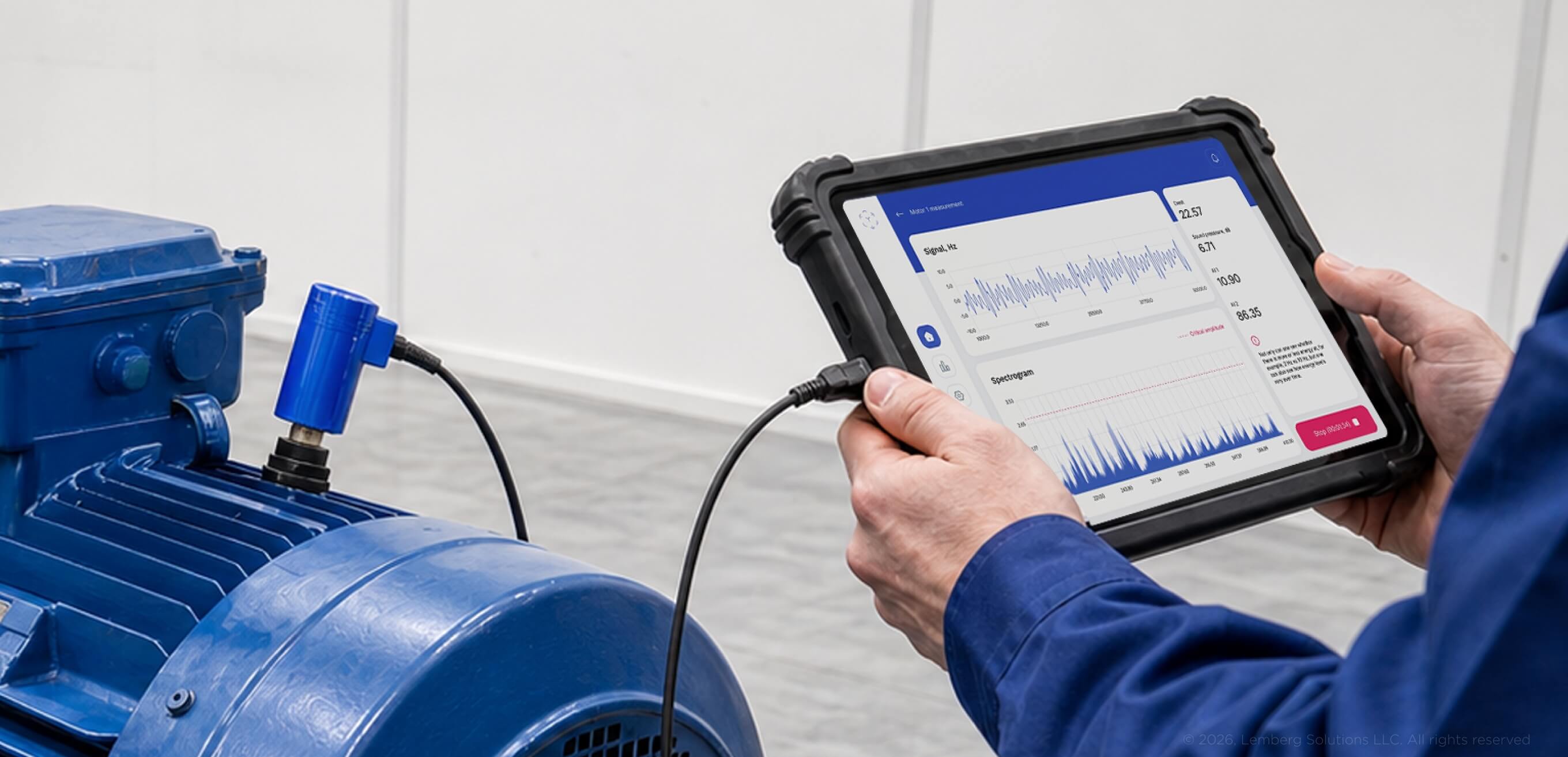
The world’s biggest companies lose around $1.4 trillion because of unplanned equipment downtime. With edge AI, predictive maintenance solutions can process the sensor data directly on the machinery. This allows operators to get alerts about potential degradation and analysis of machinery performance on their dashboards.
One of the edge AI use cases Lemberg Solutions worked on was a rolling bearing predictive maintenance solution for industrial settings. Our team handled the system design, selecting components that collect clear ultrasonic data from sensors. The aim of the solution is to convert these signals into a digital format suitable for further processing by an AI model. As a result, machinery operators can track remaining useful life estimates to prevent downtime and avoid costly unplanned replacements.
Real-time monitoring & safety
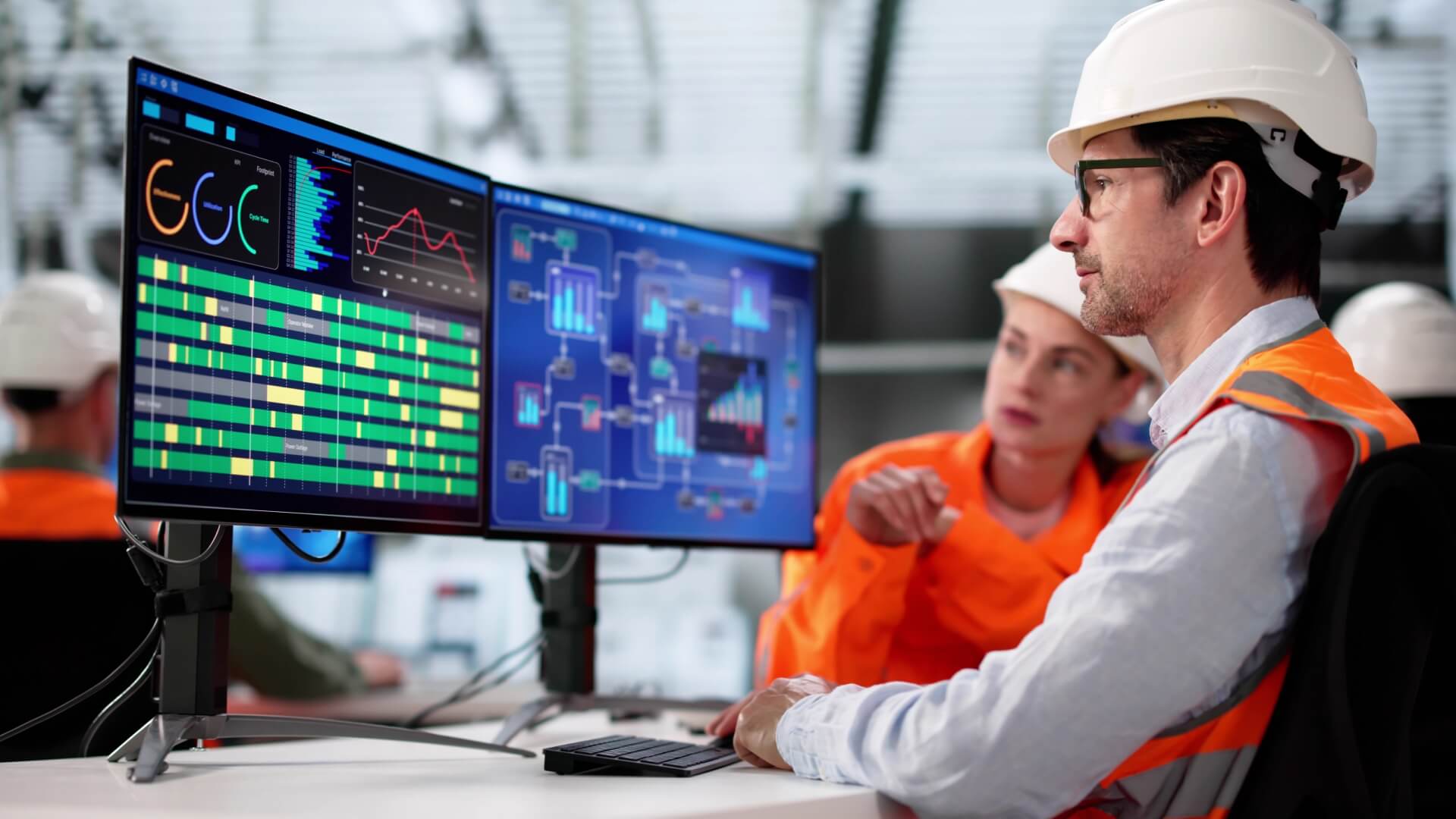
Healthcare, automotive, agriculture, and energy — these industries often demand visibility into what happens right now with people and the environment. Edge AI continuously processes incoming data, detecting the current state and deviations in real time, whether they involve a patient’s vital signs or security threats. In safety-critical situations, edge AI systems can trigger alerts or even autonomously activate safety protocols to either stop machinery or inform the user to take appropriate measures.
For example, an IoT gateway device, one of our projects, allows continuous monitoring of patient health and symptom progression. To make this solution effective, the Lemberg Solutions team programmed an AI algorithm to filter and process only medically useful audio. Once the system has gathered all insights, it sends them to the web portal, where doctors have a comprehensive overview of the patient's condition. This telemedicine solution supports healthcare workers in making accurate diagnoses and providing proper treatment.

Operational efficiency
Most edge AI examples show: many manual tasks that slow down operational efficiency can be easily automated. By taking pressure off human workers, such automation can support them in decision-making, improve quality control, and optimize operational speed and accuracy.
For instance, in agriculture, many tasks still rely on manual labor, especially weighing animals. To automate this process for pig farms, Lemberg Solutions developed a computer-vision edge AI solution. Instead of spending a lot of time moving animals to scales, workers can do their job up to 24 times faster by simply capturing the weight with a camera. The system instantly provides measurements, even for a moving animal, with up to 98% accuracy. This way, farmers can collect all the necessary data on livestock health, which can help in many business decisions.

Autonomous decision-making
Today, many physical systems demand human supervision to program them on what to do. However, waiting for decisions from a person or a central system can affect the system's safety and performance.
Edge AI enables autonomous physical intelligence by allowing machines to perceive their environment and take real-time actions that fit the situation. Navigating spaces, avoiding obstacles, adjusting operations to changes in the environment — all of that they can do without a human supervisor. With built-in context awareness, robotic systems powered by edge AI can continuously adapt to unstable, unpredictable, and even risky environments. In many hazardous settings, they have already replaced human workers and taken over tasks that require significant physical effort.
Edge AI implementation examples in 2026: By industry and use case
As an edge AI development company with years of delivery experience, Lemberg Solutions identifies the following ways edge AI can be used across different industries.
Manufacturing & industrial IoT
- Predictive maintenance. Edge AI systems analyze sensor data on vibration, visual flaws, thermal, and acoustic signals to detect malfunctions and assess the equipment's performance and condition.
- Quality inspection. With computer vision technology, businesses can more accurately detect flawed items directly on the production floor. From surface imperfections to wrong labels and print checks, AI-based systems empower human workers to validate quality quickly and consistently.
- Worker safety monitoring. At industrial sites equipped with heavy machinery and hazardous materials, safety risks for workers increase. However, the network of cameras and sensors with edge AI analytics allows manufacturers to identify unsafe conditions and intervene in real time to prevent accidents.
- Autonomous robots. These machines can move materials and execute labor-intensive tasks to support human workers. Powered with AI at the edge, robotics systems process their surroundings using onboard sensors to navigate and adjust their mechanisms to specific tasks.
- Factory floor optimization. Edge AI models continuously read sensor data and adjust factory-floor parameters in real time. It allows for optimized resource use: as conditions change, the system adapts instantly.
Energy & utilities
- Smart grid management. Edge AI powers real-time monitoring of grid performance and energy distribution. With its capabilities, an edge AI system can automatically adjust the grid and alert operators when a serious issue arises.
- Load balancing. With edge computing, it is possible to act on real-time consumption patterns directly at the asset. This is the most efficient way to balance supply and demand, preventing energy overloads.
- BESS optimization. By deciding when to store or release energy, edge AI optimizes battery energy storage systems (BESS). This, in turn, allows for more profitable energy arbitrage through real-time pricing analysis.
- Predictive maintenance. Continuous monitoring detects early signs of equipment degradation or failure. Edge AI allows for timely maintenance, reducing downtime and extending asset life.
Transportation & logistics
- Intelligent fleet management. By optimizing routing, monitoring vehicle health, and coordinating fleets in real time, edge AI eliminates latency and powers autonomous decision-making.
- SoC & SoH estimation. To ensure optimal range prediction and a longer battery lifespan, advanced edge AI models can continuously estimate the state of charge and state of health directly in electric vehicle batteries.
- Autonomous & semi-autonomous vehicles. They are the most popular edge AI examples. Edge computing allows vehicles to perceive their environment and make local decisions about driving conditions, without relying on constant connectivity.
- Warehouse & inventory automation. Using servers and sensors, edge AI solutions collect and analyze data on key inventory parameters, such as equipment status and order fulfillment. For logistics, edge computing optimizes operational flow in distribution centers, ensuring all required inventory is in stock and orders are processed quickly.
Healthcare
- Real-time patient monitoring. Heart rate, temperature, oxygen levels, and other sensitive patient data remain on the premises, ensuring not only rapid detection of dangerous conditions but also data security.
- Medical imaging & diagnostics. With computer vision technology, edge AI systems can accurately assist in spotting abnormal states in X-rays, CT scans, and MRIs. Real-time insights, therefore, allow doctors to make more precise diagnoses and treatments.
- Surgical assistance. Operating on the edge, medical robots can perform minimally invasive surgeries. Even if the operating room has no stable connectivity, they can continue the process without risk to patient health.
Consumer electronics
- Wearables. Most smartwatches and fitness trackers are now powered by edge AI. They easily monitor vital signs and general wellness; many of them even detect falls in real time.
- Smart home devices. From voice assistants and access control systems to smart thermostats and pet wellness devices, all these real-world edge AI examples rely on on-device intelligence for instant response times.
- Mobile devices and laptops. On-device AI capabilities allow modern smartphones and laptops to support real-time speech-to-text transcription, facial recognition, and other advanced features. And most importantly, all of these features are totally secured and available offline.
Edge AI implementation examples by project scale
When it comes to the budget for an edge AI project, business owners should understand a key trade-off. While these solutions are often more cost-effective in the long run than cloud-based architectures, they still require a significant upfront investment.
Below is a breakdown of typical budget ranges and what they usually include.
Small-scale edge AI projects with a budget under $50K
For under $50K, you can get a working PoC prototype focused on validating the core logic (a single use case) and whether it can meet your specific demand. Typically, this type of project includes a pre-trained AI model that runs on ready-to-use hardware, deployed on 1 or up to 5 devices. Also, there is a basic user interface or system that streams the results. The main aim of this PoC project is to validate the feasibility and justify further full-scale investment into solution development. As key deliverables, you will get a working prototype, a demo environment, as well as a feasibility report with model accuracy and a recommended architecture.
Mid-scale edge AI systems with a budget of $50K-$100K
Moving from a prototype to a more mature system that can run reliably in real-world conditions requires more investment. Usually, it takes up to $100K to refine the AI model and the software architecture in a few iterations and optimize its performance for proper deployment on target hardware.
Still, the deployment is limited to a considerably small number of devices — from 10 to 50. At this stage, an edge AI system typically supports device authentication, secure boot, OTA updates, and telemetry data collection for monitoring. It can also be integrated with your operational systems, like ERP or SCADA, so that all generated insights can be visualized directly there. Deliverables here typically include the deployment of the system into production, a monitoring dashboard, and remote device management capabilities. Alongside this, most vendors also provide complete documentation and training to support ongoing operation and maintenance.
Large-scale edge AI deployments with a budget exceeding $100K
With over $100K of budget, your edge AI system becomes a compliant, production-ready solution built for scale and long-term operation. Everything, from hardware and software architecture to AI model design, is custom-engineered to meet the requirements of your enterprise end-customers. This includes adapting to different types of hardware and complying with industry standards and requirements. It covers ensuring audit logs, passing cybersecurity reviews, and aligning with procurement requirements. At this level, an edge AI solution is built to be deployed across hundreds of devices, managed centrally, and integrated across multiple operational systems. Also, the system supports edge MLOps, including automated model retraining, safe rollout, or rollback of updates.
How to make edge AI systems work: Key implementation advice
The principle behind edge AI systems is simple. Sensors collect data, which is instantly processed by an AI model either on or near the device where it is generated. The user gets instant insights, and sometimes devices can automatically adjust their operations without human input. However, to make it all work seamlessly, consider the following recommendations.
Choosing the right inference architecture
One of the most critical decisions in any edge AI project is where AI processing should take place. Usually, the most common approach is on-device inference. It is the right choice when decisions must be made instantly and without relying on connectivity. For example, instant object detection on cameras, safety-critical industrial monitoring, or medical wearables. Because when the model is small and efficient, it can keep inference on-device, minimize latency, and maximize privacy.
However, AI algorithms can also run on gateways.
For example, a gateway can be placed between many devices, like sensors or microcontrollers, and the broader network. Instead of hundreds of sensors sending raw data to the cloud, the gateway runs a light model to detect anomalies, alerting the system when something is wrong. Basically, its aim is to decide what is critical to pay attention to and not to perform deep data analysis. The most common application areas are smart homes, retail stores, and factory floors.
Apart from that, AI algorithms can run on edge servers.
This approach is suitable for compute-intensive tasks that process large volumes of data and require data security. An on-site edge server provides cloud-like power while keeping data within the building’s walls. This approach is commonly used in highly regulated industries, where data leakage can lead to serious issues.
Building a proper dataset for model training
Reliable edge AI performance depends on data quality and its representativeness. If the training data doesn’t reflect condition variability, the edge AI system can fail when it encounters an unfamiliar scenario.
Keep in mind that while it is relatively easy to collect data under perfect conditions, edge cases are rare because they do not arise on demand. With a reliable vendor, this issue can be solved by generating synthetic data that recreates hardware faults, unpredictable user behavior, environmental changes, and many other conditions.
As an advanced approach, your edge AI solutions can be designed as closed-loop, autonomous intelligent systems. As devices operate and occasionally fail, these edge cases go straight into the AI model's training pipeline. It will ensure that the model continuously adapts its performance to new conditions.
Matching AI models to hardware constraints
If the AI model is designed without considering the hardware, it may affect the overall performance. It is especially crucial for reliable offline AI processing. Properly selected hardware that aligns with the AI model’s performance enables continuous operation while meeting latency requirements.
On the other hand, an overly heavy algorithm can cause hardware to overheat, run too slowly, or use too much power. Based on these constraints, it is easier to select components that will enable the AI model to run reliably.
Usually, there are several types of hardware categories to choose from. First is a low-end microcontroller or MCU. They are a great fit for AI to perform one or a few tasks. Often, low-end microcontrollers are used in equipment like smart thermostats, fitness wearables, and smart lights. If you need powerful components with more memory, choose high-end microcontrollers. They can be used in advanced wearables or predictive maintenance sensors.
Another category is microprocessor units, which provide high-performance computing, run heavy AI algorithms, and multitask. Such microprocessors can be found in industrial edge computers, smart cameras, or in-vehicle systems and ADAS platforms.
The next category includes GPUs. Graphics processing units are the most suitable for multi-model pipelines, real-time object detection, natural language processing, and generative AI at the edge. However, for devices where performance and power consumption must be balanced, neural processing units (NPUs) are the best components.
For the industrial, defense, and telecommunication sectors, the most common hardware components are FPGAs. With better power efficiency, they are flexible enough to perform specialized workloads.
In addition to these categories, many modern edge devices use system-on-chip architectures that combine CPUs, GPUs, and NPUs on a single chip. This allows for more efficient computing, especially for applications like autonomous robotics, computer vision, or IoT devices.
Setting up proper communication channels between devices for better data processing
Within the edge AI ecosystem, real-time performance depends on how devices communicate with each other. For instance, a sensor installed on industrial equipment must transmit the signal quickly to the system for analysis. However, the main obstacle here is that these systems usually operate within specific data formats. To make everything work well, your edge AI device and enterprise systems must communicate using compatible protocols. Or include an additional software layer to connect them.
As data generated on the edge is often noisy, unclear, and even in the wrong format, the preprocessing step is crucial. This is why raw data must be converted into lightweight formats to ensure real-time processing and memory usage optimization. In many cases, images or ultrasonic signals are transformed into a digital format with the help of an additional layer that automatically resizes them. Another thing is that your system must automatically reject low-quality inputs to ensure the model does not waste time on irrelevant or non-representative material.
Ensuring reliable connectivity for edge-cloud collaboration
If you want to improve the system's overall performance and also save costs, a hybrid system is the most efficient approach. It smartly divides the AI workload so that each task is performed in the best-suited way. The edge handles immediate perception and decision-making, while the cloud acts as an intelligence hub. After receiving data insights from the edge counterpart, it performs a high-level analysis to identify important patterns. Also, a cloud system can coordinate IoT devices and even update AI models.
Securing edge AI systems
The most crucial thing most businesses overlook is that the entire system must be built on core data security and industry standards from the start. Apart from that, the security should work at two levels: protecting devices from physical impact and protecting the AI model.
A secure AI system should include:
- Secure boot to verify that only trusted software runs on the device.
- Trusted Execution Environments (TEEs) to create safe spaces for processing sensitive data and running models, even if the rest of the system is compromised.
- An encryption mechanism to prevent the extraction of model files from memory or storage.
- OTA updates, another crucial component for keeping AI models up to date with security patches.
- Rollback mechanism to return to the previous state if something goes wrong.
- Encryption and authentication for communication channels, depending on the protocols you use.
How to match edge AI partners to your use case and system complexity
Use the following simple guidelines when choosing an edge AI development vendor to check whether potential partners fit your requirements.
Scope level matches the vendor's expertise. If you are unsure where to start, a good vendor will provide consultancy and help you determine whether edge computing is suitable for your use case. When your requirements are already defined, the crucial step is to validate whether a potential partner can support this scope. Ask whether they can cover only the MVP phase for you or end-to-end development. Do they cover embedded and AI development under one roof, or do they specialize only in one area? Based on the answers, choose the partner whose capabilities align with your demands.
Check across which industries they operate. Familiarity with industry regulations and compliance requirements ensures that development processes align with certification standards and security expectations. For example, in healthcare, it can include FDA, HIPAA, MDR, IEC 62304, and ISO 13485; for automotive — ISO 26262, IEC 61508, and AUTOSAR; and for manufacturing — IEC 62443, IEC 61508, and ISO 13849. Moreover, vendors with domain knowledge are better positioned to recommend current best practices in both embedded systems and AI, helping you build a scalable solution.
Ability to bridge artificial intelligence and embedded development. Edge AI demands proficiency in both AI model design and embedded development. Prioritize partners that have strong experience in both. This way, you can be sure that your system can run AI efficiently with optimized resources and be deployed correctly.
Experience working with datasets. Data quality is the basis of any reliable AI system. A good partner will handle data collection, labeling, and cleaning (especially from noisy sensor data). Make sure that, apart from working with existing data, the potential vendor can synthesize edge-case inputs to train the model to act on more advanced data.
Security-first focus. As a core requirement for a successful market launch, security cannot be treated as an afterthought. Evaluate how potential vendors approach data protection, secure deployment, and system resilience, particularly when operating across distributed edge devices. This includes secure boot, encrypted model storage, tamper detection, and secure OTA update mechanisms.

What makes an edge AI project succeed
Edge AI projects are easy to fail. They demand a lot of expertise and a proper development roadmap. Therefore, the success of deploying your use case starts with a specific problem you need to solve. Not every AI model must run on the edge. However, if you need to eliminate latency, enable real-time decision-making with unstable connectivity, ensure data security, or cut operational costs, these are genuine reasons to opt for it. The fair share of success also depends on a well-chosen vendor that can handle complex AI and embedded development, delivering an edge AI system according to standards and, above all, your needs.

