AI-powered automation: streamlined document processing for a German retail enterprise
About the client
hagebau GmbH & Co. KG is one of Germany’s leading retailers in the building materials industry. Its network consists of 300 medium-sized shareholder companies, uniting independent businesses across different European countries. From specialty trade outlets to retail stores and online platforms, hagebau works across almost 1,500 locations.

The challenge
As a retail company, hagebau works with various suppliers who manufacture building materials, some of which may be hazardous. To comply with regulatory requirements, such items come with safety data sheets. These documents outline important information about the product’s chemical composition and storage recommendations. And any updates to safety data sheets must be reflected directly on product labels, both online and offline.
Previously, hagebau had to pay for costly third-party solutions to process supplier documents and identify labeling data. However, the results came in incompatible formats, so hagebau employees had to manually prepare the data for further processing in the company’s systems. The company wanted to improve this process and approached Lemberg Solutions with the following objectives:
Delivered value


Solution
During the discovery phase, our team studied the architecture of hagebau’s internal platform to ensure our solution would be a proper fit. The main requirement was to work with a specific LLM model — OpenAI GPT-5.1, which was the core of our tool.
As the most suitable approach for the client’s needs, we decided to build a stateless application. The system allows single-user mode, meaning only one user can run the app at a time. This way, it can perform efficiently while also keeping operational costs low.
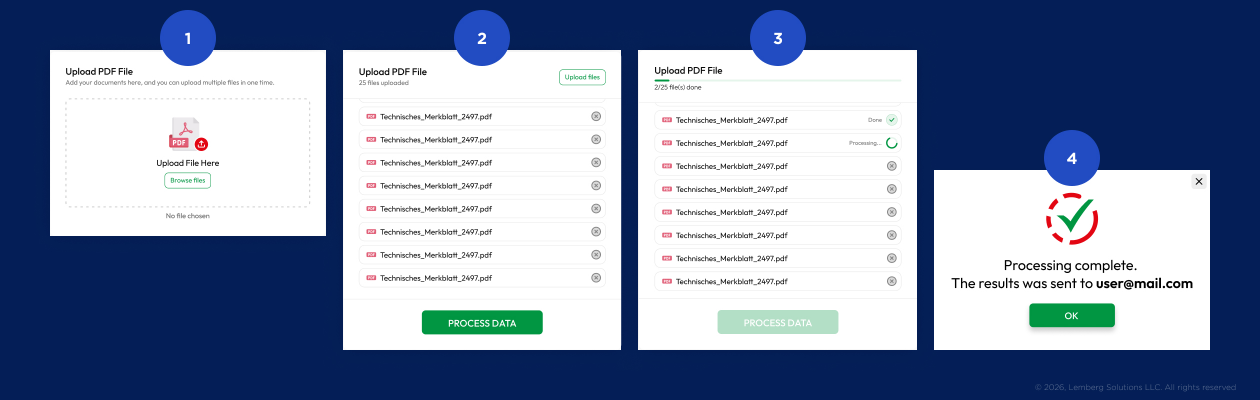
Once the files are uploaded into the system, our tool applies semantic search to find relevant sections in safety data sheets. Specifically, it targets “Section 2: Potential Hazards” with subsections “2.1 Classification of the substance or mixture” and “2.2 Labeling elements”.
Then the system performs structured data extraction to capture compliance-critical information. It includes H-phrases, P-phrases, EUH phrases, signal words, and hazard pictograms.
Despite variations in the structure and formatting of safety data sheets from different suppliers, the system automatically arranges the data in the relevant predefined columns of the Excel file. Alongside the final output, the system generates an error report highlighting any missing or inconsistent data.
This smart automation application is also built to be resilient to any operational issues. Without interrupting the overall workflow, it can handle situations such as broken source files or temporary service disruptions.
By developing a customized solution to extract safety data sheets on our hagebau AI platform in collaboration with Lemberg Solutions, we can now provide our stores with the product data required by regulations faster and at a lower cost. The collaboration went smoothly: on time, on budget, and within the scope.

How it works