


In recent years, Reddit has seen hardware-driven companies report difficulty finding qualified engineers with expertise in software and hardware integration. An independent 2025 global semiconductor industry outlook by Deloitte confirms the onset of a skilled worker deficit, including embedded systems engineer roles, being fueled by the imbalance of growing need for custom, low-level microcontroller code and a reducing workforce supply. Not to mention the complex geopolitical situations in the US and EU regions, only deepening this gap.
As embedded engineering vacancies remain open for months, product managers and engineering leaders face critical delays in product launches and inflated operational budgets. Hiring a dedicated software development team from a professional agency offers a decent solution to this problem, helping to neutralize the staffing deficit and get hardware projects on track within weeks.
In this article, we break down the reasons why companies struggle to find proper embedded talent, explain how dedicated teams stand out in addressing these issues, and provide a practical approach to hiring a dedicated embedded engineering team for your business.
What does it mean to hire a dedicated embedded software engineer?
Hiring a dedicated embedded software engineer means you get to cover the need for specific technology expertise in software-hardware co-design with minimal effort and great security guarantees. In contrast to hiring an in-house team member, this approach saves you a ton of time and costs on operational activities. Compared to freelance hires, dedicated teams offer much more control over project execution and IP assurances.
Choosing the best hiring model for a project is always dependent on time and budget constraints, commitment expectations, and the current talent market. Here, we discuss the three most popular hiring approaches — in-house, freelance, and dedicated engineers.
In-house engineers
The most important benefit of an internal team is the full control and continuous on-site presence. For embedded projects, which involve hands-on hardware testing, local lab access, and, in some cases, strict regulatory compliance, this is critical. But such convenience comes at a high price: internal hiring of an embedded software developer with narrow expertise requires lengthy recruitment and substantial ongoing costs. To afford this, you are expected to have internal recruiters and HR support, offer competitive benefits and contracts. For these reasons, in-house hiring remains the best choice if you need to cover core operations, especially where remote setups are technically or legally impossible.
Freelance developers
Freelancers are great when you need specialized expertise for short-term tasks. They don’t ask for benefits or long-term corporate commitments. You can find and onboard one within one to several weeks, making it your go-to solution for urgent tasks. Sourcing reliable embedded freelancers, however, can be prohibitively expensive and pose risks to IP and confidential data. To ensure more security and reliability when hiring freelancers, companies often have to involve specialized sourcing agencies. You should also remember that freelancers often balance multiple clients at once, so if you want your project to have their undivided attention, this point should be discussed in advance.
Dedicated teams
When you hire a dedicated software development team, it provides you all the benefits of the two other approaches: quick expertise gap coverage plus complete operational support, minus the burden of employer commitments or business data security concerns. An embedded software development company sources, vets, and handles people management, while you only direct project execution. Your dedicated engineers focus exclusively on your product during the timeline and following the conditions fixed in the service contract. As for reliability, outsourcing vendors carefully build their reputation, which depends on quality delivery, so they genuinely strive to live up to their clients’ expectations.
Below, we organized key data points on each hiring model into a comparison table to help you evaluate their benefits and downsides at a glance.
| Hiring model | In-house hire | Freelancer | Dedicated embedded team |
|---|---|---|---|
| Time to hire | 12–24 weeks | 1–3 weeks | 3–4 weeks |
| Time to onboard | 4–12 weeks | 1–2 weeks | 2–4 weeks |
| Employer commitments | - Full-time employment contracts - Local labor law compliance - Paid time off - Health benefits | Flexible, short-term independent contractor agreements | B2B service contract with an external vendor |
| Management effort | Hiring, training, long-term retention | - Low administrative burden - High risk of communication and delivery gaps | - Vendor handles HR, payroll, replacements - You direct high-level technical execution |
| Control and security | Maximum control over daily tasks, company culture, and proprietary hardware or code | Low control over schedules and availability, plus higher intellectual property risks | Intellectual property protection through secure and transparent contracts, complete alignment with a client’s delivery process |
| Expected engineer engagement | Highly committed, proactive, and motivated | Low, focused on providing required expertise effectively | Mid-to-high, effectively providing expertise and proactive tech recommendations |
| Cost structure | High fixed overhead to cover recruitment, onboarding, equipment, and workspace | Variable hourly or project-based rates reaching $150+/hr, no benefits | Сontractually fixed hourly rates based on seniority and skill set |
| Best for | Long-term engagements, ongoing support | Short-term projects, temporary/narrow expertise gap coverage | Mid-to-long-term engagements, ongoing support, narrow expertise gap coverage |
Why is it so hard to hire embedded software engineers right now?
Hiring embedded developers is difficult primarily because of a structural gap: demand for expertise in connected devices is outpacing the supply of highly qualified specialized engineers. According to the European Chips Skills Academy (ECSA) 2025 report, 27% of surveyed organizations say software roles are among the hardest to fill, while European companies face a shortage of roughly 10,800 trained professionals needed to design and build computer chips.
Having analyzed community discussions about the lack of skilled embedded engineers revolving on Reddit in 2024-2026, we can formulate several reasons contributing to this shortage:
- Academic training shift and seniority bias on the job market: Popular university Computer Science programs focus on web, cloud, and data science and pay little attention to low-level programming. Meanwhile, employers look for candidates with five or more years of experience and aren’t too enthusiastic about training juniors.
- Companies and engineers attempting to translate web development skills to embedded engineering: Numerous job descriptions and applications for embedded roles often list general software development skills. In reality, however, even senior-level web or cloud development expertise in Python and JavaScript doesn’t make engineers skilled enough for working with low-level firmware, bare-metal code, or physical memory constraints.
- Unrealistic skill requirements paired with uncompetitive budgets: Due to IoT and edge AI growth, job descriptions more often include an excessively broad range of skills, running from PCB design to RTOS kernel modifications and high-level algorithms. Meanwhile, many applicants deem salary offers for such positions inappropriately low.
- Skillset and requirements mismatch: The talent pool is filled with either Computer Science graduates who don't have electrical engineering knowledge or Electrical Engineering graduates who lack structured software discipline. And there’s only a small fraction of candidates that can do both.
- Overreliance on AI coding tools: Today’s junior developers have been using code generation heavily starting from the school or college bench, while skipping the manual, deep-level engineering tasks important for understanding the groundwork.
- Recruitment knowledge gaps: HR departments don’t have enough hardware context needed to screen embedded candidates properly, so quite often they filter out good candidates just because job postings are too rigid.
The result is a market paradox. All these factors together create an imbalance: companies receive hundreds of applications for their embedded job postings, yet struggle to find a candidate with needed skills and experience. Tech vendors outsourcing dedicated embedded teams prove to be effective in this respect: in addition to continuous talent pool monitoring, they usually have a bench of skilled engineers ready to onboard upon request.

How much does it cost to hire a dedicated embedded engineer?
The cost of an embedded software engineer depends on more factors than just base salary or hourly rates. When you hire embedded systems engineers, you should also consider the geographic region, their technical domain, and, of course, the engagement model. The latter will define additional expenses, like physical hardware costs and long-term financial risks.
In-house engineers
In addition to the high yearly salary for US- or EU-based in-house engineers, count in the substantial fixed overhead including taxes, health benefits, and paid leave, which typically add 30% to 40% to the baseline compensation. Beyond the social package, you have to equip your embedded engineers with specialized software development and hardware testing tools — one more line item in upfront expenses.
Freelancers
Despite zero employer commitments and overhead, working with independent, contract-based developers does carry hidden operational and financial risks. First, freelancers typically work remotely and don’t have access to your lab equipment, which makes it difficult for them to test and troubleshoot hardware-software integration properly. Second, when freelancers have access to proprietary schematics and firmware source code, consider your intellectual property at risk; it’s completely trust-dependent. Third, you cannot expect swift response times, as freelancers often balance multiple clients, work flexible hours, and might be located in a completely different time zone. All these administrative nuances eventually may come down to financial consequences.
Dedicated development teams
With outsourcing software vendors, you can hire dedicated embedded engineers at clear hourly rates that already include vendor overhead, office space, and management efforts. The service contracts typically include guaranteed team member replacement, IP protection, NDA, and hardware lab access, which removes potential operational risks.
The cost-efficiency of outsourced teams, however, comes with certain trade-offs, such as different business hours, especially for US-based businesses that hire dedicated embedded engineers from other continents. Tech vendors like Lemberg Solutions, have experienced managers who take care of smooth communication, even under conditions of scarce business hours overlap. Specialist on-site visits and hardware delivery, completely organized by the vendor, neutralize the location misalignment and are eventually more cost-efficient than full-time in-house engineers.
| Hiring Model | In-house hire | Freelancer | Outsourced dedicated embedded team |
|---|---|---|---|
| Average rates | $90,000–220,000/yr | $30–180+/hr | $50–100/hr |
| Overhead | 25–40% (health insurance, taxes, workspace, specialized tools) | None | None (vendor rate includes developer salaries, hardware, and administrative overhead) |
| Caveats | $30,000–50,000 per hire in recruiter and administrative fees | Availability gaps, context switching across clients, unexpected project abandonment | Partial-to-little business hours overlap |
How do you vet an embedded software engineer's skills?
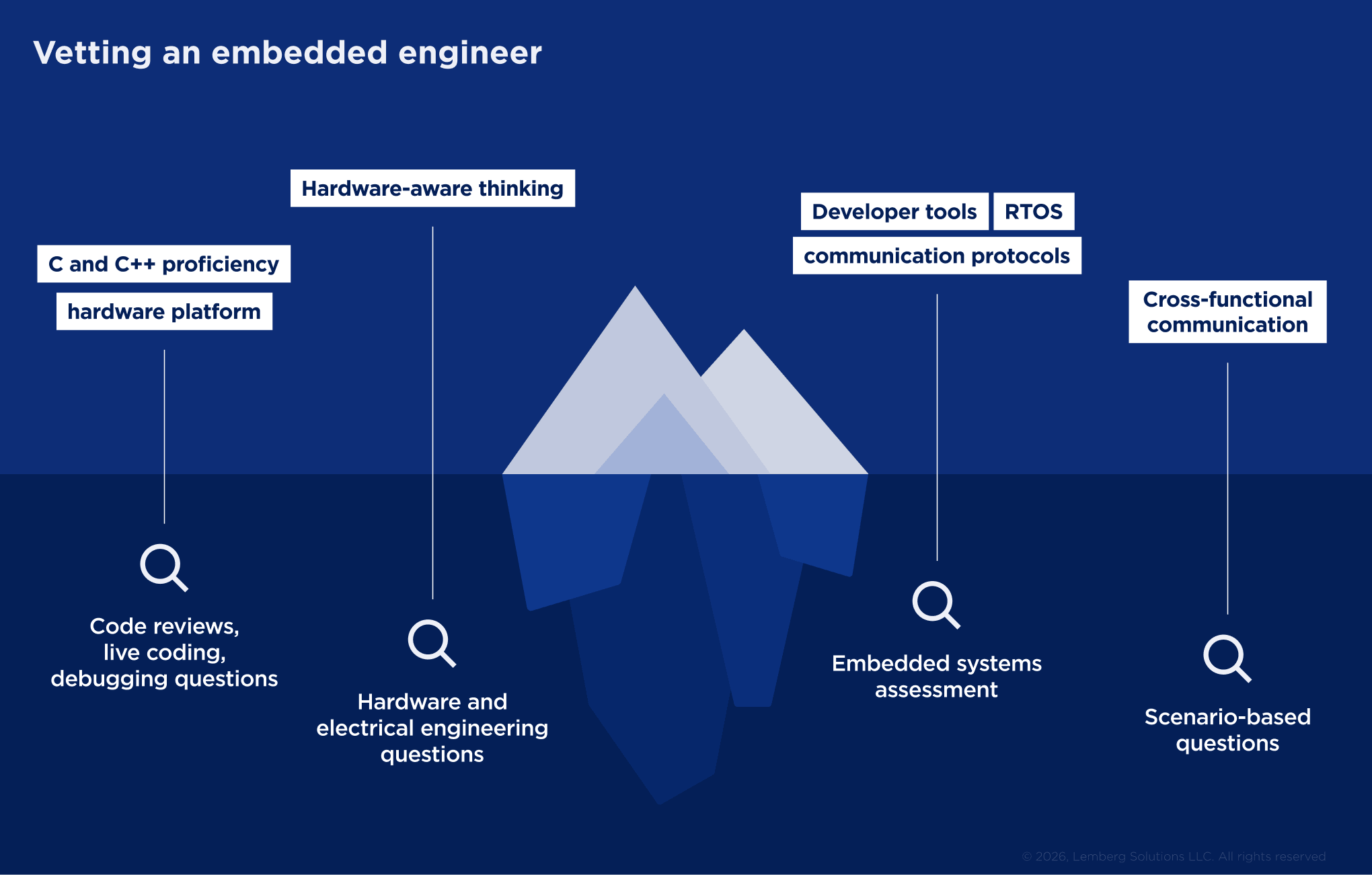
When vetting an embedded engineer, it’s important to evaluate both software engineering skills and hardware-oriented thinking. Since these specialists write low-level code for microcontrollers, they must have a solid understanding of electrical schematics, hardware registers, and physical board design. Also, embedded systems impose memory and processing limits, which requires specialized, hardware constraint-aware knowledge from engineers working with them.
Core Technical Competencies
A qualified embedded engineer should have a combination of software fluency and electronics fundamentals:
- Core languages and embedded IDEs: Knowledge of such coding tools as Keil, IAR, or Eclipse along with proficiency in C and C++ to be able to set up precise memory control, peripherals interaction, and real-time system responsiveness.
- Hardware architecture and peripherals: Familiarity with MCU platforms (such as ST, NXP, Nordic, TI), ability to read datasheets, and skills in configuring peripherals like I2C, SPI, UART, DMA, and ADCs.
- Real-time operating systems: Expertise in managing multitasking, interrupts, and timing constraints to ensure system response within strict, predictable time limits, critical in embedded software.
- Hardware debugging: Hands-on experience in using physical board testing and troubleshooting equipment: logic analyzers, oscilloscopes, JTAG, and multimeters.
- Communication protocols: Understanding of wired and wireless standards for communication between system components (e.g., CAN, Ethernet, Bluetooth, Zigbee, Wi-Fi)
- Basic circuit design: Sufficient knowledge to understand whether a system failure is caused by a software bug or a physical fault like a solder bridge.
- Security and compliance: Awareness of required domain-specific safety certifications and ability to use common device security protocols.
Assessment methods
To evaluate the skills of an embedded engineer, test how they can handle physical limits, unexpected hardware behavior, and cross-functional communication:
- Code and driver reviews: Help evaluate a candidate’s driver-level C coding and test their register manipulation, interrupt handling, and memory efficiency skills.
- Practical debugging: Through a short board bring-up or firmware debugging exercise, you’ll be able to see how they solve hardware-constrained issues.
- Bare-metal and real-time reasoning: By explaining diagnostics and fixing of race conditions, timing delays, or intermittent bugs on an MCU, an engineer demonstrates how deeply they understand CPU registers, clocks, and assembly-level details
- Architecture discussion: If you need to assess a candidate’s system-level thinking for a senior role, ask them to suggest architectural trade-offs for a given embedded application.
- Scenario-based questions: This way, you can understand their communication skills and ability to collaborate with other team members during every stage of product development.
What does the hiring process look like for a dedicated embedded team?
When you hire an embedded systems engineer under the dedicated team model, it streamlines the process considerably: such stages as talent sourcing, technical screenings, and administrative tasks are already covered by the vendor. The only steps that will require your attention from the initial contact to team member onboarding will include:
- Requirements gathering: During an introductory discovery call with the delivery manager, you voice your technical requirements, microcontroller targets, software stacks, and the overall project scope. The vendor then uses these parameters to shortlist their candidates.
- CV review and selection: You have to evaluate the candidate profiles for matching your project needs. Here, we recommend focusing on their past hardware projects, platform expertise, and domain experience relevant to your application.
- Technical interviews: You can conduct interviews with the selected candidates to test their low-level programming skills, hardware debugging methodology, and cultural fit.
- Feedback exchange: If there are any adjustments to be made, the vendor will ask for detailed feedback on the interviewed candidates and suggest new profiles.
- Contract sign-up: When a candidate is approved, the two parties finalize a Master Services Agreement (MSA) along with the necessary redlines. This agreement establishes non-disclosure terms, financial structures, hourly rates, intellectual property rights, and standard operating conditions.
- Onboarding and project kickoff: Once contracts are signed, the developers onboard your development environment, toolchains, repository, and communication channels. As your project requirements evolve, you can scale your dedicated team up or down.
Following this workflow, the timeline for hiring embedded engineers compresses significantly. In most cases, it takes no more than 3–4 weeks to move from the discovery call to a developer working on your codebase.
What are the most common mistakes when hiring embedded engineers?
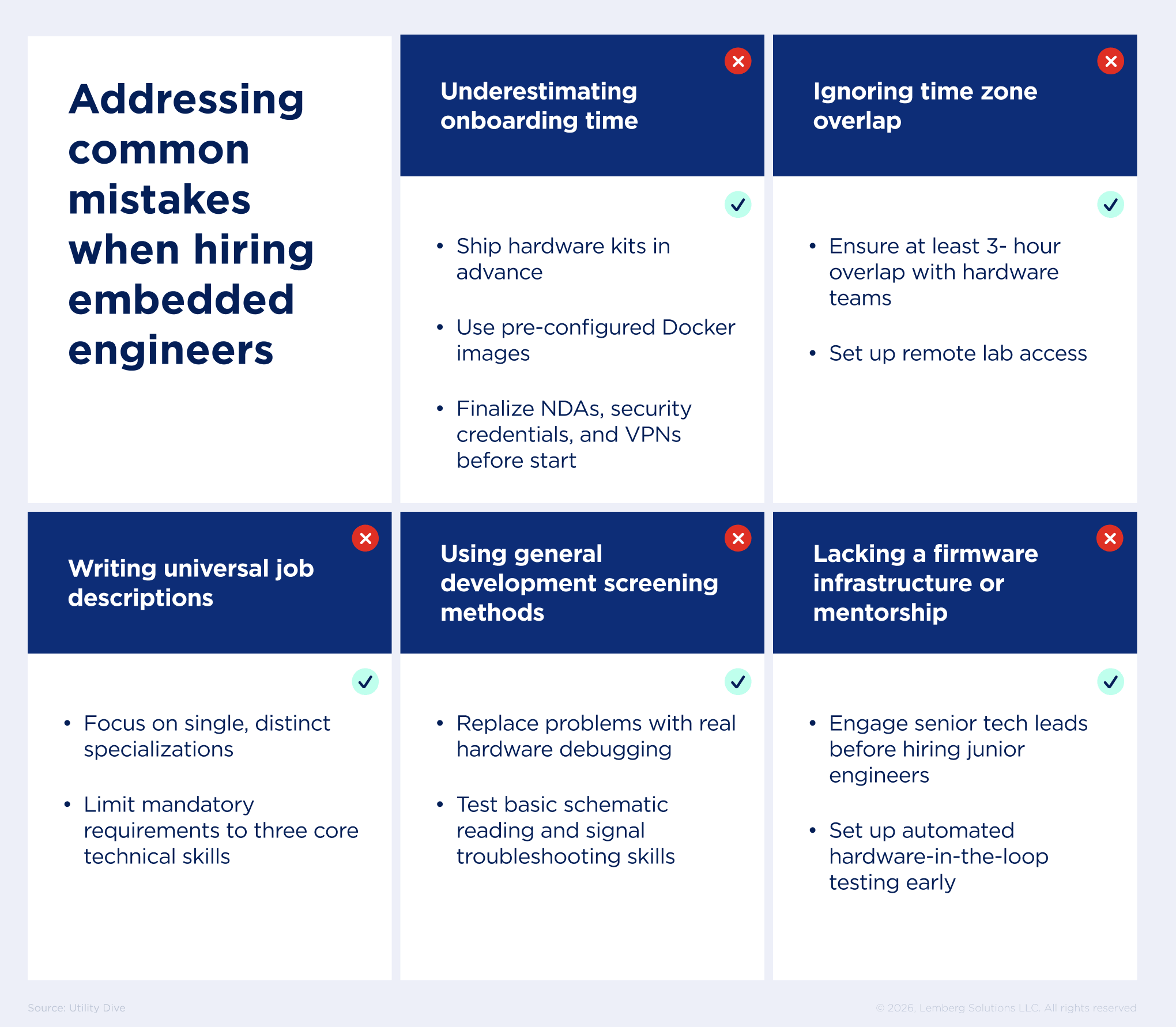
As embedded engineering consultants, we often see companies make mistakes when hiring embedded developers at different stages of the process — from formulating their requirements in the job description to onboarding the new team member. Here, we review the most common oversights.
Writing "unicorn" job descriptions
HR teams with little experience hiring embedded engineers tend to combine disparate technical requirements into a single job description. As a result, their candidate pipeline is empty. A realistic job description would include either RTOS kernel development with skills in DSP algorithms or embedded Linux with cloud IoT integrations mastery or custom PCB design with basic RTOS/bare-metal driver development expertise, but never all at once.
Relying on standard web development screening methods
You can hardly assess an embedded engineer’s competence by abstract algorithmic problems or pure software questions. If you aim to understand whether a developer knows how to read board schematics, handle interrupt latency, manage register flags, or isolate a physical hardware fault, you have to prepare questions that can test their hardware constraints awareness and time-sensitive operations reasoning.
Ignoring time zone overlap for hardware collaboration
Firmware development often requires live, interactive troubleshooting involving both hardware and electrical engineering teams. But it can stall if they have zero business hours overlap. So, before starting any screenings and interviews, include shared operating hours on your requirements list and make sure the vendor will take on the management effort needed to support it.
Underestimating onboarding and hardware setup time
While digital product developers only need repository access and a laptop to work, embedded engineers require a more complicated setup, including physical hardware, custom evaluation boards, debug probes, lab instrumentation, and secure firmware flashing. To avoid unexpected delays, keep these in mind and make sure to arrange hardware shipping and customs, provide the necessary lab access to the team members, and resolve questions on NDA and IP agreements beforehand.
Lacking a firmware infrastructure or mentorship
When you hire an embedded systems engineer into an environment without established build systems, hardware debugging tools, or senior engineering oversight, expect a delayed or poor delivery from the start. To get maintainable code within expected timelines, make sure your developers have direct access to proper tooling, testing frameworks, and hardware documentation.
Where can you find and hire embedded software engineers?
Sourcing the rare highly qualified embedded talent is most effective with a multi-channel approach. You can combine direct networking, niche industry hubs, and external staffing partners to get as much access as possible to the candidate pool.
- Internal referrals: Your existing hardware and firmware team members can use their community connection to recommend candidates with verified technical capabilities and a strong cultural fit.
- Industry associations and conferences: Organizations like the IEEE and events such as the Embedded Systems Conference (ESC) offer specialized job boards, career fairs, and networking events aimed directly at systems-level engineers.
- Engineering communities: Online forums and platforms like the r/embedded community on Reddit help understand current developer sentiment, compensation expectations, and candidate preferences regarding employment models.
- General job boards and direct sourcing: Standard career pages and job boards can attract active job seekers when paired with targeted employer branding and outbound recruitment efforts.
- Dedicated team partners: Specialized development agencies source, vet, and manage engineers so you don’t have to build a hardware-aware recruitment pipeline from scratch. Partners like Lemberg Solutions provide access to pre-screened, project-ready specialists through tailored dedicated embedded engineering teams.

Conclusion
The severe global shortage of embedded software engineers presents a serious operational challenge for hardware-driven companies. As traditional in-house hiring can stall a delivery pipeline for months, product leaders have to look beyond local talent searches and consider staffing models that can provide speed, long-term flexibility, and an effective selection procedure.
Partnering with a dedicated embedded development team solves this bottleneck by providing immediate access to pre-vetted hardware specialists without the burden of building an internal recruitment pipeline from scratch. By shifting sourcing, HR, and administrative oversight to an outsourcing vendor, you retain direct control over technical direction while compressing onboarding timelines from months to weeks. Choosing the right partner and vetting for genuine low-level firmware and hardware debugging experience ensures your product moves smoothly from initial prototype to market deployment.


