Caltech's medical device prototype: improved performance and stability
About the client
Our client is an interdisciplinary research group at the California Institute of Technology (Caltech) developing versatile devices for electrochemical biomedical research. They focus on the design and application of innovative devices to better understand complex biological systems.

The challenge
The Caltech research group was working on a medical device prototype — a mouthguard with an embedded system that analyzes a patient’s saliva. However, the hardware performance wasn’t ideal: the system lacked stability and responsiveness, while the battery drained too quickly. To achieve better results, the team decided to switch from the legacy Cypress chip to a more powerful and efficient MCU.
The new microcontroller had to provide more processing capacity, integrate all the necessary peripherals, ensure low power consumption, and fit the limited package size, all at the same time. The selected MCU required migration to another MCU family — from Cypress to STM32 — and completely rewriting the device’s firmware.
Delivered value

The solution
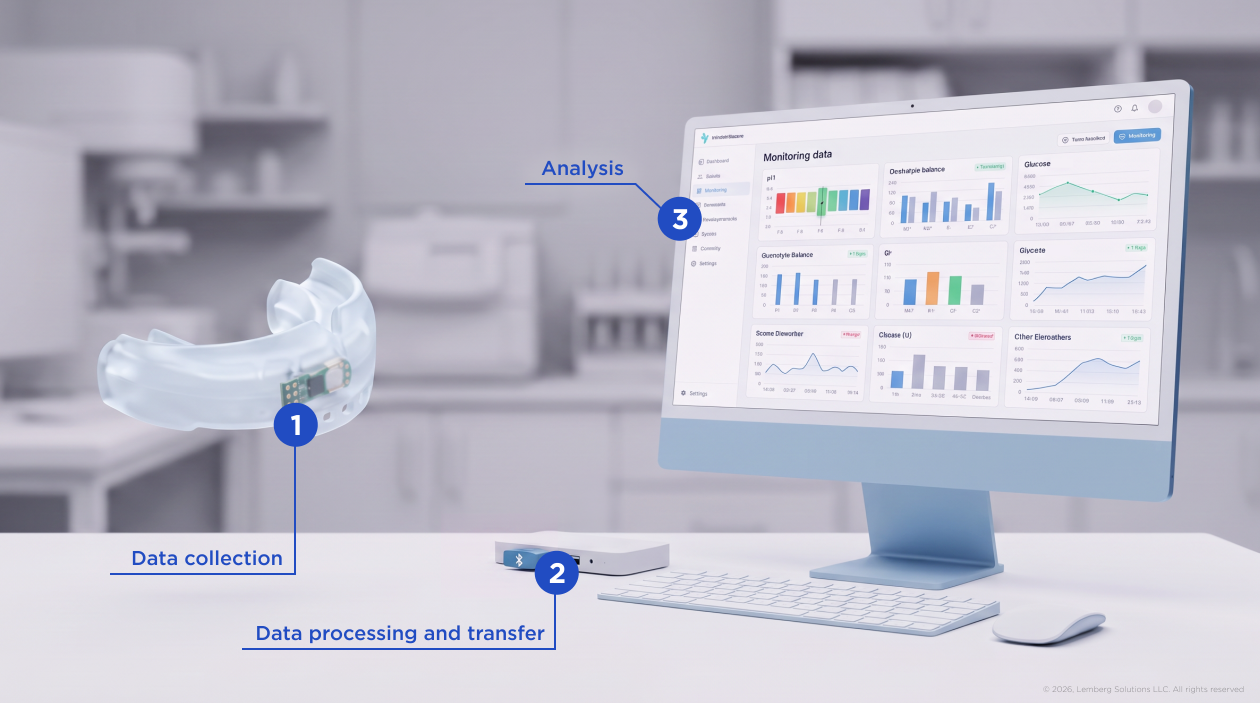
The medical device the Caltech team prototyped is a silicone mouthguard that contains a tiny embedded system with an electrochemical sensor. The system collects, transforms, and transfers data on the chemical composition of a patient’s saliva via BLE to a PC-connected BLE dongle for further analysis.
Decoding the system logic
The development started with analyzing the existing PCB and firmware and reconstructing the system behavior — it was important to keep the original device functionality despite the new hardware foundation. Our team reverse-engineered the application's functions and control flow, learned the MCU-to-BLE dongle interaction, and figured out the overall application logic.
Overcoming performance and power constraints
The entire embedded system, including the electrochemical sensor, MCU, and peripherals, had to fit onto a tiny, 25x10 mm circuit board. With the support of our embedded consultants, the client opted for an STM32 MCU model offering a lot of low-power mode options. The firmware, designed and implemented for the chip, provided performance and power consumption improvements, better-structured code, and bug fixing along the way. To enable support for the Cypress BLE dongle, the team integrated the Cypress BLE stack into the ST-based firmware.
Troubleshooting board design issues
When the Caltech group provided the first revision of the STM32-based PCB for bring-up, the initial review revealed several critical issues in schematic design. Poor soldering quality and chip misalignment caused short circuits, and some copper traces didn’t align properly, leading to operational errors. To solve this, our electrical engineers manually resoldered the MCU and provided layout refinement suggestions. After implementing these changes in the second PCB revision, the research group achieved a fully functional board.
Safeguarding future deliveries
To ensure the final PCB version corresponded to the client's request, we conducted rigorous functional and power consumption testing. The engineering team provided comprehensive support during the user acceptance testing phase, including additional documentation, investigations, and testing to ease further development on the STM32 platform for the client.
Lemberg did a great job on porting our BLE application from a Cypress module to an STMicroelectronics module. Their team was consistently responsive, friendly, and responsible throughout the project. They handled all our questions with care and were upfront about what they could deliver, ensuring there were no surprises along the way. Their straightforward and reliable approach made working with them a positive experience.
How it works