Unlike pure web or mobile development outsourcing, embedded software outsourcing introduces strict logistical friction. Embedded system development requires distinct phases, reference boards, dev kits, electronics and housing versions, and specific testing of each part. Hardware and firmware add physical constraints with lab access, board revisions, and prototype shipping. Ensuring firmware versions match specific custom PCB revisions makes vendor alignment uniquely complex with a lot of dependencies. A generic Scrum approach doesn't work for this type of product.
In this article, we look at what effective procurement handling and overall project management of a remote embedded team actually requires and why it goes well beyond applying a common software development process.
What is a remote embedded development team?
A remote embedded development team is an outsourced group of electrical, mechanical, firmware, and software engineers working off-site on a dedicated computer system within a device.
Just like any other remote development team, outsourced embedded system developers are typically located in another country, region, or continent; are more cost-efficient than hiring in-house talent; and provide access to a wider, global talent pool. However, they have an important distinction that device producers should keep in mind: no direct physical access to the client’s lab or device.
Embedded engineers cannot work with software in isolation; they must be able to physically interact with MCUs and SoCs, memory resources, power consumption, sensors and peripherals, communication interfaces, real-time processing, and the actual behavior of the hardware. Debugging embedded systems also requires working with lab equipment, such as oscilloscopes, logic analyzers, JTAG/SWD debuggers, and test rigs.
Professional embedded software outsourcing vendors, however, can bridge the gap between the benefits of remote teams and the lack of physical access to the client’s hardware on-site. Such teams typically develop their own version of the target hardware as close as they can to the client’s setup functionality or request a few devices from the client, so they have reproducible test setups, and support tight communication with the product team.
Who are the key participants, and what are their roles?
Within an engineering project, we distinguish two groups of interested parties: internal stakeholders — people within the client’s company who own, operate, maintain, or manage the product, and external stakeholders — people or organizations outside the company who procure, use, supply, regulate, or help develop the product. Engineering outsourcing vendors fall under the category of external project stakeholders.
For the sake of convenience, here we will speak of the client as a party initiating and leading a project and the engineering vendor as a party providing the people and execution capability for the project.
Client side
The client’s side typically includes a Product Manager or Product Owner, a CTO or Engineering Manager, and may also have internal hardware, manufacturing, regulatory, or operations teams. These are interested parties who own the product and its business goals, suggest and approve requirements, and make decisions about scope, cost, and product risks.
People who will actually use, install, or maintain the product, whether they are internal or external stakeholders, play an important role, too. They provide context for formulating requirements and specifications: how the device will actually be used, what physical conditions it will operate in, what usability or maintenance constraints exist, and so on. Without fitting the end user’s workflow, even a technically successful device can fail commercially.
Tech vendor side
The tech vendor provides a Project Manager or Delivery Manager accountable for project coordination, planning, communication, dependencies, risks, and delivery. However, the Project Manager does not replace the client's Product Owner: while the vendor provides recommendations and organizes how and when the engineering team delivers, the client’s representative still determines what and why.
In embedded software outsourcing, engineering roles combine a mix of specializations:
- Electrical engineers design and validate physical electronics: schematics, PCB, power architecture, components, interfaces, signal integrity, and board revisions.
- Industrial designers and mechanical engineers design the housing and prepare it for mounting the electronics components, manufacturing, and certification.
- Firmware engineers develop embedded software that runs directly on the processing unit’s operating system or bare metal: bootloaders, drivers, peripheral control, state machine logic, device communication, update functionality.
- Software or application engineers cover the higher-level software surrounding the device, such as embedded Linux applications, gateway services, companion apps, web interfaces, cloud integrations, or device-management platforms.
- QA engineers make sure the system behaves according to defined requirements and test the hardware, firmware, and software combinations. In embedded projects, testing involves checking firmware functionality, as well as working with circuit boards, sensors, peripherals, environmental conditions, and multiple hardware revisions.
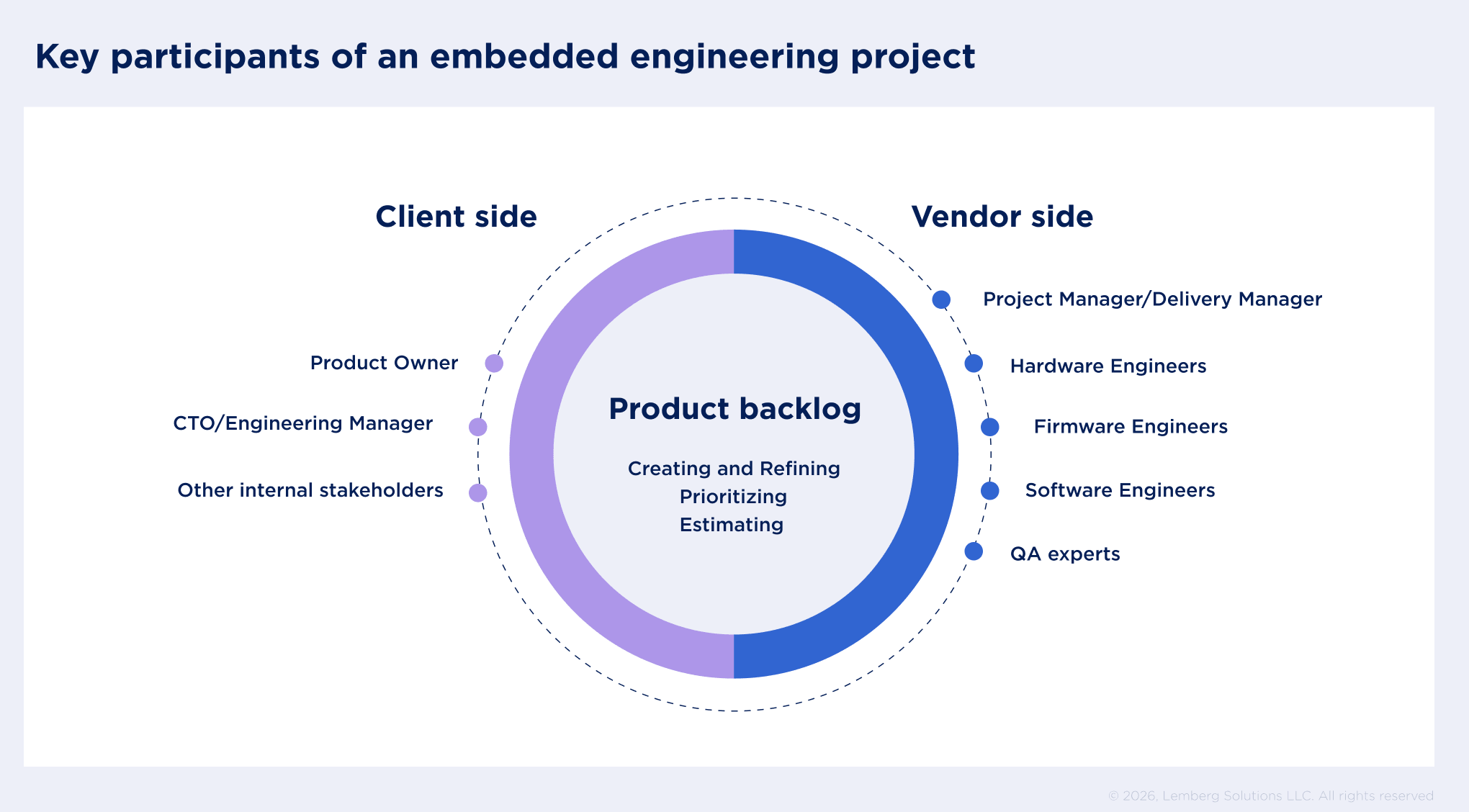
How the embedded team roles work together
The important thing in managing projects involving a remote software development team is to establish clear task ownership between the two sides.
Suppose you are a company that needs to develop an industrial-grade vibration-monitoring system for its rotating machinery. As an owner, you are the internal stakeholder. Other internal stakeholders might be your executive board, machinery operator, or production floor personnel, all interested in a more cost-efficient and simple way of maintaining the equipment.
To get the initiative running, you assign a Product Owner who should collect information from other stakeholders describing their needs in simple, non-technical language. In our case, it might be “The device should monitor vibration and temperature on industrial motors and alert maintenance teams when a bearing shows signs of degradation.” The Product Owner also asks people who directly work with the machinery about real-world constraints like installation nuances, acceptable measurement intervals, environmental conditions, and what information technicians may need when an anomaly occurs.
With that input, you can get your CTO or external embedded systems consultants to analyze the technical viability of such a solution, evaluate risks, suggest implementation options and architecture decisions, as well as a tech stack. Eventually, they formulate a generalized scope of work, budget estimation, a roadmap with the necessary engineering team composition, and product requirements formalised from the technical perspective.
When you decide to move on with technical implementation, the engineering outsourcing vendor kicks in. We strongly recommend keeping the Project Manager role on the vendor’s side, as it adds more control and creates a strong communication bridge between the client-side Product Owner and the vendor-side development team, ensuring clear collaboration and on-time project delivery.
Led by the Project Manager, the vendor’s team turns your discovery phase materials into technical requirements, a detailed scope of work, and a delivery plan. This includes a prioritized list of features per phase/release that your product must have to function. For instance, "measure vibration," "detect abnormal vibration," "send data over Ethernet," "update firmware remotely," and so on.
The delivery plan is further split into milestones, phases, or releases, each with a fixed scope, and a roadmap. During a milestone/phase, the team designs, implements, integrates, and tests a selected scope synchronized among the electrical, mechanical, and firmware teams. The Project Manager coordinates the progress and dependencies, while the Product Owner reviews and approves the results.
The technical roles of the embedded team include several types of engineering specializations:
- The electrical engineer selects the necessary system elements, like sensors, MCUs, power components, and produces the Bill of Materials (BOM), creating a schematic design and a PCB layout.
- The mechanical engineer drafts the concepts, detailed designs, and prepares files for manufacturing, coordinating inner and outer parts of the housing with the PCB design.
- The firmware engineer implements various features the product should have: signal processing, device diagnostics, communication.
- The software engineer develops the user-space applications and interface that maintenance personnel or machine operators will use.
- The QA specialist builds and runs test scenarios to check sensor accuracy, communication failures, firmware updates, and alerts across electronics parts and firmware functionality.
An important embedded-specific caveat: physical system development cannot be planned like a software project. If a component requires a PCB revision, prototype assembly, or a fabrication run, the engineering team may complete the design at one point in time but physically receive the hardware weeks later. A true embedded project manager therefore plans around physical dependencies using simulations, development boards, existing hardware, remote labs, and parallel software/firmware work where possible.

What tools work best for managing a remote embedded team?
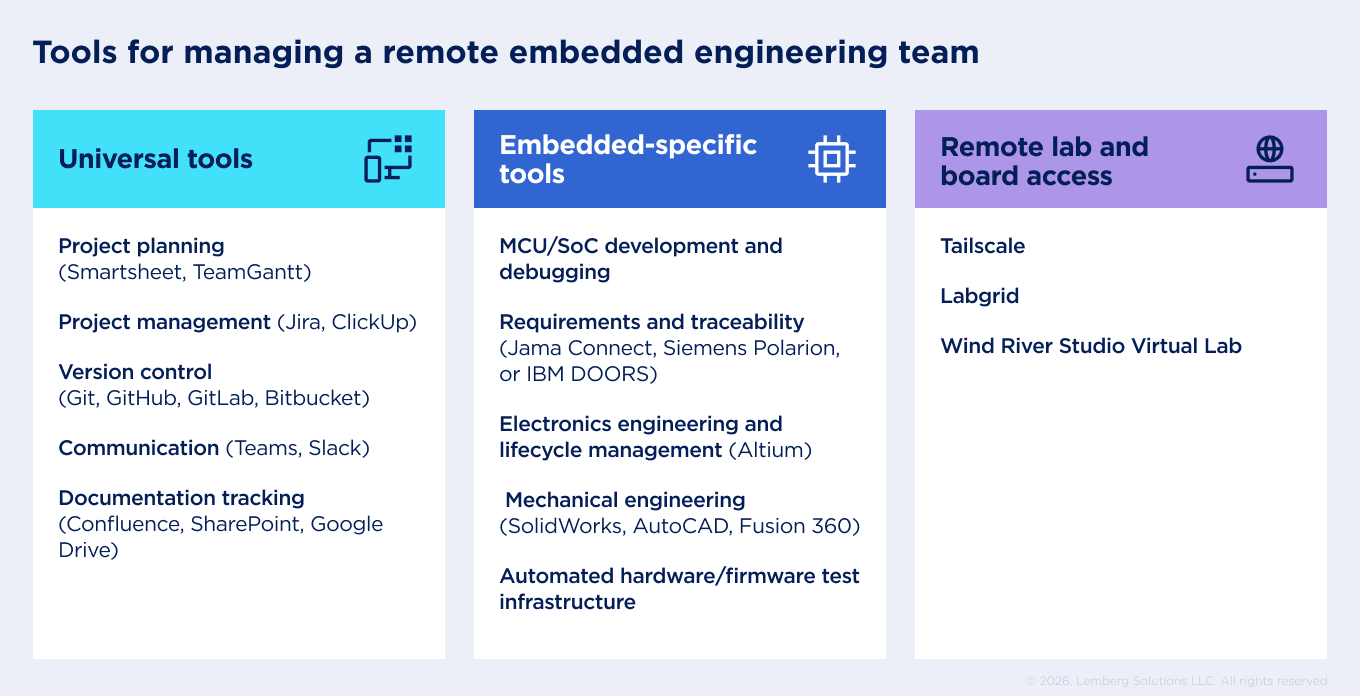
The tooling stack for embedded software outsourcing combines two layers: the universal engineering/project-management layer and the embedded-specific layer.
In addition to Jira ticket status, embedded PMs have to track more aspects: current board revision, component availability, PCB fabrication status, and the latest firmware revision test coverage. Thus, the first layer keeps the team organized, while the second gives engineers visibility and control over the physical product they are developing.
Universal project and collaboration tools
Project planning tools, like Smartsheet or TeamGantt, help to plan the timeline of the project, providing a view of all dependencies and work done by different team members in parallel. If some tasks or shipments get delayed or done faster than initially planned, such tools allow the Project Manager to adjust the task and instantly see the impact on other activities and deadlines months ahead.
Project management tools, such as Jira or ClickUp, help teams manage day-to-day task statuses, bugs, priorities, and overall delivery status. While they mostly work equally well for digital and embedded projects, PMs should remember that embedded tasks often need to be linked to hardware revisions, test results, manufacturing milestones, or physical dependencies.
Version control applications like Git, GitHub, GitLab, or Bitbucket work perfectly for firmware, embedded software, scripts, configuration, and documentation. Providing a shared history of changes, code review, branching, and traceability, they equip any remote engineering team with a common, reliable source of truth.
Teams and Slack are the most popular communication tools that support daily communication, quick technical questions, meetings, and coordination across time zones. Important decisions, however, should still be captured in the project-management or engineering documentation systems.
Development teams also widely rely on Confluence, Google Drive, or SharePoint as the go-to documentation and file-sharing tools for keeping track of requirements, architecture decisions, interface specifications, test procedures, and Altium or SolidWorks files.
Embedded-specific engineering tools
MCU/SoC development and debugging tools, usually vendor-supplied IDEs, compilers, debuggers, and JTAG/SWD tools, as well as logic analyzers and oscilloscopes, provide firmware engineers with the means to build, flash, trace, debug, and diagnose software on the actual target hardware.
Requirements traceability can be done manually in tables or using such tools as Jama Connect, Siemens Polarion, or IBM DOORS. They link the requirements to implementation and verification evidence, which explicitly demonstrates that the intended functionality has actually been implemented and tested. This feature is particularly important for regulated, safety-critical, or complex embedded products.
Electrical engineering and lifecycle management tools like Altium support managing BOMs, component versions, schematic design, PCB design revisions, approved components, manufacturing files, and engineering change orders. Since hardware has more physical dependency than ordinary software, better supply-chain exposure helps avoid unexpected consequences from a single component change.
Mechanical engineering tools like SolidWorks, AutoCAD, or Fusion 360 are essential for enclosure 3D modeling and certification documentation development, as well as preparing for manufacturing (3D printing, CNC or molds) when it’s time for DFM and Tooling on the factory side.
Automated hardware/firmware test infrastructure, including test frameworks, HIL (Hardware-in-the-Loop) setups (custom for the product or OTS), automated flashing, test fixtures, and CI systems that can build firmware and execute tests against real devices, helps streamline the physical development process.
Remote lab and board access
If the only full setup is sitting in the client's office or lab and can not be replicated or shipped to the vendor, remote hardware access using such tools as Tailscale, Labgrid, or Wind River Studio Virtual Lab turns the client’s physical device into an asset the distributed team can work with continuously. A remote lab allows engineers to connect to a physical board over the network, power-cycle it, flash new firmware, collect logs, run automated tests, and sometimes control measurement equipment without being physically present.
How do you coordinate hardware and software work remotely?
Remote hardware–software coordination requires electrical, mechanical, and firmware engineers to have physical access to the right hardware, enough information to work independently, and regular opportunities to resolve hardware–firmware dependencies before they become blockers.
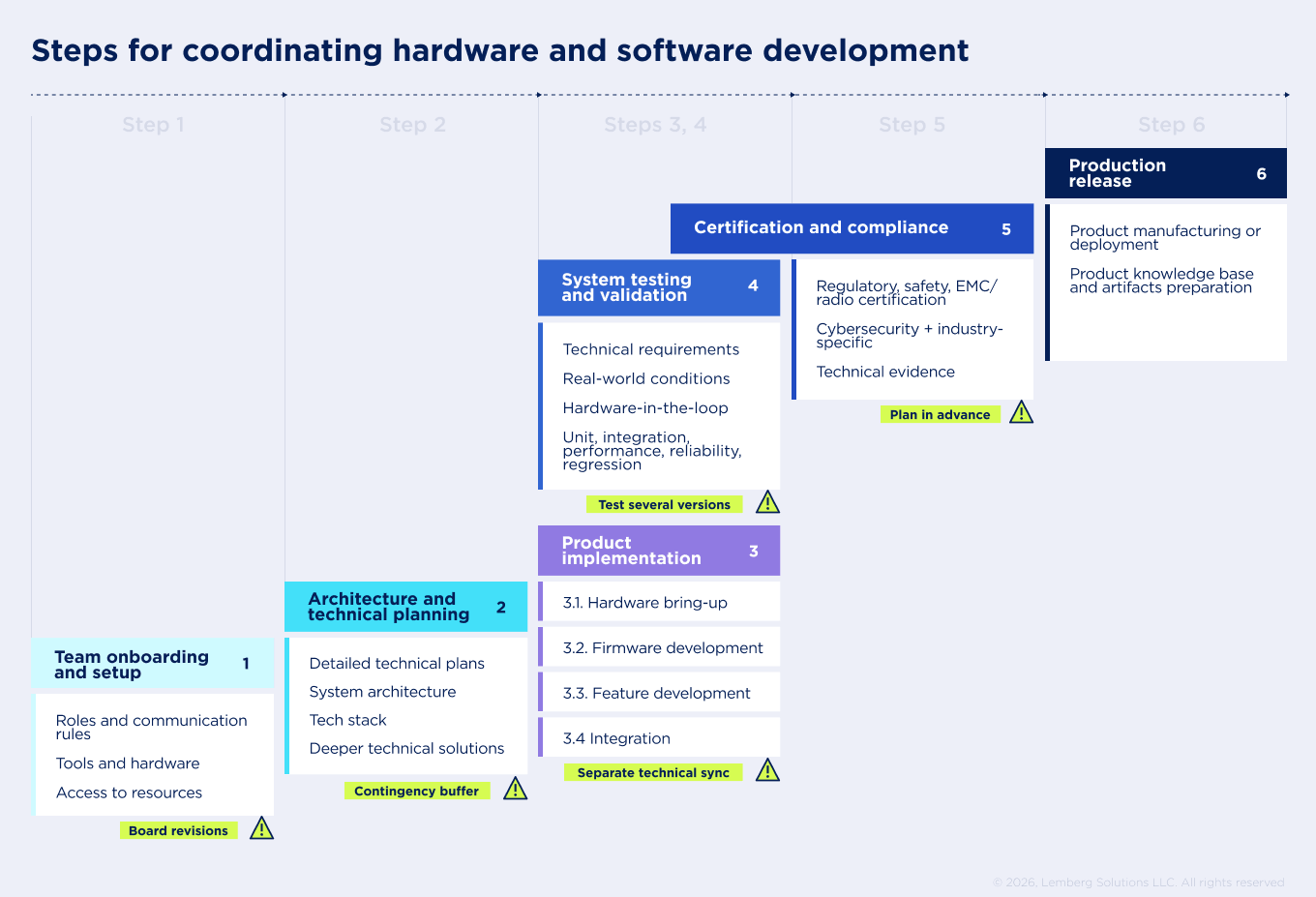
The important difference from a software lifecycle is that the phases of embedded system development overlap rather than form a strict linear sequence. Software and hardware implementation here often progress in parallel, while each new board revision or prototype can trigger another integration and validation cycle. Here are the steps that form a typical flow for managing outsourced teams on embedded systems projects.
Team onboarding and project setup. The client and vendor teams get familiar, establish roles and communication rules. The task of the client at this point is to provide the outsourced team with development boards and tools, give them access to repositories and project-management systems, and confirm the project scope and delivery process. Roles, communication rules, workflows, responsibilities, as well as delivery milestones should be agreed before implementation begins.
Tip: Outsourced embedded engineers should have the same board revision (or at least an agreed equivalent) in their remote lab. For later revisions, it’s important to keep track of the new prototypes: label the hardware clearly, record which firmware versions were tested on which revision, and keep spare boards available when possible.
Architecture and technical planning. The Project Manager and engineers translate the approved requirements and system architecture into detailed hardware, firmware, and software plans. This step defines the system architecture and key technology choices: MCU/SoC, sensors, connectivity, power, OS/RTOS, hardware–software interfaces, application architecture, validation strategy.
The role of the client or Product Owner is to review and approve architectural or deeper technical solutions or suggestions. To clarify the requirements, assign a responsible tech expert who can assess the implementation approach the team suggests, as implementation options can limit the product’s scalability or performance in case you decide to add three more features.
Tip: Together with the vendor’s PM, regularly check the roadmaps and keep the budget under control, since no project is ever ideal, so changes in implementation, component shortages, or reworking an enclosure will require prompt decision-making. For the same reason, make sure you have a contingency buffer for changes in timelines and budget.
Hardware bring-up and low-level development. Hardware engineers finalize or adapt the relevant hardware, while firmware engineers establish the basic platform: bootloader, BSP, drivers, peripherals, RTOS/Linux configuration, communication interfaces, and other low-level functionality. Early board bring-up exposes hardware–software issues before they propagate into higher-level development.
Feature development and integration. The team implements product functionality in increments, continuously integrating the hardware and software on real devices, with consecutive validation. Hardware revisions and physical dependencies should be managed alongside the software backlog, not treated as separate activities.
Tip: In the implementation process, reserve a fixed technical (hardware–firmware) sync, separate from the general project standup, providing a space to resolve more technical dependencies. A short weekly session between the hardware and firmware leads can cover board revisions, component changes, interface changes, bring-up status, open hardware dependencies, and upcoming testing.
System testing and validation. The integrated product must be tested against technical requirements and real-world use cases. This includes unit and integration testing, hardware-in-the-loop where appropriate, performance and reliability testing, regression testing, validation with representative users and real-world operating conditions. Test findings may trigger hardware revisions, firmware changes, or architectural adjustments before the design is frozen.
Make sure your team tests several versions of the product across the project: proto, engineering validation sample, design validation sample, production validation sample. This helps discover design flaws, power issues, or software glitches when they are still cheaper and easier to fix. The goal of product validation is to establish that the design is stable enough for production and that the required documentation, test evidence, BOM, manufacturing files, and support processes are ready.
Certification and compliance. The tested and validated product undergoes the required regulatory, safety, EMC/radio, cybersecurity, or industry-specific certification activities. For regulated products, the engineering team prepares and maintains the technical evidence needed to demonstrate compliance.
Tip: To prevent costly redesigns due to a failed safety or radio test, the best strategy is to plan for certification activities in advance: choose pre-certified modules and incorporate certification requirements throughout development. But it’s good to have a contingency buffer if you still need a rework because of an unexpected rejection from the certification authority.
- Production release. After validation and certification gates are passed, the product is released for manufacturing or deployment. At this point, the outsourced team should leave the client with the knowledge and artifacts needed to operate, maintain, and further develop the product: firmware/software, source code, documentation, test results, configuration records, and other agreed deliverables.
How much time should you budget for remote team management?
As of 2026, about 15% of efforts/hours on top of engineering team effort/hours is spent on project management, without increasing the timeline. The Project Manager is aware of potential risks and makes a lot of day-to-day technical and non-technical decisions to remove potential blockers and follow the roadmap without significant changes.
Typically, there are from 6 to 10 people on the team. The PM knows what each member of the development team does and sets the priorities and dependencies based on external or internal factors. On average, milestones for proto, engineering validation, design validation, production validation phases last 3-4 months, but this figure can vary drastically based on the team’s size or product complexity.
Embedded projects add another planning dimension: physical dependencies don't follow the clock. A firmware feature may take a few days to implement, but testing will depend on a PCB fabrication run, component availability, board shipment, hardware bring-up, or access to a particular prototype. Therefore, an embedded PM needs to manage a hardware/firmware dependency timeline and a lot of moving parts in parallel inside the milestone.
What are the best practices for managing a remote embedded team?
The best practices for how to manage a distributed team developing an embedded system increasingly focus on removing ambiguity and reducing the physical dependencies that are harder to control because of remote work. Recent practitioner discussions around contracting and remote embedded work emphasize continuous communication, making deliverables visible, documenting work, getting things reviewed and approved promptly and being clear about problems and delays.

Agree on communication rules up front
As a client, you should always know where to look for the current status and where key decisions are recorded. Define which channel is used for urgent issues, technical discussions, decisions, status reporting, and documentation. Talk over who the product owner should contact if the project manager is unavailable. Don’t forget to establish expected response times and the overlap hours if you and your team work in different time zones.
Task descriptions should contain user value and detailed engineering activity
Let your embedded team see the product outcome, not simply a list of technical tickets. To do this, the engineering tasks should describe the driver, hardware configuration, testing, and integration work supporting this outcome. For example, instead of “Implement SPI driver for the vibration sensor,” a better product-level item might be “Make sure the device reliably captures vibration measurements from the sensor.”
Document hardware constraints
Keep the important constraints, interface specifications, board revisions, known issues, and assumptions accessible to the whole team and update them when hardware changes, so that your engineers don’t have to discover such information by chance.
Ship development kits before the team needs them
If a milestone requires revision B of a PCB, the engineers should ideally have that board before it starts. Otherwise, the team can miss its Release commitment just because a physical dependency arrived late.
Use recorded debugging videos and logs when live hardware sharing isn't practical
A short recording of an intermittent sensor failure or board behavior can be more useful than trying to reproduce everything during a scheduled call. Moreover, this allows engineers in different time zones to collaborate asynchronously.
Why do remote embedded projects fail?
Remote embedded projects tend to fail for the same fundamental reasons as other engineering projects — unclear requirements, weak planning, and poor knowledge transfer. However, with embedded systems, the consequences are amplified because software is tightly coupled to a physical product.
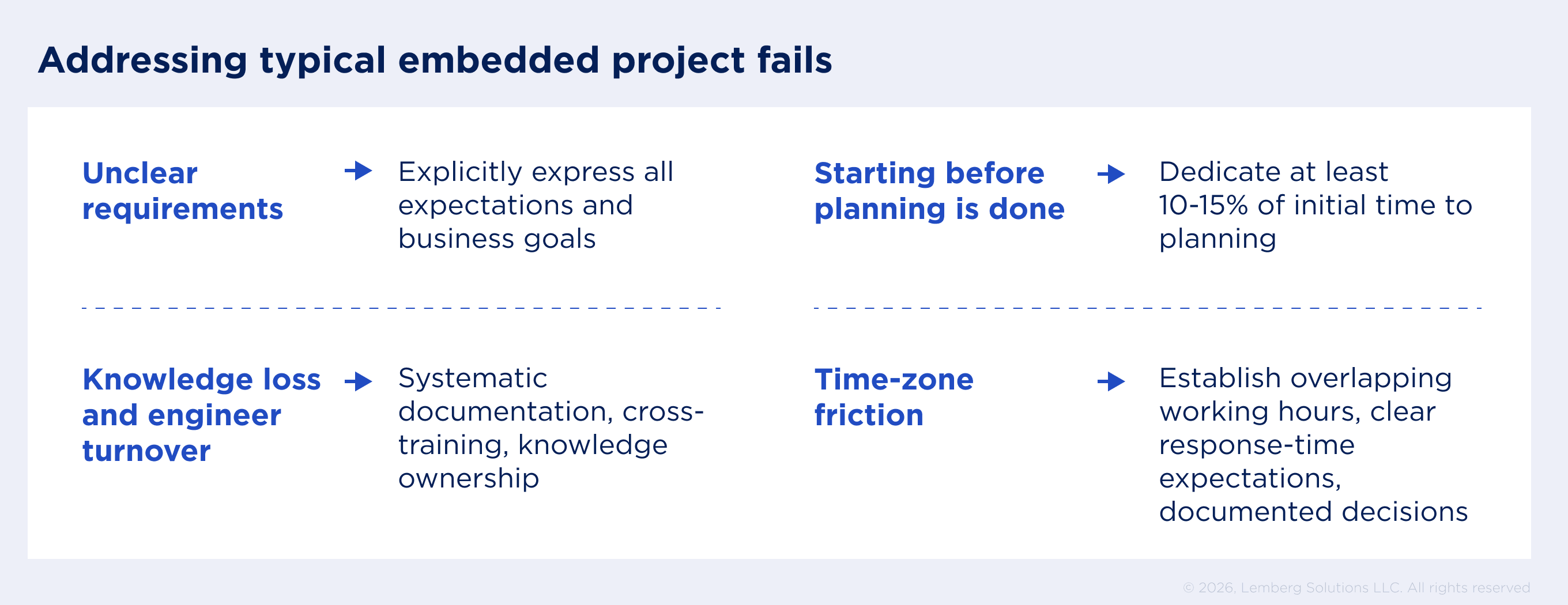
Unclear requirements pose the biggest problems. When the team does not know what the device must actually do, under what physical conditions, with what performance, power, timing, or reliability constraints, engineers will deliver a technically feasible product that can’t solve the client’s problem. An outsourced setting makes things worse: the vendor cannot rely on the informal product knowledge that an internal team has accumulated over years.
To avoid such situations, all members of the project team need to be on the same page; therefore, it’s crucial for you as the client to express all of your expectations and business goals.
Starting development too quickly is another surprisingly wrong approach. Teams sometimes want to "get developers started" before architecture, requirements, and dependencies are clear, creating a false sense of progress. But this only results in firmware written against assumptions, hardware changes needed later, and the team paying for integration and rework.
Decent preparation and planning at the beginning of the project build a solid foundation. It’s completely acceptable when the project manager dedicates at least 10-15% of the time to this stage.
Knowledge loss and engineer turnover are particularly painful for embedded projects. When a firmware engineer leaves a project, they usually take the knowledge that cannot be reconstructed from the source code: the nuances of a particular PCB revision, undocumented timing behavior, why a workaround exists, which sensor occasionally fails, or how a production fixture behaves.
Systematic documentation, cross-training, code reviews, and knowledge ownership integrated into project management can save you from such trouble.
Some discussions of remote engineering work also highlight significant time-zone differences as a burden, when a question raised by one side sits unanswered until the next working day, delaying the work dependent on that answer.
The solution here is to establish overlapping working hours, clear response-time expectations, documented decisions, and ensure enough autonomy for the remote team to keep progressing when the client is offline.
Speaking of the cost vs. time zone overlap vs. talent pool tradeoffs, we cover different engagement models in our article “Is the Dedicated Team Model Right for You?”

Final thoughts
Managing a remote embedded development team is different from managing a remote software development team in several aspects. Embedded projects combine software and physical hardware, so project delivery depends heavily on board availability, hardware revisions, firmware–hardware interfaces, debugging equipment, manufacturing lead times, and physical testing.
Engineers work across different technical domains and vocabularies — hardware, firmware, software, QA, product, and operations — which requires coordination points that a generic process does not fully address. This makes the management setup itself part of the engineering solution:
- Roles and ownership must be clear;
- Tools should cover both software development and hardware lifecycles;
- Hardware-firmware coordination needs a separate process;
- Remote labs, shipped development boards, documented interfaces, overlapping working hours, and structured communication actually remove practical blockers.