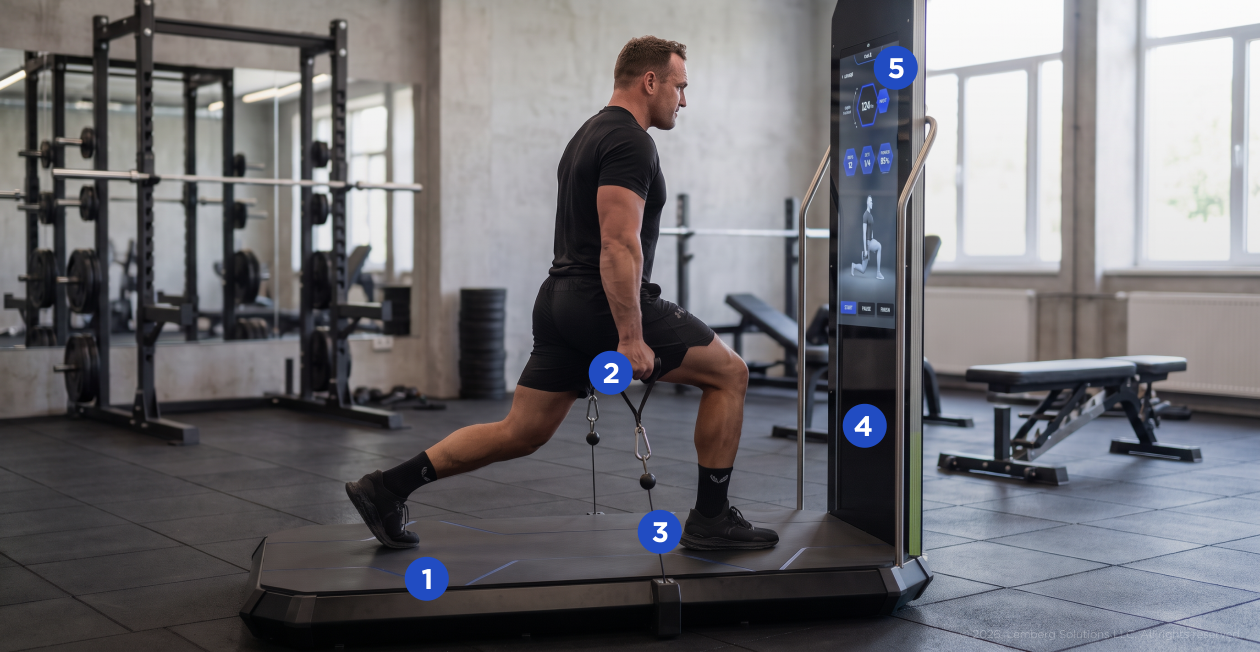
Speede: Investment-winning training machine for a US-based startup
About the client
Speede is an American fitness startup offering customers a way to reduce workout duration and enhance muscle definition with 50% more efficiency than other training equipment. By implementing an innovative, science-based approach to strength development, the company aims to revolutionize the experience for both professional athletes and at-home users.

The challenge
Inspired by the latest muscle science, Speede wanted to create a first-of-its-kind strength training machine that would incorporate isotonic, isokinetic, and eccentric training modes. The startup was planning to present its first working prototype during one of the US's most popular sports events, the Super Bowl, with ambitions to raise investments and gain popularity.
Unlike traditional powerlifting machines that leverage physical weights and gravity, a digital resistance machine simulates a physical mass using software-controlled electric motors. This poses technical challenges for energy and heat management, motor control under huge mechanical load, and physical safety assurance.
Delivered value

Solution
The client came up with a concept of a power-lifting machine that leverages digital resistance for simulating physical weight and can be used both by professional athletes and enthusiasts. It was projected to fit any environment and provide the load and efficiency of professional gym equipment — due to 500 lb resistance and a combination of isotonic, isokinetic, and eccentric training modes.
Real-life experience in remote conditions
The work on the device prototype started with creating a life-sized model of the device in the lab environment. The client’s concept presumed that the machine should be compact and lightweight enough for portability and home use, which implied space limits for all the necessary hardware. Thus, the life-sized model served for hands-on hardware selection, convenient hardware and electrical design, and system testing.
Hardware resilience
Based on the motor drive system and stack selected by the client, our team proposed matching hardware. It was important to consider the massive power needs of the 500-pound force generation as well as further energy dissipation for the eccentric mode that would eliminate overheating. We used a high-ratio reduction gear, a powerful 120-amp power unit, and Raspberry Pi control system that enabled quick prototyping — to meet the deadline for device presentation.
Accurate motor control
The machine simulates heavy weight with extreme motor torque multiplication. This same motor has to eliminate mechanical backlash from hardware and withstand sudden torque spikes. The firmware algorithm enables the motor drive to sustain extreme workout intensity and adapt to the pulling force a user applies. Safety mechanisms ensure millisecond system response to changes in user behavior and prevent injury or jamming in the high-load mechanism.
Multifunctional user interface
The device’s HMI relied on a sensor display with a Qt application fulfilling multiple functions, including device control and the provision of detailed exercise instructions. But most importantly, users get real-time feedback about the training status, their performance indicators, and even posture analysis. To implement this real-time feature, we developed an algorithm that could quickly extract motor motion and sensor data and transform it into performance insights.
Achieving seamless motor synchronization
While testing the device, one of the most important aspects was motor calibration using the 3D model. For a machine providing 500-pound resistance power, it’s critical that the two motors move in sync, simulate weight accurately and evenly, and adapt well to the user’s pulling force in the isokinetic training mode, where exercise speed stability is key.
To polish the system operation before the prototype presentation and help the client achieve their business goals, one of our embedded engineers traveled to the company’s office and worked with the actual device. This ensured more accurate quality assurance and secured smooth device performance during the decisive moment.
One of the most impressive things about Lemberg Solutions is their communication and the fact that they take ownership of the product. They truly not only understand what it takes from an engineering perspective, but work with the customer to understand what the business needs are as well.

How it works