Continuous fleet control and automated business operations for a UK agritech provider
About the client
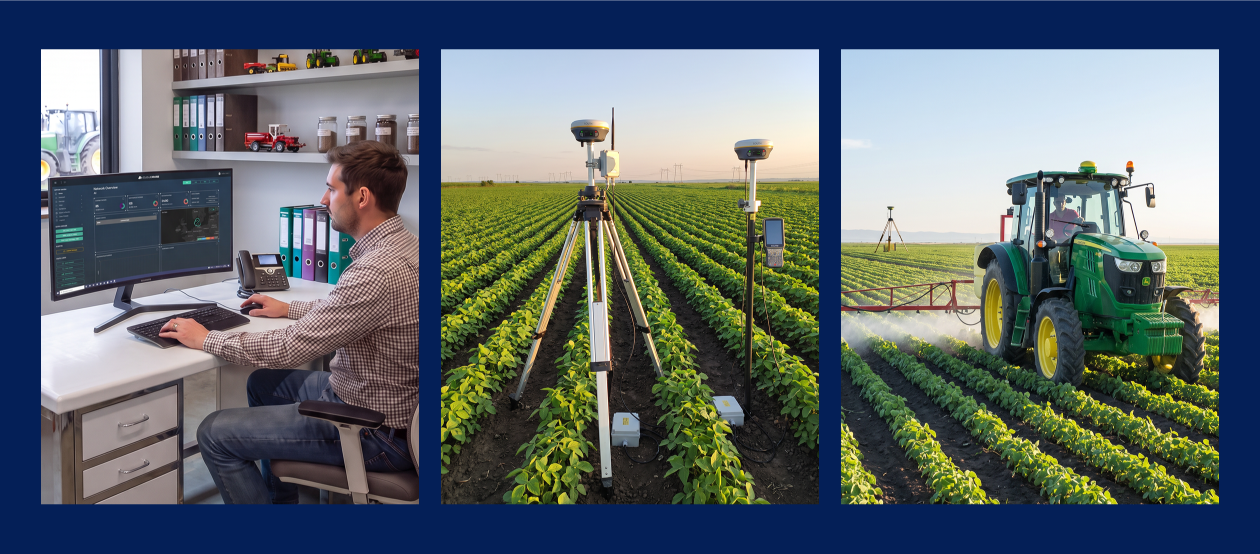
The client is a leading UK-based provider of real-time kinematic (RTK) solutions and connected control systems for agricultural machinery. The company is helping farming businesses increase fleet observability by supplying technology for process automation and management, as well as next-gen, fail-proof connectivity.

Challenge
The client’s system is a complex subscription-based service that connects farming machines with a cloud fleet management and administration platform. It relies on internet connectivity to deliver RTK corrections to the machines for centimeter-accurate auto-steering and remote fleet monitoring. To support the owner’s scaling plans across the UK and EU and deliver decent service quality, the system had to overcome certain technical limitations.
First of all, RTK signal receivers in the vehicles — modems — didn’t support other connectivity channels but the mobile (4G/GSM) network, which prevented remote control and auto-steering in locations without network coverage.
Secondly, the admin web-based platform relied on an outdated tech stack, architecture, and deployment process, bringing in high operational overhead, security vulnerabilities, and unstable performance. This posed a major obstacle to core business operations like managing client base and billing, as well as providing farmers with the fleet management service.
Delivered value


Solution
Any proper renovation starts with a complete review of the existing code and infrastructure. The system underwent a technical and security audit, which revealed coding errors, security weaknesses, and infrastructure inefficiencies.
The DevOps and cybersecurity engineer restricted access to databases and virtual machines and protected administrative features with VPN-only use. An automated CI/CD pipeline was set up for fast and secure application deployment with a rollback mechanism, reducing operational interruptions to zero. Due to service containerization and infrastructure updates directly in production, the downtime in RTK signal transfer during migration didn’t exceed 15 minutes.
Modernizing the system
To align the existing system with the client’s business goals, it was necessary to work with different components in parallel.
Embedded modem:
- The hardware transitioned to a new generation of MCU (ESP32-C5) that supports the 5GHz signal frequency from Starlink terminals and industrial cellular 4G modules.
- Firmware was updated to fit the new MCU, support dual-band WiFi (2.4 GHz and 5 GHz), and implement automatic Multi-WAN failover — to ensure a stable vehicle connection to the internet in case the mobile network becomes unavailable.
- A simple, mobile-friendly interface for quick, on-site device setup without installing any additional applications: network selection, server setup, or signal checkup.
- Implemented over-the-air (OTA) updates with a fail-safe mechanism provide easier maintenance and operational continuity in case the connection gets interrupted during the installation.
Web platform:
- The front-end portals supporting different business operations were stabilized to automate or streamline subscription management and billing, user administration, and real-time geolocation data transfer for live vehicle monitoring.
- Server back-end stack update and major solution code refactoring improved system stability and compatibility for future integrations.
- New features support business process automation: billing, managing subscriptions, registering customers' SIM cards, system health monitoring.
Infrastructure:
- Identified unused services and reallocated the freed resources to more efficiency-driving or high-priority infrastructure needs.
- Resolved the data overlap issue occurring when different dealers registered client companies with identical names. With user data isolated at architecture level, each dealer sees only their own clients and machines.
Their organization is very impressive, and the quality of the developers also stands out. They pick up the requirements quickly, even when developing obscure solutions, which makes handing over a project quick and easy.

How it works