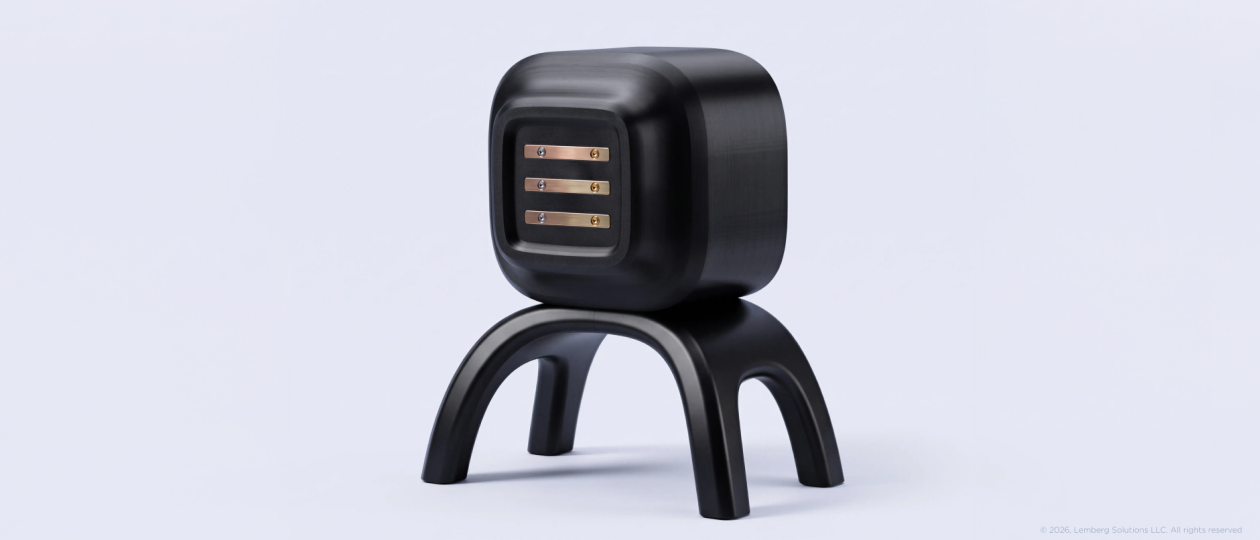
Hands-free charging dock for Plim, a home robot companion
About the client
Plim Robotics (formerly Devanthro), a Munich-based company that created Plim, a robot companion that keeps households running and families connected. Starting in elderly care, they work with families and care organizations to make everyday support available to more households.


The challenge
Plim is a robot companion that can handle everyday tasks and help people in households stay connected. Ahead of alpha tests in real conditions, the client wanted to make life with Plim even smoother: a robot built into a daily routine can’t wait for someone to plug it in. It had to dock without anyone plugging it in, charge, and return to work.
Electronics architecture, enclosure concepts, component selection, prototyping, manufacturing, assembly, and testing — all had to fit into three weeks, with no room for a second iteration.
Delivered value

Solution
In this project, our team took the dock from first concept to a tested prototype, covering schematics, architecture, component selection, detailed design, 3D printing, and assembly.
Every decision centered on one question: how should a charging dock behave in a room where people live? So, we started by developing several design concepts for the client to review. Throughout, we prioritized mechanics, electronics, safety, and ergonomics.
Mechanics. A robot driving into a dock will rarely line up perfectly, so we chose the contacts and designed the docking around that. The robot’s wheeled base drives into the dock, tolerating an angled approach, both vertically and horizontally, so the robot can arrive a few degrees off straight-on and still make a secure connection.
Electronics. The electronics are built around a certified, programmable off-the-shelf charger, configured for the robot’s power requirements. The dock starts charging as soon as the robot docks and stops automatically when the battery is full; a full charge takes up to 1.5 hours.
After the client selected the concept that best suited Plim, we 3D-printed the parts and assembled the mechanics and electronics into a working prototype.
Safety. Our team added a LED indicator and a third, low-voltage contact. It carries only a 12 V signal, which is safe, and it keeps the main contacts floating until docking is confirmed.
Ergonomics. Smooth, rounded forms and a wall-friendly cutout make the dock stable and unobtrusive, and the connector module is shaped to blend into the robot’s body.
The result is a two-part charging system: a compact connector module built into the robot’s body and a dock that plugs into a wall socket and receives the robot in 3 contact points.
Lemberg Solutions moved at an outstanding speed. They answered within hours, iterated fast, and assembled an on-demand team of mechanical, electrical, and systems design engineers over a weekend. When a German supplier quoted six weeks for the charging plates, the team sourced them in China through their own network. The engineering was solid: a lean, functional system architecture that met our requirements. Communication was clear, and the working solution fits Plim well. We are genuinely impressed and look forward to the next project.

How it works