

Choosing between in-house software development vs outsourcing is a strategic decision for businesses. With rising salaries, long time-to-hire, and a persistent talent shortage, many companies are rethinking how to strike a healthy balance between in-house and outsourced teams. While the in-house specialists require ongoing investments in recruitment, education, and retention, an outsourced development team provides ready-to-deploy expertise. It can supplement in-house capacity during peak load periods, accelerate delivery when deadlines are tight, and provide specialized expertise. Whether through team extension or a fully dedicated team, outsourcing brings skilled experts who shorten time-to-market and keep projects moving.
This article explores the key differences between in-house software development and outsourcing in terms of costs, operations, and supervision across Western markets. It also shows how external teams can strengthen business and delivery processes and how to choose the right partner.
What is the difference in cost structure for software development outsourcing vs in-house?
In-house developers typically cost 5–6x their base salary once recruitment, non-wage costs, and vacancy time are counted, while software development outsourcing vendors offer predictable, flat rates.
Recruitment cost
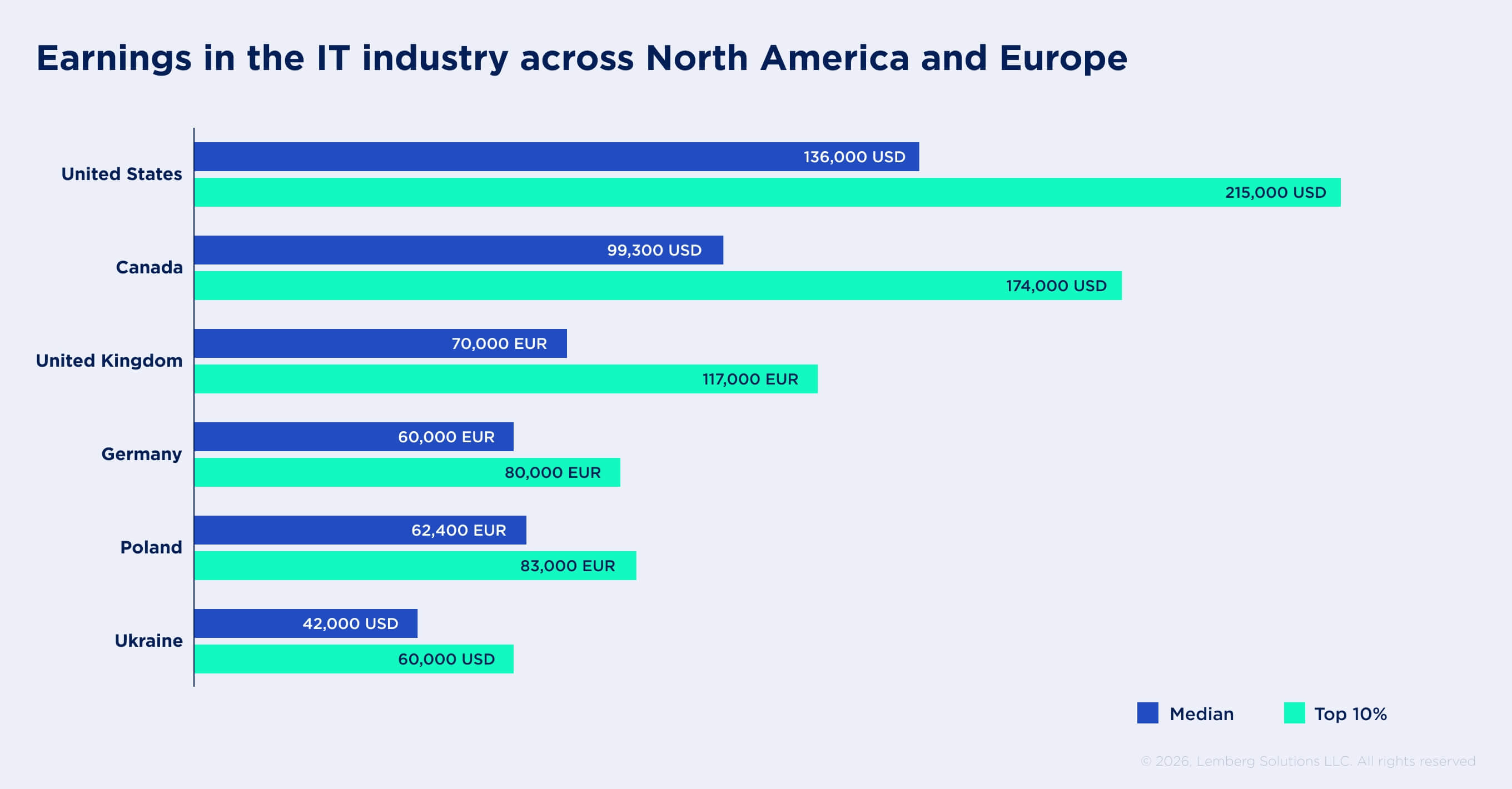
Most companies begin with internal recruitment, which is far from cost-free. First, it includes specialists’ salaries themselves. For example, according to the 2025 salary review, in Germany, a software development expert earns an average of €62,400 gross per year, excluding bonuses or equity. Meanwhile, US-based specialists have a median annual wage of $135,980 per year. Salaries vary significantly by role, seniority, and individual experience, and can reach up to €120,000 and $220,000 correspondingly for narrow in-demand specialists such as AI architects.
In addition, the recruitment costs also include salaries for recruiters, hiring tools, sourcing time, and months of effort that accumulate quickly. If internal recruitment is not successful, companies turn to external agencies. They typically charge 15–30% of the candidate’s annual gross salary, constituting an additional €13,000/ $30,000 in agency fees alone for software engineering roles that usually fall at the upper end of that range. At the same time, direct recruitment cost per hire (CPH) reaches €6,000–€12,000 or $6,200–$16,000 for one technical specialist, depending on seniority and location.
Expenses for outsourced software development teams are lower and much more predictable, with the recruitment costs largely absorbed by the vendor. Unlike in-house hiring, outsourcing clients pay a much more predictable daily or hourly rate.
The vendor distributes recruitment and talent acquisition costs across multiple projects, thereby significantly reducing the financial burden on any single client. The difference becomes even clearer over time. While an internal mis-hire can cost a company up to 30% of the engineer’s annual salary, outsourcing providers replace underperforming team members at no additional cost. Thus, an outsourcing software development company handles sourcing, screening, replacing, and scaling the team, while the client typically pays only for the capacity they actually use. This adds another value: clients scale up or down without restarting an expensive recruitment cycle each time.
Non-wage costs
For an in-house software development team, substantial non-wage costs, which include health, pension, unemployment insurance, paid vacation, bonuses, and other benefits, are added to salaries. As of 2026, on average, non-wage costs amount to 24,8% of an employee’s gross salary in the European Union and as much as 42.7– 46.0% overhead added on top of base wages in the US, covering employer-paid health insurance, legally required payroll taxes, paid leave, and retirement contributions.
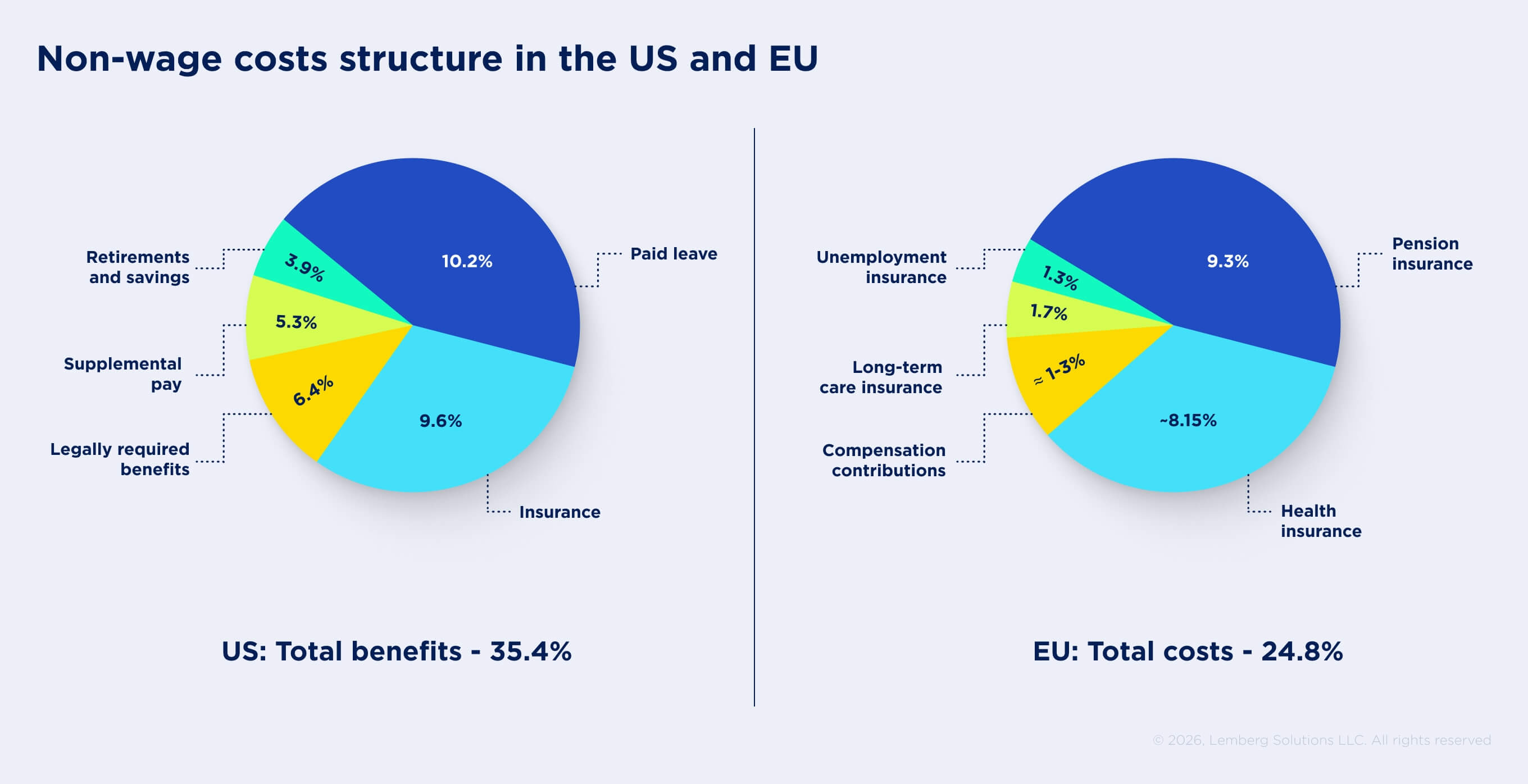
With outsourcing, non-wage labor costs are effectively baked into the software development vendor’s rate. The relationship changes from employer–employee to client–service provider, with the provider being responsible for specialists’ social insurance, payroll, and other non-wage costs. Instead of paying salary plus employer social charges, the client pays an agreed service fee.
Time-to-hire
Long time-to-hire for in-house engineers has become more costly in 2026 than earlier. Globally, the median time-to-hire for software engineering and specialized tech roles is 62 days, making it the slowest function in the talent market. In the Western economies, Germany has one of the slowest hiring cycles globally, with IT positions remaining vacant on average for 7.7 months in the country’s companies.
For senior roles, the hiring cycle alone can stretch up to 9 months. Adding the typical 3-month notice period, it can take 9–12 months before a senior developer can start. This way, an average vacancy costs may reach around €49,500 per open role. For senior embedded, AI, or security engineers, this “empty seat” quickly becomes one of the largest hidden cost drivers.
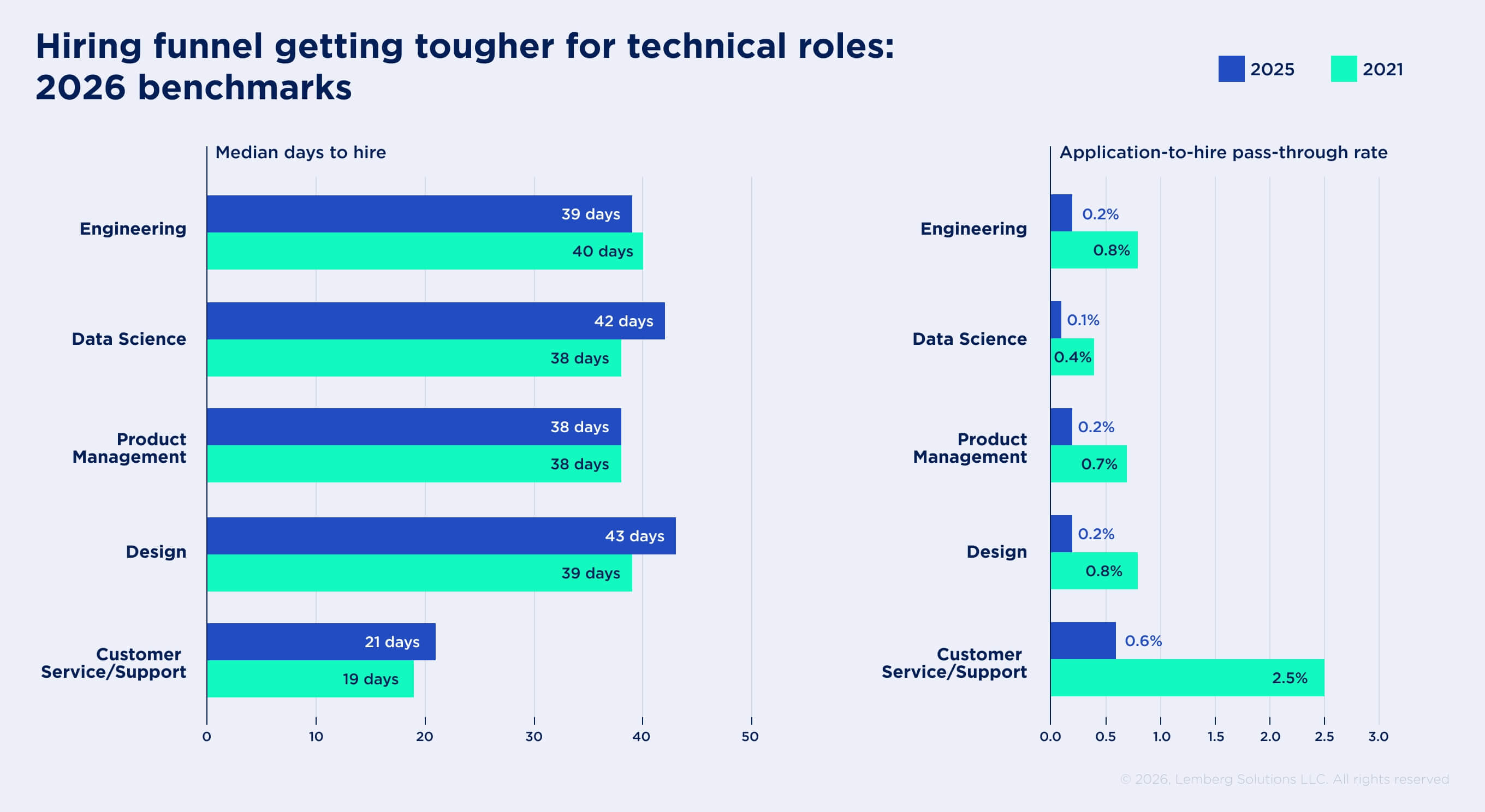
Time-to-hire is usually spent on sourcing and top-of-funnel screening, scheduling and conducting multiple interview rounds, waiting for offer approval, and negotiating it with the candidate. During this period, projects are delayed, or existing teams are overworked. Even after the contract with the specialist is signed, companies must plan for 2–3 additional months of onboarding, including familiarization with the product, codebase, industry specifics, and internal processes. In practice, this means that a role opened in January might only become fully productive toward the end of Q3, significantly impacting core business processes.
While the in-house IT positions remain vacant for up to 12 months, software development outsourcing can shorten this time by 2–8 weeks, dramatically reducing time-to-start.
The typical timelines are 1–4 weeks to assemble a small team (e.g., 2–5 engineers). Another 2–6 weeks for domain onboarding and knowledge transfer, depending on project complexity. Established vendors maintain an active engineering bench, internal talent pools, and ongoing recruitment pipelines, allowing them to fill specialized roles far faster than a single company could on its own. Furthermore, experienced software development teams often work in parallel with in-house teams, streamlining the delivery process and reducing delays.
Total costs for an in-house vs software development outsourcing
To understand the real financial impact of outsourcing software development, it’s important to compare the full cost of employing an engineer in the EU or the US.
We start with the median IT salary of €62,500/$134,000. Internal hiring, recruiting agency fees, and employer social contributions further increase the total in-house cost, and the typical long time-to-hire in the regional IT markets creates substantial vacancy losses compared to outsourcing.
The table below breaks down the total cost difference between in-house hires and outsourcing software development agency rates.
| In-house | Outsourcing | |
| Recruitment costs | €12,000/$16,000 | ~€ 0 direct recruitment cost |
| Non-wage costs | €17,500/$59,600 | ~0% (handled by vendor) |
| Time-to-hire | ~€30,000/$45,000 per role | ~€12,220/$13,900 |
| Education | ~€1,500/$1,800/yr per role | ~0% (handled by vendor) |
| Administrative overhead | ~€9,100/$6,800 | ~€200/$230 |
| Total cost impact per engineer | ~€70,100/$129,200 | ~€12,420/$14,130 |
In-house vs. outsourcing software development: which should you choose?
Choose in-house development when your priority is direct managerial oversight, daily workflow control, and strict adherence to internal, regulation-biased standards. Choose outsourcing when you need to develop or scale a product, move fast, or bridge specialized skills gaps without carrying fixed headcount liabilities, non-wage overhead, or local hiring bottlenecks.
You can see more details in the software development in-house vs outsourcing comparison table below:
| Hiring model | In-house | Outsourcing |
|---|---|---|
| Cost structure | Recruitment + non-wage + time-to-hire + training + bureaucracy | Vendor rate covers direct and hidden costs |
| Time to start | Slow: 40–75 days for recruitment, vetting, and onboarding | Fast: 1–4 weeks with pre-vetted, ready-to-deploy teams |
| Control level | High: Full direct management over daily workflows, code quality, culture, and architecture | Medium to High: Shared governance managed via SLAs, KPIs, and vendor project managers |
| Scalability | Rigid: Scaling up takes months; scaling down is constrained by legal notice periods and severance | Flexible: Scale team capacity up or down on demand based on project scope |
| Best for | Need for direct workforce management, strict regulatory labor standards, un-siloed domain knowledge, architectural continuity. | Cost-efficient product development, rapid market launch, niche technical expertise, temporary capacity spikes. |
An internal team provides complete, hands-on managerial oversight over daily workflows and engineering culture, while ensuring strict alignment with internal security compliance frameworks (SOC 2, ISO 27001) and regulatory labor standards. On the other hand, it requires ongoing investments in recruitment, continuous onboarding, non-wage labor overhead, and compliance with strict statutory termination laws. In-house hiring remains the traditional choice for organizations that prefer direct management of their technical workforce under a single payroll. Recruitment, onboarding, and continuous training costs can be worth the long-term returns and the benefit of keeping specialized domain knowledge within the company.
Software development outsourcing eliminates fixed headcount commitments, non-wage labor burdens, and complex regulations — all while handling core products and multi-year roadmaps. Reputable providers enforce robust Master Services Agreements (MSAs), NDAs, and Work-for-Hire contracts that legally guarantee 100% IP assignment to the client. Outsourced engineering teams help eliminate high-tier payroll overhead, can deploy within 1 to 4 weeks, and effectively bridge specialized technical skills gaps, delivering long-term product continuity, high quality, and total intellectual property ownership at the same time.
If you are a growing company building a core product but without the resources necessary for internal hires, you can go for a hybrid model: start with an outsourced team to close a near-term skills gap, and bring in-house specialists once your project gets more stable, merging your internal and external efforts.
How managing skill gaps, education, and retention compares for in-house software development vs outsourcing
Skills gaps and the limited specialization of software development teams are structural issues. As of 2026, only in the US, there are over 900,000 unfilled engineering and IT roles, with Korn Ferry's Global Talent Crunch study forecasting a worldwide shortage of 85.2 million technology professionals by 2030 and companies struggling to fill expert roles, such as AI and cybersecurity specialists.
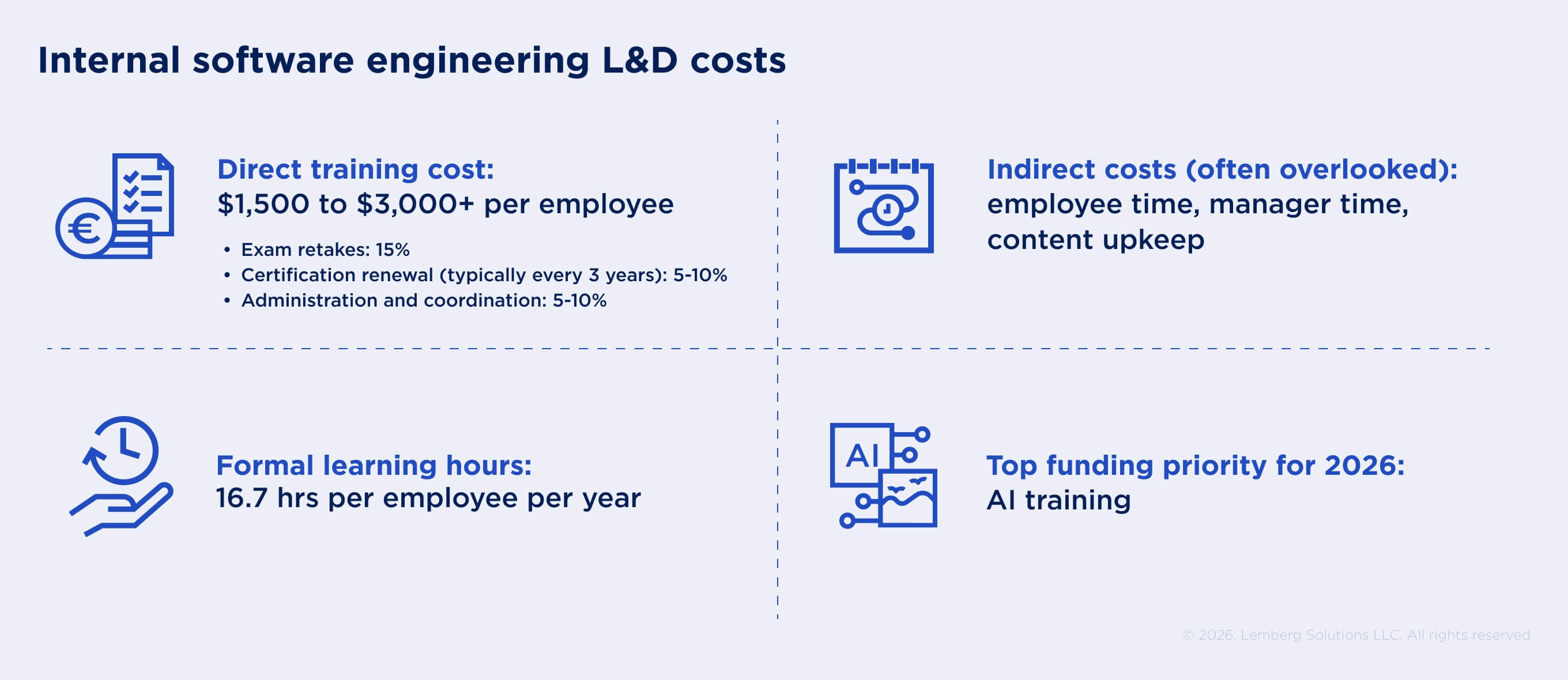
Even when companies succeed in hiring top experts in-house, they must plan for ongoing investments in their education and retention. For example, in 2025, US companies in general spent $874 to train one employee, with 25% of organizations planning to increase AI training funding in 2026. Meanwhile, additional spend for high-end software engineering certifications can easily add several thousand USD per engineer per year. While resource training is the right approach for improving in-house expertise, maintaining and retaining deep in-house expertise across areas such as embedded systems, IoT, cloud, and AI/ML is not easy.
That’s where software development outsourcing may help. It bridges the persistent engineering skills gap by providing instant access to expertise that is hard to build in-house due to time or resource constraints.
Furthermore, outsourced software development teams often share their experience with clients’ internal teams, thereby enhancing their expertise. They often work in tandem with internal teams, supplementing in-house expertise, thereby covering niche skills, accelerating delivery, and allowing internal teams to focus on their core strengths.

What is the administrative overhead when hiring in-house and outsourced development teams?
Hiring in-house experts is always accompanied by compliance burdens and strict employee protection regulations that vary by market.
For example, in the United States, this comes with complex multi-state regulatory compliance, security auditing, and labor standards. Some states require good-faith salary ranges and benefit descriptions on all job postings and impose strict prohibitions on salary history inquiries. To satisfy SOC 2 Type II and ISO/IEC 27001 enterprise audit standards, companies enforce mandatory background vetting for candidates, strict Identity and Access Management (IAM) provisioning, and documented compliance logging.
In Western Europe, in-house software engineering hires operate within highly protective, statutory employment frameworks and strict EU regulatory mandates. In France and Germany, employee dismissals can’t go without strict legal justification, formal warning procedures, statutory notice periods, and mandatory severance. German and Dutch employers must submit software engineering hiring requisitions, compensation structures, and remote-work monitoring policies to internal Works Councils for formal co-determination approval. General Data Protection Regulation (GDPR) severely restricts employee tracking tools and candidate vetting.
In addition to employment law, companies must comply with rigorous regulatory obligations. From 20 employees who work with personal data, German law requires appointing and registering a data protection officer, which adds cost and organizational effort. In industries that handle highly sensitive data, the bar is even higher.
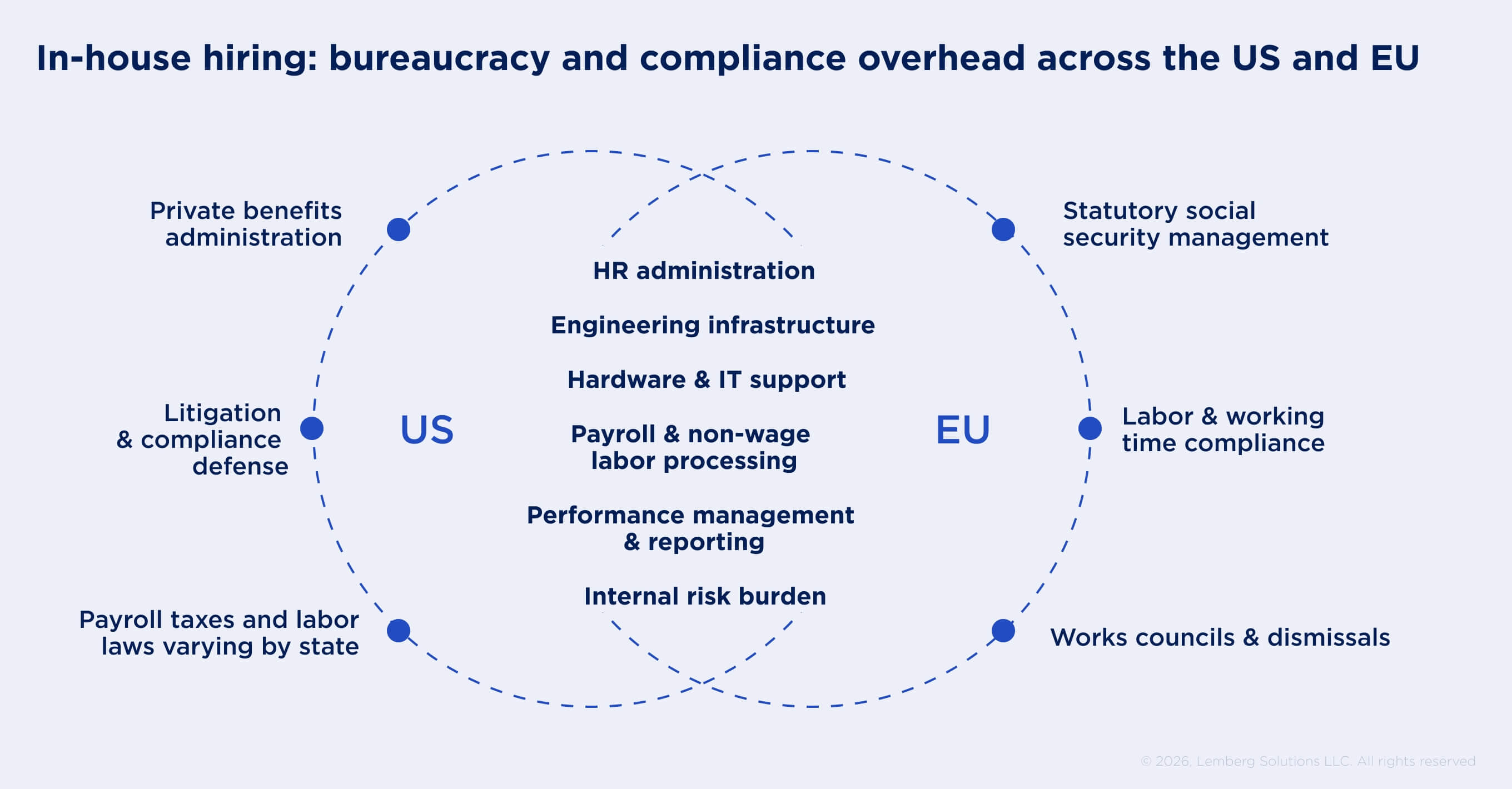
By choosing an outsourcing software development team, the compliance workload falls on the provider. Reputable outsourcing partners follow GDPR-aligned workflows and maintain ISO/IEC 27001–based security management. This means much of the operational compliance work, such as security documentation, access governance, audit evidence, and data-processing safeguards, comes built into the partner’s established processes.
Another advantage is scalability. Companies can expand or reduce their engineering capacity upon requirements, without the administrative overhead, long notice periods, or contractual rigidities typical of in-house teams. Outsourcing vendors maintain a continuous talent pipeline, allowing clients to add specialists within weeks, temporarily boost capacity during peak workloads, or scale down when a project enters a maintenance phase.
What is the supervision workload for in-house teams vs outsourced engineers?
Managing an in-house engineering team requires continuous coordination, performance management, mentoring, conflict resolution, and administrative oversight. These responsibilities generally fall on product owners or engineering managers. Boston Consulting Group's 2024 study found that more than 30% of internal technology development projects run late or over budget, with a lack of alignment between the technology and business sides cited as the top cause. Moreover, 62% of German mid-sized companies report that internal IT teams consume too much management capacity, slowing down decision-making and product delivery.
Reputable software development vendors have their own project managers, delivery leads, and QA coordinators, ensuring smooth workflows, sprint planning, documentation, and reporting. Instead of excessive supervision, the client communicates with one or two responsible people, discusses priorities, and focuses purely on business outcomes.
External teams operate within established delivery frameworks such as Scrum, Kanban, SAFe, or ISO–aligned development workflows. This results in predictable communication, cleaner documentation, and fewer managerial bottlenecks.
Community discussions by practitioners show that offshore teams generally provide on-time delivery and proactive communication when the vendor is good. On the other hand, time zones and quality control remain recurring complaints.
How to choose the right outsourcing partner
Choosing the right outsourcing partner requires a balance of technical expertise, transparency, and operational maturity. Look for a vendor with proven expertise in embedded, AI/ML, and cloud, and a track record of delivering stable, long-term engineering teams.
A reliable outsourcing software development company should offer clear budgets, communication timelines, and full responsibility for recruitment, screening, replacement, and team scaling. Prioritise partners who work with transparent processes, provide access to specialised talent without additional fees, and demonstrate cultural compatibility and proactive project management. The right partner not only reduces operational overhead but also accelerates delivery and strengthens your internal capabilities.
FAQ
In-house vs. outsourcing software development: which costs less?
Outsourcing costs significantly less in the short-to-medium term because it eliminates non-wage labor overhead, direct recruitment costs, annual training expenses, and heavy regulatory compliance burdens. It also bypasses costly vacancy delays from long time-to-hire cycles through flexible, pay-as-you-go outsourcing models. Thus, while vendor billing rates do include provider margins, the overall total cost of outsourced labor remains substantially lower.
Is in-house software development better than outsourcing for long-term products?
In-house development is the ideal choice when a company prioritizes direct managerial oversight, control over daily engineering workflows, and an internally embedded corporate culture. However, an outsourced team is equally capable of supporting core, long-term products, building deep domain expertise, and contractually guaranteeing 100% IP ownership from day one. Outsourcing becomes the superior strategic option when organizations need to bypass severe local talent shortages and 40-to-75-day hiring bottlenecks, accelerate launch speed, access niche expertise, or avoid ongoing fixed labor overhead and strict EU/US termination compliance burdens.
Can you combine in-house and outsourced development teams?
Yes. By combining the two models into a hybrid team-augmentation structure, companies leverage internal technical leadership and knowledge-base control alongside the speed, scalability, and specialized expertise of external talent. This model bypasses severe local talent shortages, 40-to-75-day hiring bottlenecks, and permanent non-wage overhead while maintaining full contractual IP ownership and strategic alignment. Internal leaders retain overall product vision and success oversight, while external engineers accelerate execution or handle specialized modules without adding fixed labor liabilities.
Conclusion
Choosing between in-house software development and outsourcing comes down to balancing direct managerial oversight and internal company culture against execution speed and operational flexibility. While an in-house team offers hands-on control over daily workflows, outsourcing provides immediate relief from severe talent shortages, extended hiring cycles, and heavy compliance burdens. At the same time, dedicated teams can provide long-term core development and guarantee IP ownership at a level in-house teams do.
Ultimately, sustainable tech expansion rarely comes from picking one model exclusively; most high-performing engineering organizations run both side by side, maintaining core architectural leadership internally while scaling execution speed and specialized skills through external partners.