
RFID stands for radio-frequency identification and is commonly used for tracking. NFC means near-field communication and is associated with contactless payments. For a connected product, the technology choice affects the hardware requirements, reading distance, security measures, and how users interact with the device.
The answer to the RFID vs NFC question is simple. RFID automatically identifies tagged items, often from several feet away and many at a time. NFC is a specialized, short-range form of RFID that works only when a phone or reader is held almost against the tag.
The reader is often the deciding factor. Most smartphones support NFC, so users can interact with compatible tags without buying a separate reader. UHF RFID, by contrast, typically requires one.
RFID vs NFC comparison
| Attribute | RFID | NFC |
|---|---|---|
| Reader | A dedicated reader is required for UHF & LF; HF tags can sometimes be read by phones | Built into most smartphones; dedicated readers are optional |
| Frequency band | LF: 125–134 kHz; HF: 13.56 MHz; UHF: 902–928 MHz (US) | 13.56 MHz (HF) only
|
| Typical range | LF: ~4 in (access fobs), up to ~3 ft with larger antennas; HF: up to ~3 ft; UHF passive: ~10–25 ft (up to ~50 ft in special cases); Active tags: ~300 ft | Up to ~1.5 in (4 in max)
|
| Communication direction | Reader-initiated communication: the reader queries, and the tag responds | Multiple modes: reader/writer, card emulation, and peer-to-peer communication |
| Security model | Varies widely: basic tags have little or no encryption, though most support simple passwords to lock memory; advanced tags support cryptographic authentication | Very short range limits eavesdropping; supports encryption and secure elements (used in mobile payments) |
| Typical tag cost | Passive UHF tags: ~$0.04–0.25 each, depending on volume; active tags: $10+ | NFC tags: ~$0.10–1.00+ each, depending on chip, form factor, and volume |
| Common use cases | Inventory management, supply chain and asset tracking, toll collection, animal ID | Contactless payments, access cards, device pairing, product authentication |
What is the difference between RFID and NFC?
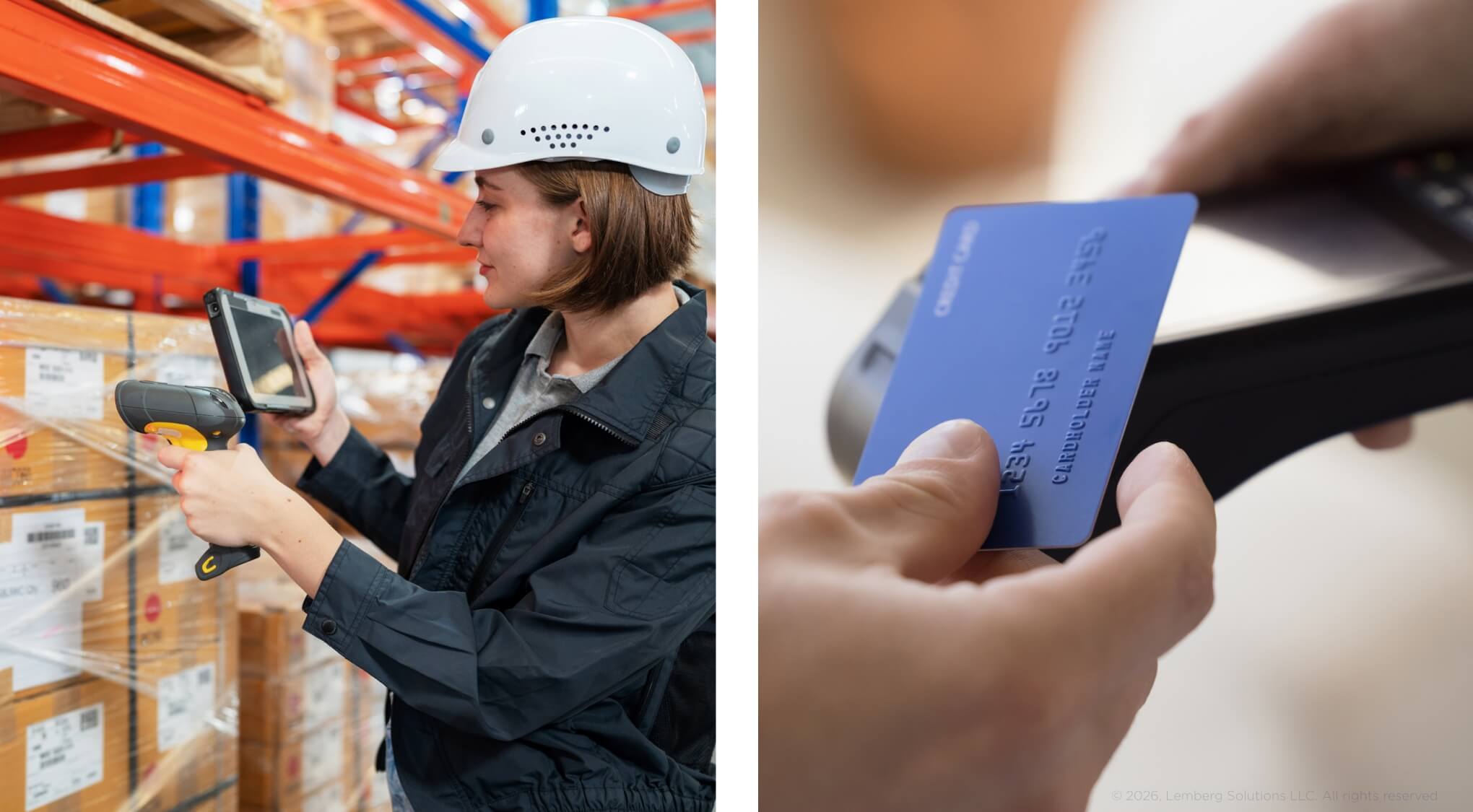
RFID is an umbrella term for wireless technologies that use radio waves to identify tagged items, mainly automatically, in bulk, and at a distance. NFC is a subset of RFID that uses one frequency, works at near-touch distance, and supports two-way communication. For a product team, the critical question is whether the user already carries a reader. For NFC, the answer is usually yes. For UHF and LF RFID, it’s no. Regular phones can’t read those tags, so you’ll need dedicated readers, and someone has to pay for them and keep them running.
One detail matters if you need to develop a product intended for more than one market. UHF RFID systems in the US run at 902–928 MHz, while Europe allows 865–868 MHz (915–921 MHz for some countries). A product sold in both regions needs to be designed for these bands from the start.
RFID vs NFC range: How far can each one read?
Passive RFID tags can be read from just a few inches (several centimeters) to about 25 feet (7.6 m) away, depending on frequency. NFC works only within about 1.5 inches (3.8 cm). But that’s not a flaw. Engineers designed it that way on purpose, so a read happens only when the user chooses to tap.
According to GS1, the standards body behind retail RFID, low- and high-frequency tags can be read from up to 3 feet (1 m) away. RFID Journal states that ultra-high-frequency (UHF) tags usually reach 10–25 feet (3–8 m), and battery-powered active tags reach about 300 feet (90 m). That’s why you can put an RFID portal at a dock door and have it log every pallet rolling in or out, with nobody scanning anything. Many RFID-based IoT solutions for asset tracking work similarly.
Don’t take the published numbers too literally, though. Metal surfaces, liquids, tag orientation, antenna placement, and interference can all affect performance. Putting the antenna inside a finished product enclosure can make it behave differently than it did in lab testing. Run a test with your tags and readers in the actual environment.
NFC is the opposite case. It only reads when someone taps, which is exactly what you want in a payment wearable or a smart lock.
So if you need to spot items from several feet away, or lots of them at once, go with UHF RFID. If a read should only happen on purpose, NFC is the best choice.
Which is more secure, RFID or NFC?
NFC is harder to intercept because the device and the reader have to nearly touch. But neither technology is secure by default. Security depends on the chip you choose and how the system around it is designed, built, and managed.
The basic weakness of RFID is that any compatible reader within range can pull a tag's data. TechTarget calls this RFID's biggest disadvantage, and the risk is real. Older 125 kHz access cards, for instance, can be cloned in seconds with an inexpensive device. In most cases, the answer isn’t to abandon RFID but to upgrade the credential. Security specialists typically recommend encrypted cards such as MIFARE DESFire or HID Seos, which, when configured correctly, are practically impossible to copy.
This raises a question that teams often address later than they should: who owns the security layer? A ready-made module shortens time to market and frequently includes built-in security, but it also locks you into the vendor’s decisions. A custom design becomes more cost-effective at scale and keeps the encryption keys under your control. Our team provides embedded development services to help you evaluate these options before you commit to the hardware design.
NFC is more resistant to attacks by design, and it’s one of the reasons why it became the standard for contactless payments. Phone-based credentials add another layer: on iPhones, for example, the key stays locked in the phone's Secure Element and can't be copied off the device.
For access control, payments, or identity verification, choose NFC with an encrypted chip or mobile wallet integration. Standard RFID is typically enough for inventory or asset tracking, but encryption is recommended if tag data could be misused.

RFID vs NFC cost and UX: Which costs less and feels better to use?
Typically, passive RFID tags are cheaper. Across the full system, however, NFC often has the lower total cost, and it’s more suitable for anything user-facing.
The reader is a key factor here. With NFC, your users’ phones are the readers, so your hardware cost is mostly the tags and, if your device reads NFC itself, a small NFC chip. With UHF RFID, you also pay for every reader, antenna, and the software behind them.
Cost
As of 2026, according to AssetPulse, passive RFID tags cost from under $0.10 (basic) to over $10 per tag (ruggedized), while the price of active RFID tags varies from $10 to $50+ each, depending on their construction.
NFC tags cost about $0.10–1.00+ each, depending on chip and form factor, and they don’t require any dedicated reader hardware. On the device side, an off-the-shelf NFC module like the IoTize TnL-FIT203 costs about $26.14 per unit, while a custom design can bring the unit cost down at higher volumes.
User experience
For users, NFC means one familiar gesture. Most people already tap their phones to pay, so pairing or unlocking a device the same way feels natural. It’s also easy to build simple workflows around it. A SparkFun forum user described sticking NFC tags on top of wine bottles in cold storage so his phone could pull up a photo of each label and look the bottle up in Evernote as a database, without any code.
RFID, by contrast, works in the background: tags are read automatically, with no action from the user. That's ideal for automated tracking, but awkward when the product needs the user to feel that something just happened. Devices people use every day nearly always need that feedback, which is why our consumer electronics projects lean toward NFC for anything user-facing.
If customers interact with your product using their own phones, choose NFC and skip the reader infrastructure. If you're tracking high volumes where nobody should have to tap anything, opt for RFID, because its upfront reader investment usually pays off at scale through less manual work.
RFID vs NFC tags: What changes when you're sourcing hardware?
An RFID tag and an NFC tag can look identical, but each is optimized for different purposes: UHF RFID tags are built for long-range bulk reads, and NFC tags for deliberate, one-at-a-time taps.
NFC tags most commonly use NXP NTAG or MIFARE chips with small rewritable memory. Phones read them one at a time, while RFID readers can query hundreds of tags in seconds.
The trickiest part of the RFID tag vs NFC tag question is labeling. Some tags marketed as "NFC tags" use chips like MIFARE Classic, which isn’t an official NFC Forum tag type and uses proprietary encryption, so iPhones can’t read them, as a developer has reported. Before you order, check whether a tag is NFC Forum-compliant. When people compare NFC vs RFID tags or NFC tags vs RFID, they often mean NFC tags vs UHF RFID tags, since that's where the real trade-offs sit.
RFID tags vs NFC tags comparison
| Factor | RFID tag | NFC tag |
|---|---|---|
| Common chip standards | HID Prox, EM4100/T5577 (LF access fobs), ISO 11784/11785 (LF animal ID, e.g., USDA 840 tags), ISO 15693 (HF), EPC Gen2 / ISO 18000-63 (UHF; 902–928 MHz in the US) | NTAG21x, NTAG 424 DNA, MIFARE Ultralight, MIFARE DESFire |
| Memory/rewrite support | From read-only IDs to a few KB of user memory | 144–888 bytes on NTAG21x; multiple memory capacities on DESFire EV3; rewritable & lockable |
| Multi-tag read | Yes, hundreds in seconds with UHF (HF ISO 15693 also supports multi-read) | Typically, one tag per tap |
| Typical unit cost | Passive UHF tags: ~$0.04–0.25 each, depending on volume; active tags: $10+ | NFC tags: ~$0.10–1.00+ each; more for secure chips like NTAG 424 DNA |
| Best-fit use case | Retail inventory, logistics, livestock, tool tracking | Authentication, pairing, access, consumer interaction |
How do you choose between RFID and NFC for a connected product?
Start with one question: who holds the reader? If it’s your customer’s phone, choose NFC. If you install the reader yourself, at a dock door, on a shelf, or inside your own device, RFID becomes an option. In addition, pay attention to the interaction your product requires: choose RFID for automated, bulk, or long-range identification, and NFC for a deliberate, single-tap action. Some products need both. A retail item might carry an RFID tag for inventory tracking and an NFC tag so customers can check that it's genuine with their phone. Dual-frequency tags are made for exactly this.
The examples below show how this logic plays out.
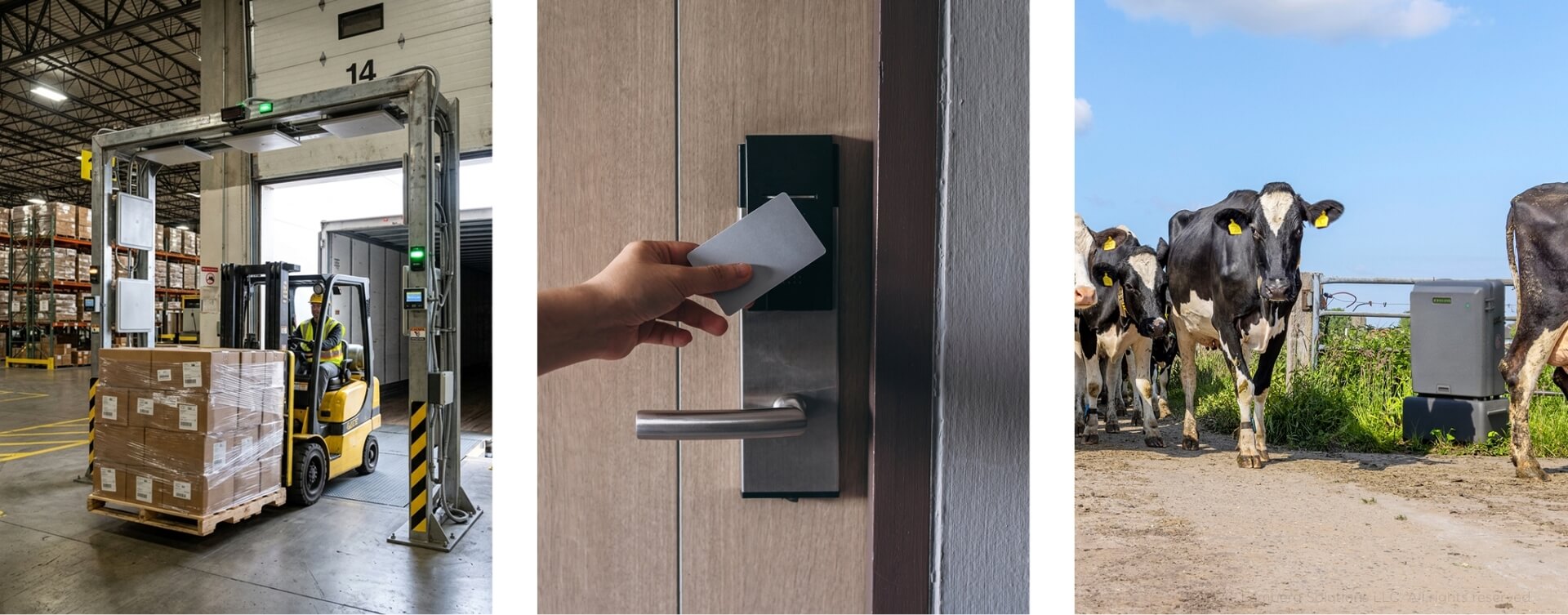
- Warehouse asset tracker. Hundreds of items, nobody tapping anything, readers at the doors. Need: reading many items at a distance. Choice: long-range (UHF) RFID.
- Smart lock or payment wearable. One user, one action, must work with phones or payment terminals. Need: security and compatibility. Choice: NFC with an encrypted chip.
- Livestock monitoring system. Rough conditions, tight budget. Need: reliable short-range reads. Choice: low-frequency (LF) RFID. For US cattle moving between states, tags must also be USDA-approved.
Common use cases: RFID or NFC
| Use case | Best fit | Why |
|---|---|---|
| Warehouse/pallet tracking | UHF RFID | Bulk reads at 10+ feet |
| Smart lock, access credential | NFC (new designs) | Deliberate tap, phone and mobile-wallet support, secure chips; many US buildings still use older 125 kHz cards |
| Mobile payments | NFC | Used by Apple Pay, Google Pay, and contactless cards |
| Livestock ID | LF RFID (UHF also accepted by USDA) | LF works near water and tissue; UHF suits fast reads at chutes |
| Product authentication | NFC | Consumers verify with their own phone |
| Retail inventory & customer engagement | Both | UHF for stock (required by some US retailers), NFC for the shopper to check product details |
If you're unsure which way your product leans, validate the choice before you commit to antenna layouts and tooling. Lemberg Solutions’ embedded consulting team can review your requirements and help you choose the right technology.
Conclusion
RFID and NFC rarely compete for the same role. The main question is who holds the reader. When it’s the user’s phone, NFC is the clear choice. If you install and manage the readers yourself and want to track goods without anyone tapping anything, RFID is the better fit. Most other hardware choices follow from that one decision.