

AI, like ChatGPT, has gone from a premium to a mainstream productivity tool across enterprises and industries. Tasks that once required significant time, expertise, or human resources can now be completed in seconds. Yet, generative AI still has important limitations. It can assist with ideas and content, but it cannot independently execute business processes.
That’s why AI is evolving to the next tech layer—agentic AI that can not only process information but also plan tasks, interact with software tools, and perform work across business systems and internal databases. Rather than operating solely within a chat interface, AI agents can retrieve data, trigger actions, coordinate multiple steps, and verify results before completing tasks.
This shift is why many organizations are exploring how to transform their AI tools into autonomous work units. Continue reading for a detailed generative AI vs agentic AI comparison, including their capabilities, architectural differences, and the business scenarios where each delivers the most value.
Key difference between generative AI and agentic AI
The main difference between agentic AI and generative AI is that generative AI is a creator; agentic AI is a doer. This is the easiest distinction to make between the two.
Generative AI produces outputs based on the data it has learned, but doesn’t adapt in real-time or interact dynamically with systems. The more accurate the data, the better the results. In contrast, agentic AI is dynamic. It constantly processes new information, learns from its environment, and adjusts its actions accordingly.
See the table below for a broader distinction between generative AI vs agentic AI.
| Dimension | Generative AI | Agentic AI |
|---|---|---|
| Purpose | Produce outputs | Get outcome-based autonomous action |
| Core function | Generates content (text, images, code, audio) in response to a user’s prompt or request | Make autonomous decisions and have the ability to pursue complex goals with limited supervision |
| Human interaction | High; requires constant supervision and prompting | Low; requires goal setting |
| Architecture | Low effort for integration because of available, ready-made instruments | Requires custom development and testing |
| Infrastructure | Minimal resources (for tools like ChatGPT or Gemini) | More complex infrastructure due to the functional capabilities that the agent provides |
| System integration | Usually plugs in lightly with existing systems | Requires deep integration with (CRM), (ERP), and other apps via APIs |
| Relies on | Uses large language models (LLM) and other technologies | Brings together large language models (LLMs) with traditional programming. At the same time, it can also have classic deep learning |
| Best at | Drafting, ideation, summarization, code generation | Automation and multi-system coordination |
| Weak at | Long multi-step execution | Creativity without clear goals; brittle in messy environments |
Why this distinction matters for regulated industries
In regulated industries, the agentic AI vs generative AI differences directly affect accountability and regulatory exposure. While generative AI mainly assists human decision-makers, agentic AI can autonomously execute multi-step workflows, raising the bar for governance, monitoring, and safety controls. As a result, selecting the appropriate AI approach, as well as partnering with providers of specialized AI development services, influences not only efficiency and cost structures but also compliance readiness.
Healthcare
In healthcare environments, AI technology decisions are inseparable from patient safety and data protection. Regulatory frameworks governing medical records and clinical systems require precise control over sensitive information.
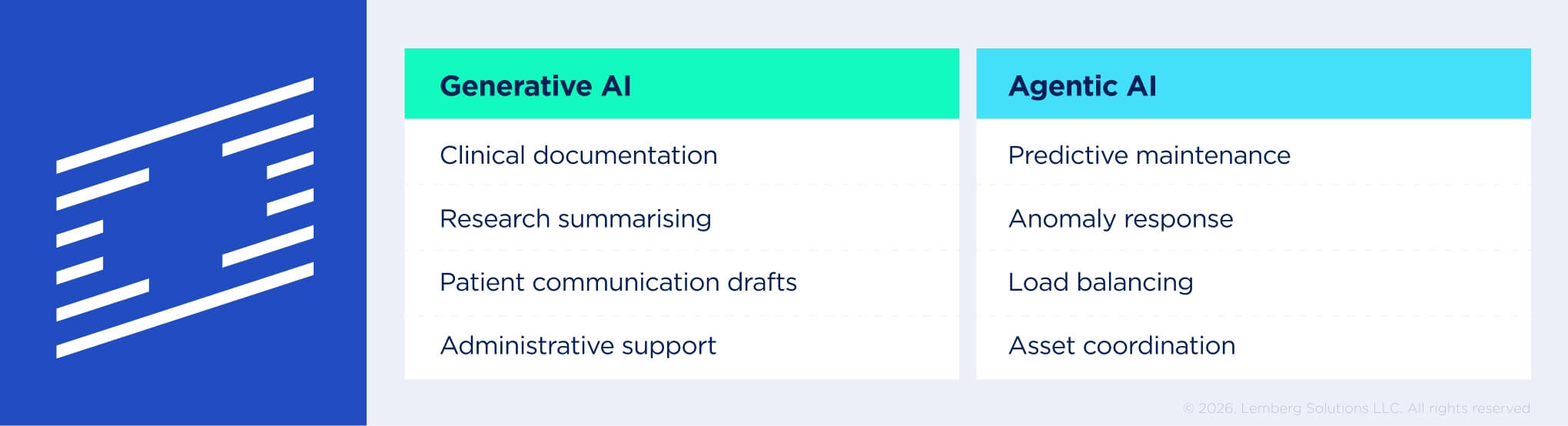
Generative AI is therefore most often used as a support tool, helping clinicians draft documentation, summarize research, or reduce administrative workload. Medical professionals keep full responsibility for decisions.
Agentic AI operates closer to core operations. It can coordinate appointment scheduling, assist in patient triage, monitor connected medical devices, and optimize hospital resource allocation. Because these systems influence real clinical workflows, they must meet higher standards of validation, oversight, and traceability.
Energy
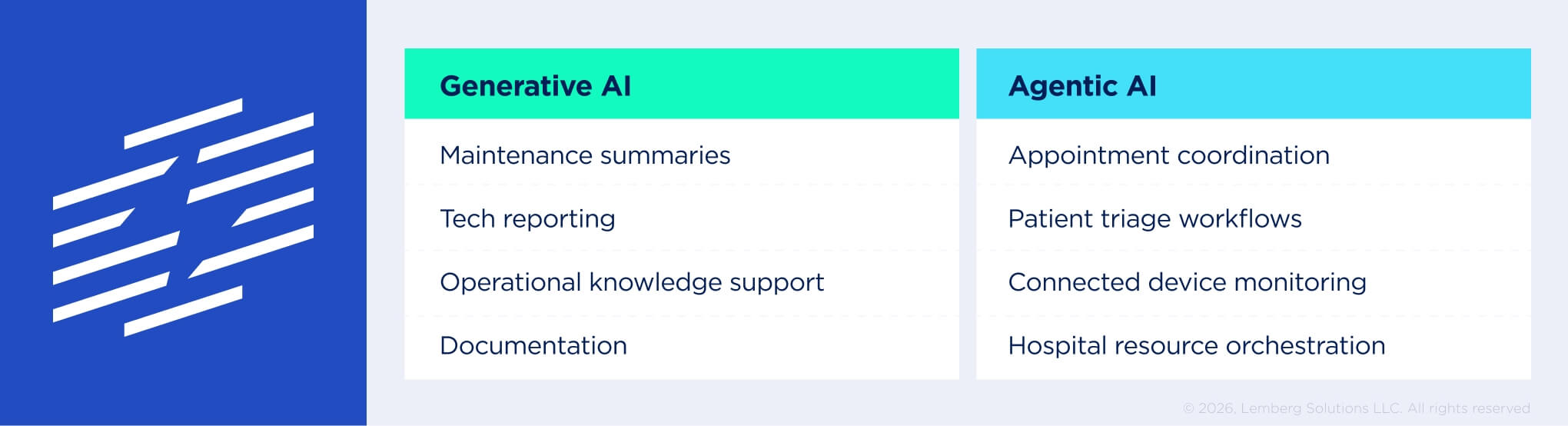
Energy systems rely on continuous operational stability. In this context, engineers use gen AI primarily to prepare technical documentation, summarize maintenance reports, and manage operational knowledge bases. Agentic AI, however, can take a more active role in grid operations. It may balance energy loads, optimize distribution networks, coordinate predictive maintenance activities, or respond automatically to equipment irregularities.
Manufacturing and industrial operations
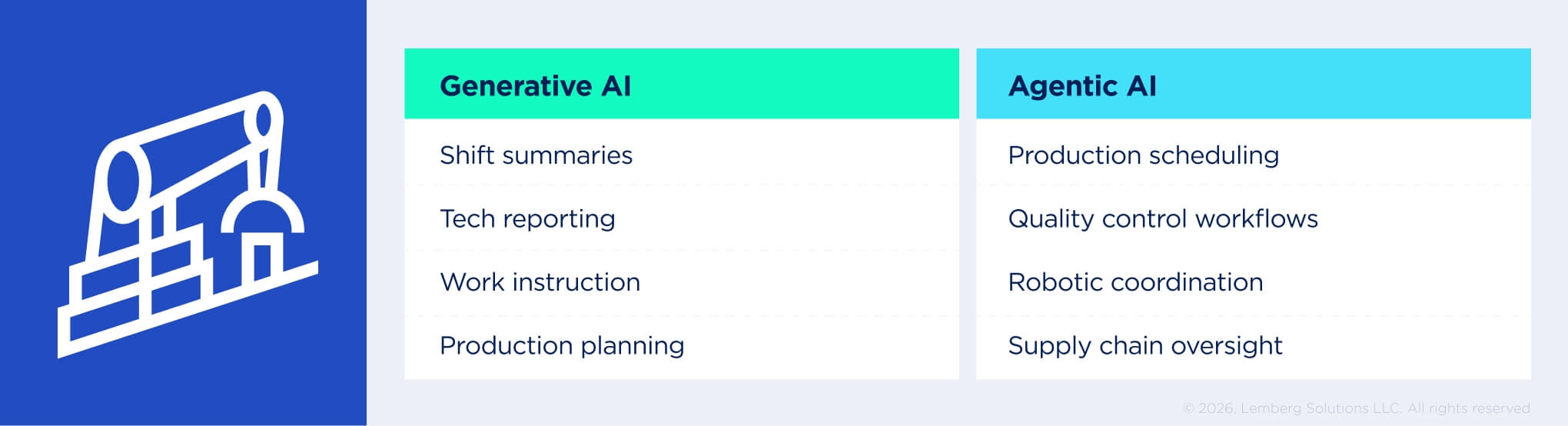
In manufacturing, generative AI is typically introduced as a productivity layer. Some businesses use it to support technical documentation; others find it effective in production planning or workforce training materials.
Agentic AI moves deeper into operational control. It can coordinate supply chain flows, adjust production schedules in real time, supervise industrial robotics, and monitor automated quality-control pipelines. Because these systems interact with physical equipment and production environments, reliability becomes critical. So, decision-makers must opt for custom, well-designed, and well-maintained agentic AI.
Choosing between agentic vs generative AI
As AI becomes embedded in everyday business operations, many organizations face strategic decisions. And the final choice depends less on technology trends and more on the organisation’s objectives, operational capacity, and resources:
- Rely on generative AI or invest in an agentic system.
- Get benefits from custom solutions tailored to internal workflows and proprietary data.
- The choice of AI approach directly determines the scale of business impact an organization can achieve.
Operational objective
The first question businesses should ask is: What role should AI play in daily work?
Generative AI is well-suited for improving productivity in knowledge-intensive tasks such as research, documentation, and customer communication. In particular, generative AI tools can increase customer support and reduce employees’ workload by 30–50%, with the greatest gains observed when supporting less-experienced employees.
Agentic AI becomes relevant when organizations seek to automate repetitive, high-volume operational workflows rather than assist individual tasks. Solutions that can analyze machine sensor data, detect equipment performance anomalies, retrieve diagnostic information from maintenance systems, and automatically trigger a service request are generally based on agentic AI.
System integration
Another key factor is the extent to which AI must interact with enterprise systems.
Generative AI typically integrates lightly into existing tools such as documentation platforms, collaboration software, or developer environments. It generates responses that employees review and incorporate into their workflows. This makes implementation relatively simple and allows for AI benefits without significant infrastructure changes.
Agentic AI, by contrast, requires direct integration with operational platforms such as CRM, ERP, and internal databases. The agent must be able to retrieve information, interact with APIs, and execute tasks while respecting user permissions and security policies. Based on this, companies with mature digital infrastructure are better positioned to adopt this approach.
Privacy, safety, and governance
Data governance and operational risk also strongly influence AI strategy.
In generative AI systems, mistakes usually affect information quality rather than business operations. However, they introduce a different category of risk: sensitive data exposure through user prompts. Users may inadvertently submit proprietary information, internal documentation, or customer data. Actually, this happened at Samsung when employees unintentionally uploaded confidential source code and internal meeting notes into a generative AI chatbot while seeking help with their work. The incident prompted Samsung and other companies to restrict the use of public generative AI services and accelerate efforts to develop internal solutions with stronger data controls.
Agentic AI introduces a different risk profile. Because such systems can execute actions across enterprise platforms, errors and misconfigurations can have direct operational consequences. To mitigate these risks, organizations implementing agentic AI must establish strong governance frameworks, including role-based permissions, approval checkpoints for critical actions, detailed audit logs, and continuous monitoring of automated workflows.
Architectural complexity
Finally, organizations must consider the engineering complexity of implementation. Generative AI systems are relatively straightforward to deploy, typically consisting of model access, prompt design, and optional retrieval systems for internal knowledge.
Agentic AI architectures are more complex because they include components such as planning logic, task orchestration, tool integration, memory systems, and runtime monitoring. As a result, many companies adopt a phased approach. They begin with generative AI to improve knowledge workflows and later introduce agentic capabilities once their governance frameworks, integration layers, and operational maturity are ready to support more autonomous automation.

Keeping AI under control: cost, reliability, and security safeguards
Despite the proven flexibility and effectiveness, even custom-built AI systems, both agentic and generative, are not immune to failure. This can lead to runaway costs, inefficient execution loops, or the exposure of sensitive data. To deploy AI safely at scale, organizations must introduce clear operational guardrails. These mechanisms help minimize the risk of automation errors and ensure that AI-driven workflows operate more consistently and predictably than manual processes.
Cost considerations
When properly designed and maintained, a custom AI assistant can deliver meaningful economic advantages over human labor in routine operational roles.
With an average hourly wage of $20, one customer support representative costs roughly $60K annually, including benefits and other employer costs. By contrast, an AI assistant would cost around $50K to design, integrate, and test. For the sake of fairness, let’s add the annual maintenance cost of about $1,5K in model usage, plus the annual $5K operating cost. That puts the agentic and generative AI services at roughly $57K in year one and $5K in later years, compared with about $60K per year for one support representative.
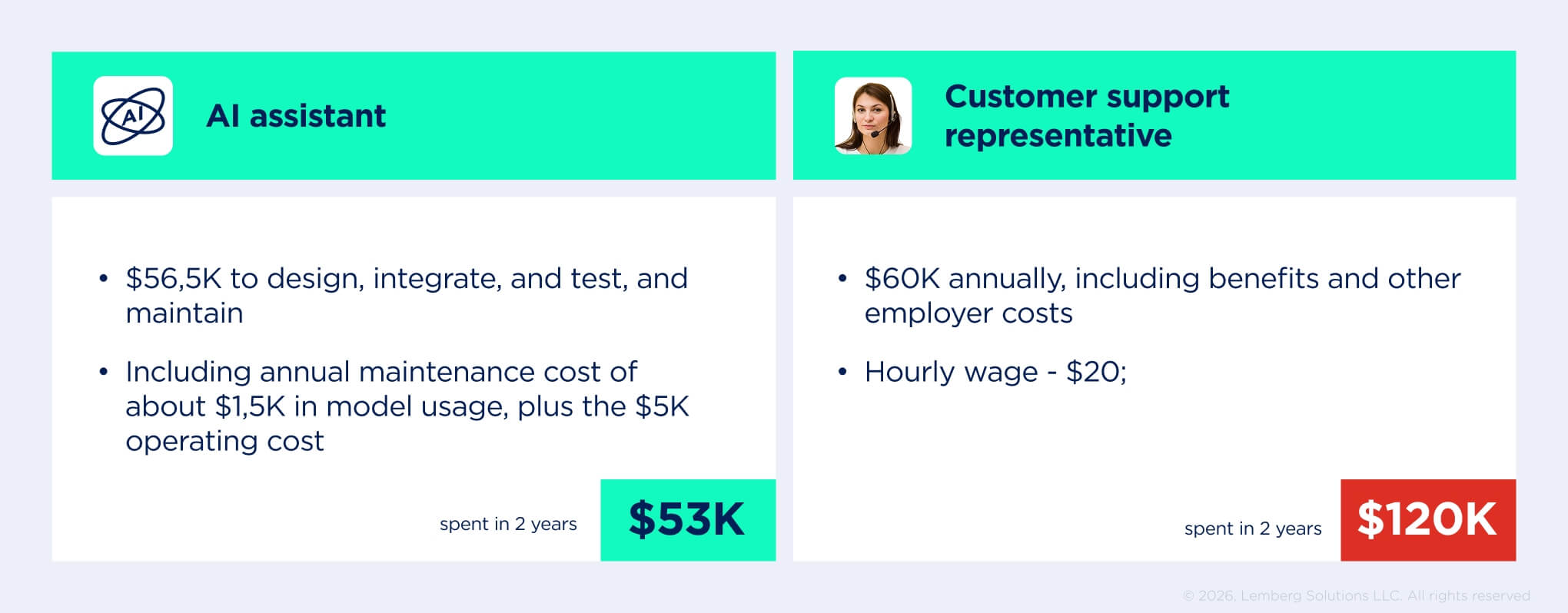
The economic advantage emerges over time. While the first year is cost-comparable to employing a human, ongoing expenses can drop to roughly one-third of a full-time employee's annual cost. A well-maintained AI assistant can operate continuously, scale instantly during demand spikes, and handle thousands of repetitive requests without fatigue, scheduling constraints, or turnover costs. As task volume increases, the cost per interaction declines further, making automation particularly valuable in high-throughput environments.
However, this advantage primarily applies to routine, rules-based, and lower-complexity tasks. Agentic systems still require skilled human supervision to manage exceptions, oversee the quality of decisions, refine workflows, and ensure responsible operation. Rather than replacing experienced professionals, well-implemented agentic AI is most effective at offloading repetitive work so that qualified specialists can focus on complex responsibilities.
Preventing infinite loops and inefficient workflows
Beyond cost control, organizations must also ensure operational reliability. A common risk in agentic systems arises when agents become trapped in iterative reasoning loops. Because many architectures follow a cycle of planning, acting, observing results, and revising plans, poorly designed workflows may repeat the same steps without meaningful progress. This can waste computational resources, increase infrastructure costs, and delay task completion.
To mitigate this risk, organizations implement governance mechanisms such as iteration limits, execution timeouts, and workflow checkpoints. These safeguards monitor the number of reasoning steps or tool calls an agent performs and intervene when predefined efficiency thresholds are exceeded. More mature systems also evaluate intermediate outputs against expected progress indicators, allowing them to detect stalled workflows early and redirect or escalate tasks when necessary.
Data security and access governance
Organizations must also safeguard how AI systems interact with enterprise data. Because AI tools can directly access internal tools, databases, and workflows, poorly governed permissions may expose sensitive information or allow unintended system actions. The risk is not inherent to agentic or generative AI itself, but to insufficient access design and oversight.
Strict governance mechanisms, including role-based access controls, API permissions, and clearly defined data boundaries, help mitigate these concerns. Agents typically operate within sandboxed environments where they can reach only the systems and datasets required for their assigned tasks. Sensitive information, including customer records, financial data, and proprietary assets, should be properly encrypted or even excluded entirely from AI workflows.
Potential pitfalls and constraints in AI adoption
Generative AI limitations and risks
While generative AI has proven highly effective in augmenting knowledge work, several limitations remain relevant for enterprise environments.
First, generative AI poses extensive reliability and hallucination risks. Generative models may produce inaccurate responses when the underlying knowledge is incomplete or ambiguous. Furthermore, generative AI systems often rely on training data or static knowledge bases that may not reflect the most recent operational information.
Second, there are strong data privacy and confidentiality concerns. Organizations must carefully manage the use of sensitive internal data in prompts. Improper configuration may expose proprietary information, customer data, or regulated datasets to external AI providers or unintended model outputs.
Third, model outputs may reflect biases present in the training data, posing risks to customer interactions and regulated decision-making environments. This can expose organizations to reputational harm and regulatory scrutiny.
Finally, genAI is highly dependent on human oversight. As a result, organizations must still rely on human operators to validate outputs and perform actions, which can limit the degree of operational efficiency gained, says Volodymyr Andruschak, our Data Science Expert.
Agentic AI limitations and risks
Unlike genAI, agenting AI is more autonomous. Thus, it can pose more operational risk if necessary safeguards are not in place.
There are strong governance and accountability challenges when using agentic AI. Automated decision-making raises concerns about responsibility and accountability, so organizations must ensure that agents' actions can be monitored, logged, and reviewed to comply with internal policies and regulatory requirements.
Next, agenting AI can pose substantial risks to system stability and workflow orchestration. Agentic systems often operate through iterative loops that involve planning, tool use, and feedback evaluation. Without careful design, these processes can produce inefficient behavior, excessive resource consumption, or unintended action sequences.
In practice, organizations mitigate these risks by adopting AI in stages,” Volodymyr Andruschak further comments. “They typically begin with controlled generative AI deployments and expand toward agentic automation only once governance frameworks, system integrations, and monitoring capabilities are mature enough to support autonomous operations.
Agentic AI vs generative AI examples and use cases
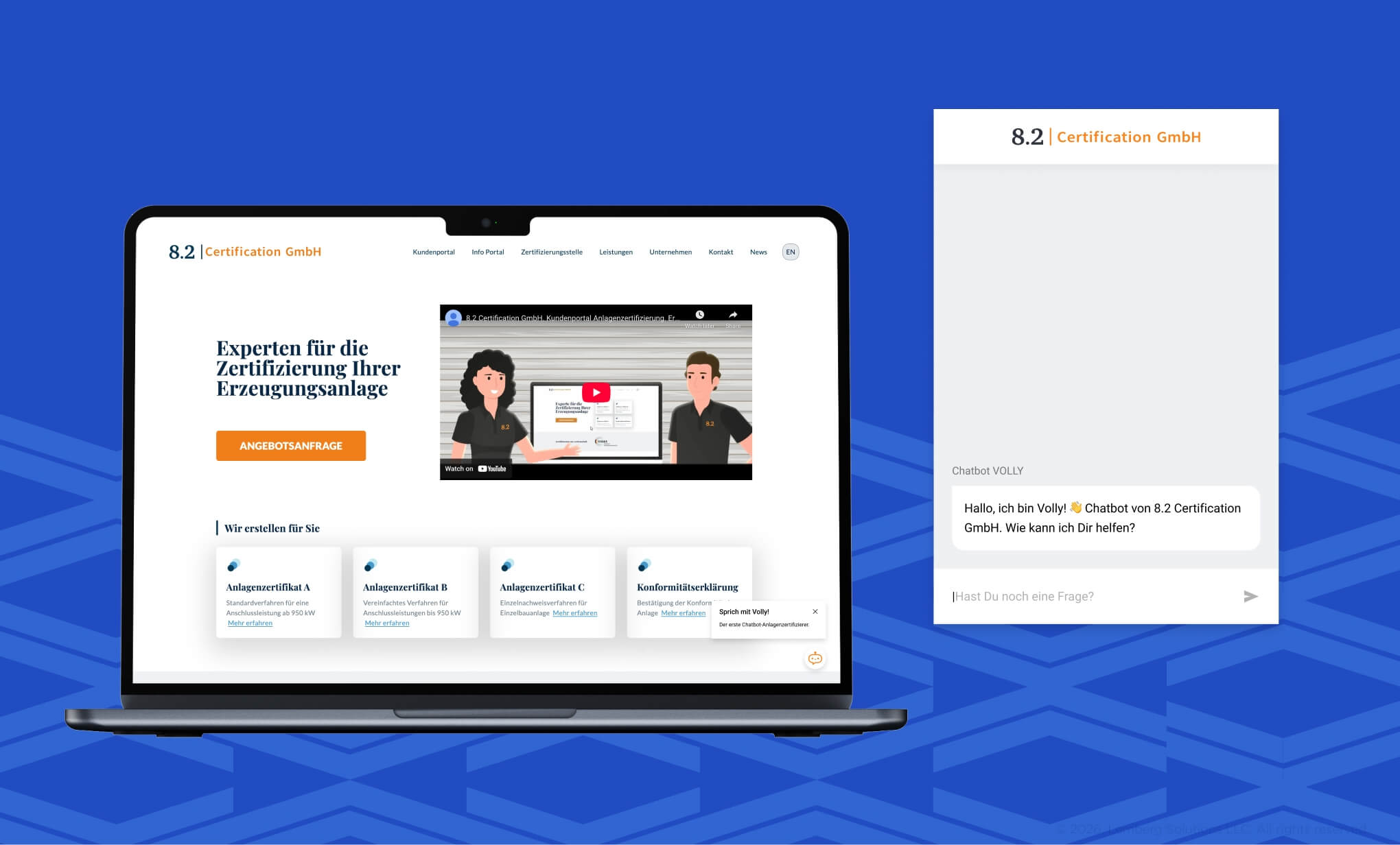
Real-time customer support
One practical example of using custom generative AI is to create an AI chatbot to automate customer support. This tool can answer common customer questions and draft responses based on existing knowledge bases. Agentic AI goes further by managing routing inquiries, escalating unresolved issues to the appropriate teams, and ensuring continuous service availability. This approach automates 70–80% of routine customer inquiries.
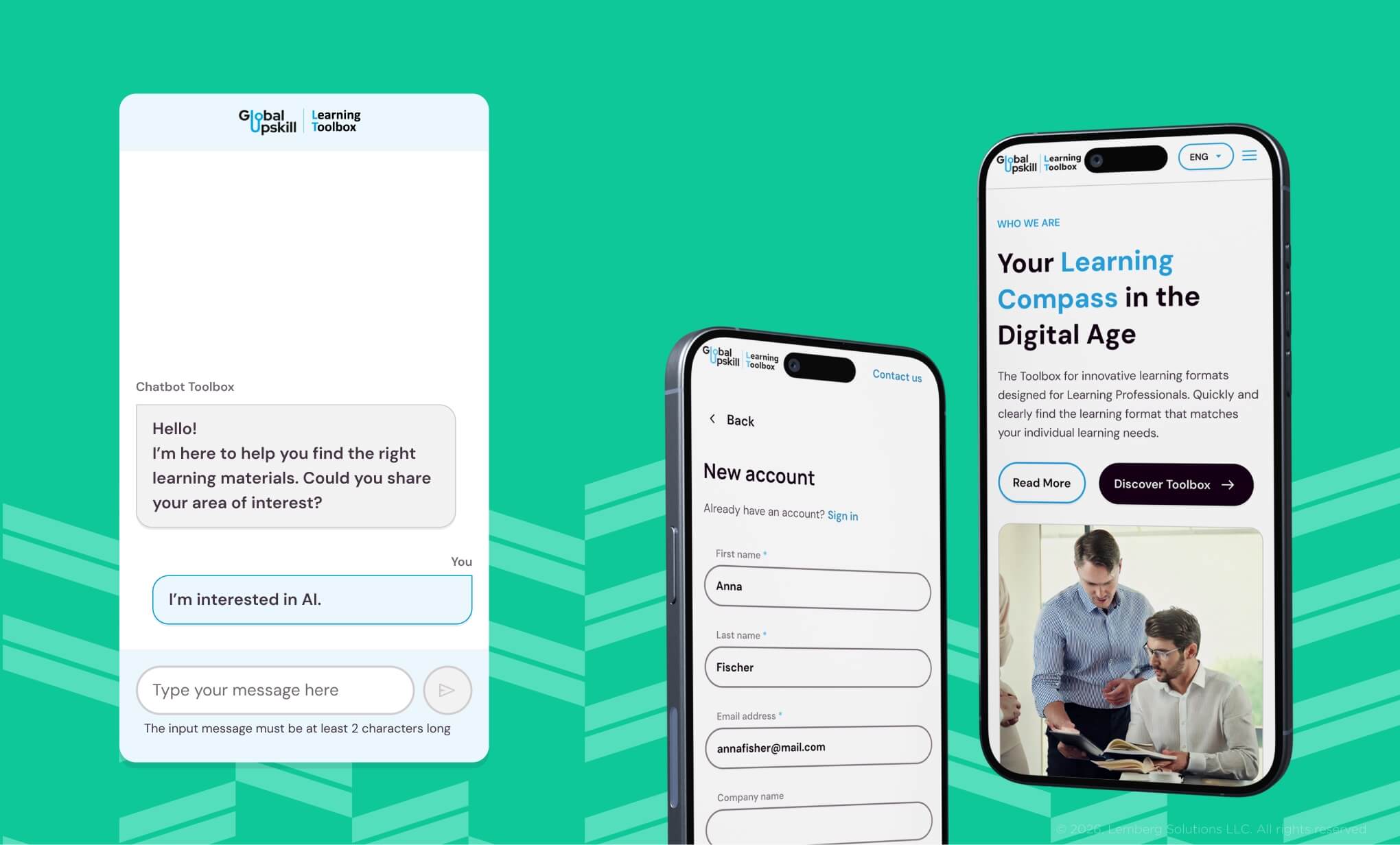
AI-powered learning & upskilling platform
AI capabilities also have implications in education. For example, in this AI-powered learning and upskilling platform, generative models personalize course recommendations based on user preferences and past behavior. In this context, AI doesn’t just respond to queries but tailors learning paths in real time, steering users toward the most relevant content and improving engagement and training outcomes. This shows how generative capabilities enhance user interaction, while agentic logic can automatically adjust recommendations and guide users through adaptive learning workflows.
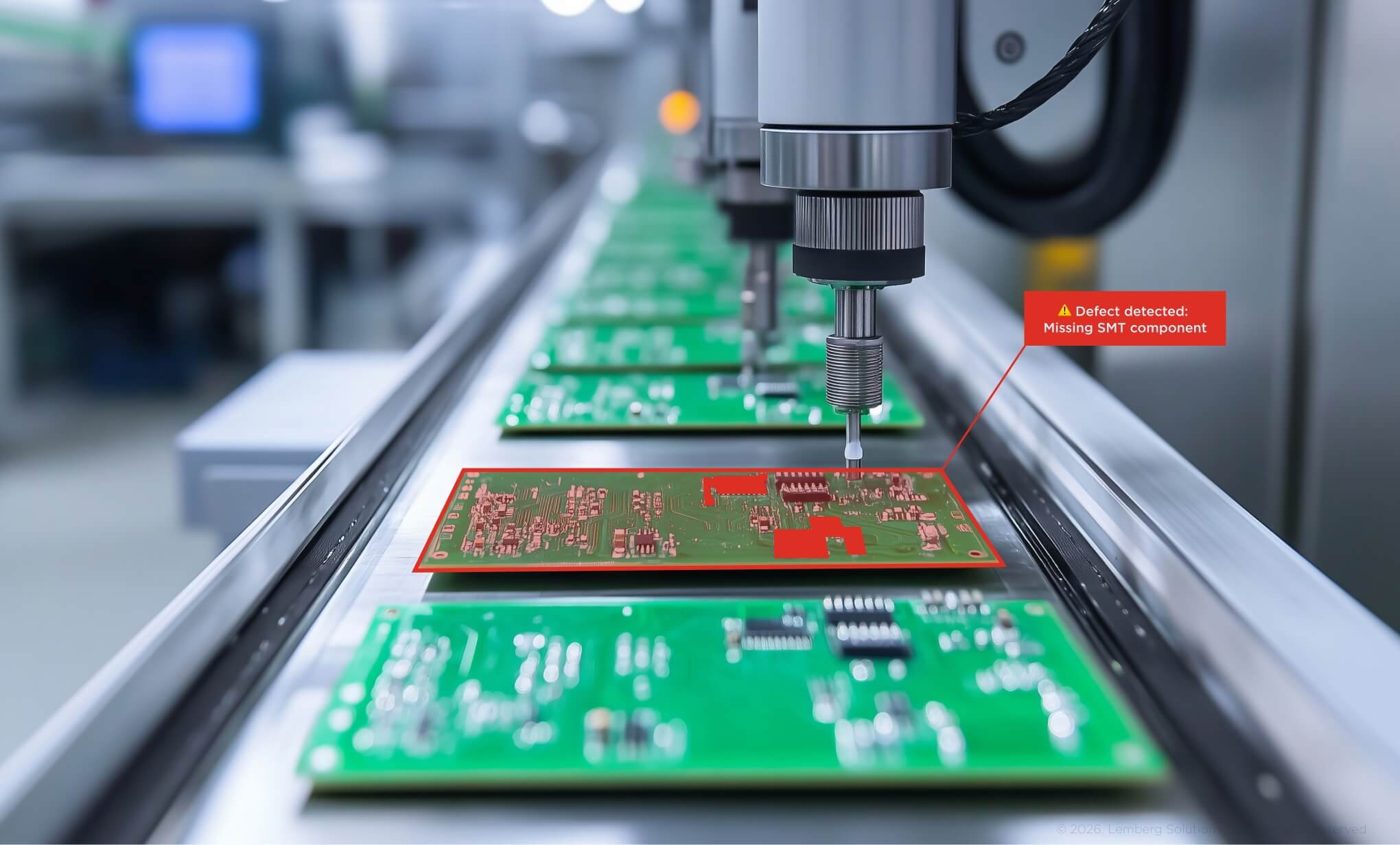
Visual quality inspection on the production line
Manufacturers use AI to help workers interpret patterns and generate maintenance or incident summaries from inspection data, images, and operator notes. More custom use cases for agentic AI include detecting recurring defects, deciding whether a product should be flagged for review, triggering a quality-check workflow, and notifying the responsible team. This is valuable in environments where fast reaction matters, but human oversight is still required for final quality decisions.
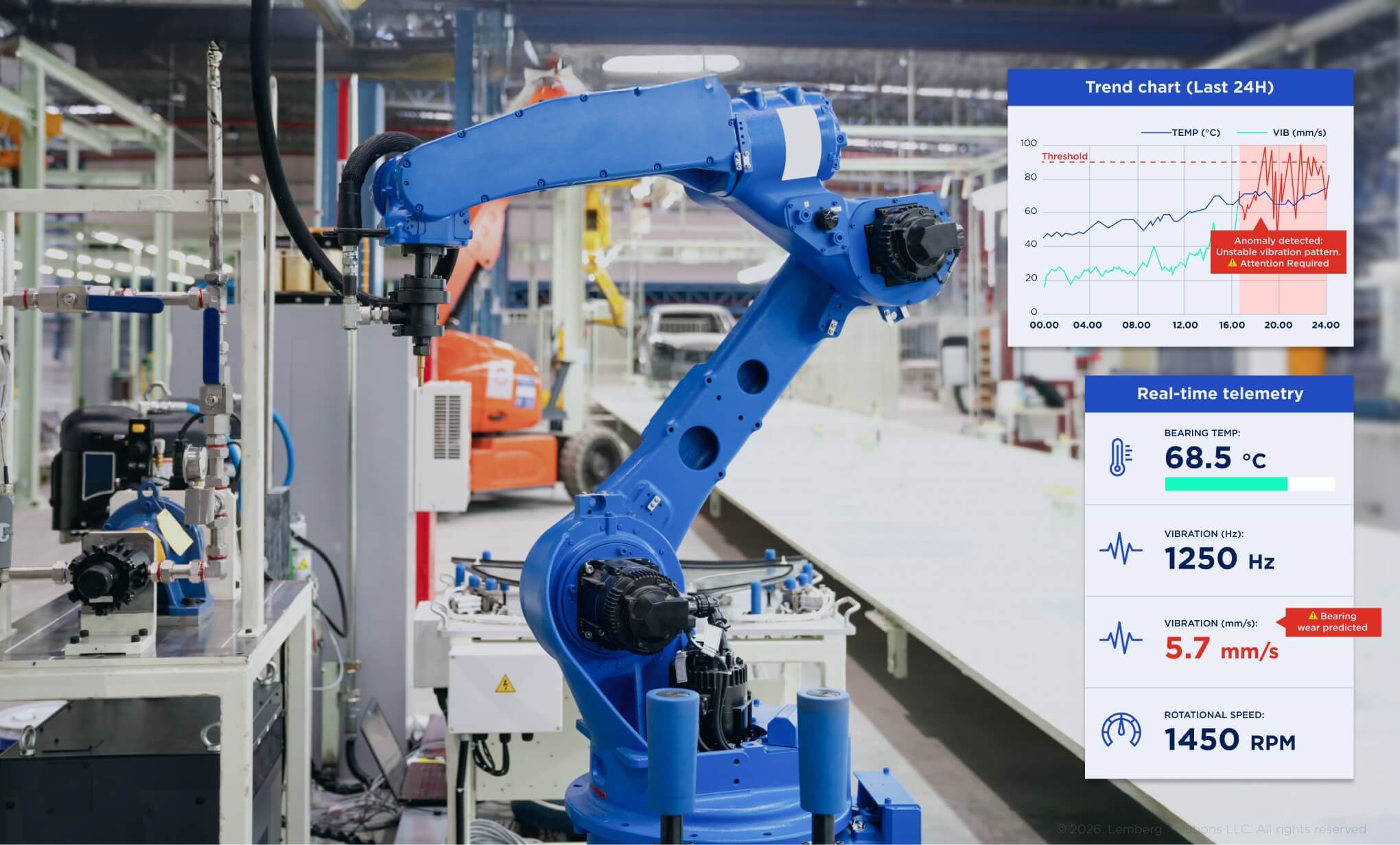
Predictive maintenance for field equipment
In the energy sector, agentic AI is increasingly applied to predictive maintenance by turning equipment logs, sensor streams, and operational history into actionable insights that help engineers understand and anticipate failures. Rather than simply alerting to anomalies, advanced AI systems continuously analyze real-time data and automatically initiate maintenance workflows when patterns indicate rising risk, transforming reactive practices into proactive operations.
Strategic AI integration: Why Lemberg Solutions is your partner for agentic workflows
The future of AI is defined by intelligent systems that move beyond content generation to autonomous execution of real business processes. Strategic AI integration requires more than selecting the right tools, but also involves aligning intelligent systems with real operational workflows. With almost 20 years on the market, Lemberg Solutions helps organizations design, implement, and scale autonomous AI solutions that deliver measurable business outcomes. Our team ensures that agentic AI operates safely, efficiently, and is fully aligned with enterprise objectives.



