Real-time telemetry data visibility for industrial vehicles with IoT data logger
About the client
Our client is a battery manufacturer that focuses on solutions for off-road industrial vehicles.

The challenge
The client’s battery data logger for industrial vehicles needed a complete redesign as one of its components was nearing the end of its life. At the same time, the growing amount of collected data was putting pressure on the company’s infrastructure: the local server could no longer process and store input efficiently.
Instead of a simple update, they wanted to evolve their legacy system into a cloud-based IoT infrastructure. This required a web application capable of integrating with both the data logger and the battery management system, providing access to battery health.
Delivered value

Solution
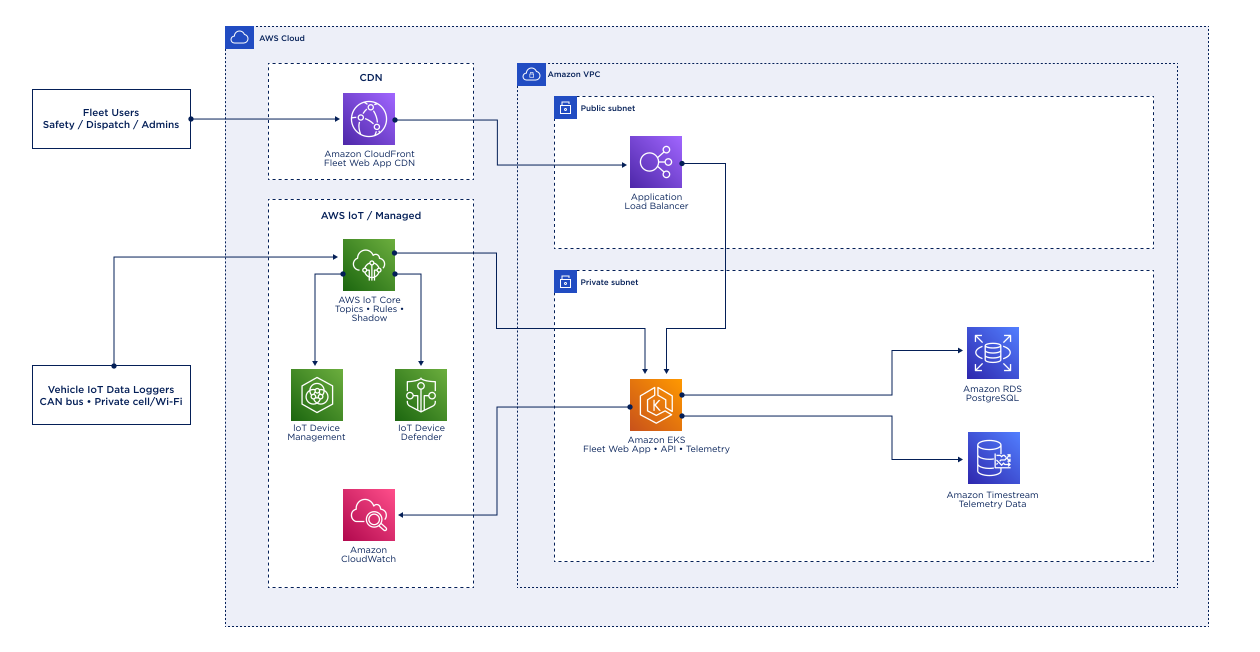
Our team redesigned the client’s data logger into a cloud-based IoT device with an integrated LTE modem.
Starting with the IoT data logger system architecture, we selected appropriate hardware components and outlined functionality that is compatible with the company’s requirements and target BOM. Then, our team developed a software architecture and firmware specifications for certain tasks.
Previously, the data logger used a local server, so the major project part was setting up a cloud environment and migrating all the data there. Our experts configured the AWS-based infrastructure and AWS IoT Core services, with estimates based on the data volumes.
To ensure smooth, reliable communication between the data logger and the cloud, we developed a custom MQTT protocol. This way, the firmware sends the collected data to the cloud, while the IoT system's backend stores it, transmitting only critical details to the web application. As a result, fleet operators can see battery health data and track vehicle location in real time, as the data logger is equipped with GPS.
The delivered cloud infrastructure allows for:
- Real-time telemetry data collection for early anomaly detection and predictive maintenance.
- Remote data logger device configuration, so users can update device settings directly from the web portal.
- Over-the-air (OTA) updates to deliver new firmware versions to keep fleets secure.
After quality testing, the IoT infrastructure is able to support current business needs while providing a scalable foundation for future growth.
How it works